


Poly mailers may look like one of the simplest forms of shipping packaging. Choose a bag, place the product inside, remove the adhesive liner, and seal the flap. In practice, however, selecting a suitable mailer involves more than finding one that appears large enough.The material affects the feel, appearance, opacity, printing surface, and disposal considerations of the bag. Its dimensions determine whether the product can be loaded without stressing the seals. Film thickness can influence puncture resistance and handling, while the closure design affects packing and returns.The product itself matters just as much. A soft T-shirt, a boxed cosmetic product, and a printed catalog may have similar dimensions, but they do not face the same risks during delivery. One may only need a lightweight outer layer, while another may require additional support, cushioning, or a corrugated box.A poly mailer is generally most suitable for soft, flexible, or durable products that do not require rigid protection. It can help keep the contents enclosed and protect them from dirt, casual handling, and limited moisture exposure. A standard unpadded poly mailer, however, does not provide impact cushioning or crush resistance.This guide explains how to read poly mailer specifications and connect the material, size, thickness, closure, and bag structure to the product you plan to ship.
How to Read a Poly Mailer Specification
If you have ever compared two poly mailers that looked almost identical but received very different quotations, the specifications were probably not the same.One supplier may be quoting a single-color stock bag with a permanent adhesive strip. Another may be quoting a custom-sized, multilayer bag with a matte surface, return strip, perforation, and multicolor printing. A product image rarely shows all these differences.A useful specification should describe the complete bag rather than relying on general terms such as “medium,” “heavy-duty,” or “eco-friendly.”
| Specification | What It Describes | Why It Matters |
|---|---|---|
| Finished size | The dimensions of the empty bag when laid flat | Shows the overall bag dimensions |
| Usable size | The space available for the product | Helps determine whether the item can be loaded and sealed |
| Flap length | The section that folds over the opening | Affects closure position and usable length |
| Material structure | The film composition and number of layers | Influences appearance, processing and performance |
| Film thickness | The measured thickness of the film | Can affect stiffness, stretching and puncture resistance |
| Opacity | How well the film conceals the contents | Important for product privacy |
| Surface finish | Glossy, matte or another specified finish | Affects appearance, printing and label adhesion |
| Closure | Permanent, resealable or double-strip | Must suit the packing and return process |
| Additional features | Gussets, perforations, handles or roll-fed construction | Supports particular products and packing operations |
| Printing | Colors, coverage, position and printing sides | Determines branding requirements and production setup |
The finished size and usable size deserve special attention. The overall length may include the sealing flap, while the product must remain below the opening and adhesive area. As a result, the full external length is not necessarily available for packing.Material descriptions also need to be specific. The phrase “plastic mailer,” for example, does not explain the film composition, thickness, number of layers, recycled content, surface finish, or manufacturing tolerance.Color is another separate consideration. A gray, white, black, or colored film does not automatically tell you what material was used. Two films with similar colors can also provide different levels of opacity. If concealing the contents is important, ask the supplier to confirm both the color and opacity requirement.
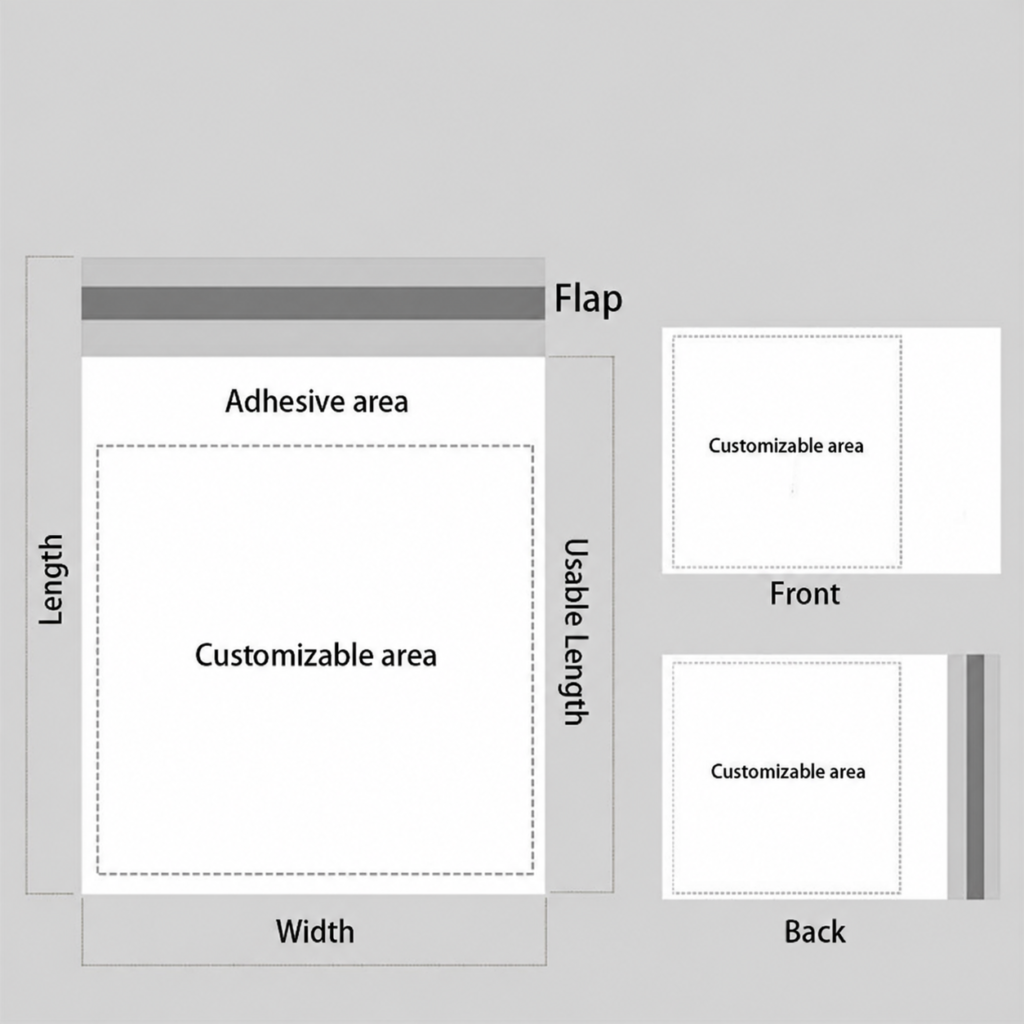
Confirm the measurement method before comparing sizes from different suppliers.A clear specification gives the manufacturer something measurable to quote and gives the buyer a reference for sample approval and production inspection. It also makes quotations from different suppliers easier to compare.
Poly Mailer Materials and Construction
Most standard poly mailers are made from polyethylene film. Polyethylene is widely used because it can be converted into flexible bags, heat-sealed, colored, and printed. Still, not every polyethylene mailer uses the same film structure.Some mailers use a relatively simple film, while others use co-extruded or multilayer structures. Different layers can be designed to support specific surface, color, opacity, sealing, or processing requirements. More layers do not automatically mean better quality; the suitability of the structure depends on the product and the intended packing process.
Standard Polyethylene Mailers
A standard polyethylene mailer is often a practical choice for apparel, textiles, soft accessories, and other non-fragile goods. It is lightweight, flexible, and normally stored flat, making it convenient for manual ecommerce packing stations.Buyers can specify the size, film thickness, color, finish, closure, and printing. Some bags are supplied as plain stock packaging, while others are manufactured to a custom specification.Polyethylene film is moisture-resistant, but the complete package should not automatically be described as waterproof. The seams, adhesive closure, punctures, openings, and level of exposure all affect the performance of the finished package.
Co-Extruded and Multilayer Film
A co-extruded mailer can combine different film layers within one bag structure. For example, a mailer may use different inner and outer colors or be designed to provide a particular surface appearance and opacity.When evaluating multilayer film, ask what the structure is intended to achieve. The number of layers by itself is less useful than knowing the material composition, total thickness, production tolerance, and required performance.A multilayer bag should also be evaluated as a finished product. Film quality alone cannot compensate for weak side seals, unsuitable dimensions, or a closure placed under excessive tension.
Recycled-Content and Recyclable Mailers
“Recycled content” and “recyclable” describe different characteristics.Recycled content refers to material that has been recovered and incorporated into the film. Recyclability refers to whether the finished package can be collected and processed through an appropriate recycling system. A bag may contain recycled material without being accepted by every local recycling program.If recycled content is required, confirm:
- The percentage of recycled material
- Whether it is post-consumer or post-industrial material
- The overall film composition
- Available supporting documents
- Any effect on appearance, color or printing
- The destination market in which the claim will be used
You can review available structures on our Recyclable Mailing Bags page.
Biodegradable and Compostable Structures
Biodegradable and compostable are not interchangeable terms, and neither should be treated as a general substitute for recyclable.If you are considering an alternative material, ask for the exact formulation, applicable test standard, certificate holder, certification scope, and required disposal conditions. A compostability claim may apply only under specific industrial or home composting conditions.The intended destination is also important. A material claim that is appropriate in one market may require different wording, evidence, or disposal instructions in another.For this reason, it is better to select the material first, review the supporting documents, and then approve the environmental wording on the artwork.
Choosing the Right Size, Thickness and Closure
Selecting a poly mailer size sounds straightforward until product thickness enters the calculation.Mailer dimensions are usually stated while the bag is empty and flat. Once a product is inserted, its depth consumes part of the available width and length. This is why a rigid box and a folded garment with the same front-facing dimensions may need different bags.A soft garment can compress and adapt to the mailer. A rigid retail box cannot. Its corners may also place concentrated pressure on the film, particularly if the fit is too tight.When checking the size, consider:
- Product length and width
- Packed product thickness
- Whether the product can compress
- The space needed to load the product
- The position of the adhesive closure
- Stress placed on the side seals
- Space required for a shipping label
- The final appearance of the packed parcel
An oversized bag is not always safer. Excess film can fold around the parcel, cover the label area, catch during handling, or make the package look untidy. A bag that is too small can stretch around the product and place continuous pressure on the seals and adhesive closure.For more detailed measuring instructions, see our Courier Bag Size Guide.Film thickness also needs to be viewed in context. A thicker film may offer greater stiffness or puncture resistance, but thickness alone does not establish how much weight the complete mailer can carry. Material formulation, seal quality, bag size, product shape, and load distribution all influence performance.A thicker poly mailer also does not provide:
- Built-in impact cushioning
- Rigid crush protection
- Structural corner protection
- Separation between multiple products
- Stable orientation for products that must remain upright
If an item needs light cushioning against scratching or minor impact, a padded format may be more suitable. You can compare these options on our Mailing Bubble Bags page.If the product is fragile, heavy, sharp, or sensitive to compression, a corrugated box may be the safer choice. Our guide to Poly Mailers vs. Boxes explains the protection and packing differences in more detail.The closure should also match your fulfillment process. A permanent adhesive strip works for ordinary one-way shipping, while a second adhesive strip can support customer returns. A perforated opening may help the recipient open the package without cutting through the return section.Before confirming a bulk order, test a representative sample with the real product. Check how easily it loads, whether the flap closes without tension, whether the label adheres correctly, and how the packed parcel looks after normal handling.
Common Uses Based on Product Characteristics
It is tempting to select packaging by industry alone: poly mailers for apparel, bubble mailers for accessories, and boxes for electronics. That approach is convenient, but it can overlook important differences between individual products.A better starting point is to ask what could happen to the product during storage, sorting, transportation, and delivery.Apparel is one of the most common applications because most garments are flexible and difficult to break. T-shirts, hoodies, socks, scarves, bedding, and other textile products often do not need rigid external protection. The mailer mainly provides containment, privacy, and a clean outer shipping surface.Some durable products already packed inside strong retail boxes may also use a poly mailer as an outer layer. In that situation, the retail box supplies most of the structure while the mailer helps protect the surface from dirt and limited moisture exposure.However, this method should be tested carefully. Weak retail cartons can become crushed, while sharp box corners can stretch or puncture a tightly fitted mailer.Printed materials require a different evaluation. A document may not break, but bending, pressure lines, fingerprints, moisture marks, and damaged corners can reduce its perceived quality. Cardboard support, a rigid document envelope, a padded mailer, or a box may be appropriate depending on the item’s value and the condition expected by the recipient.For application-specific guidance, read Mailing Bags for Documents, Photos, Books and Specialty Items.
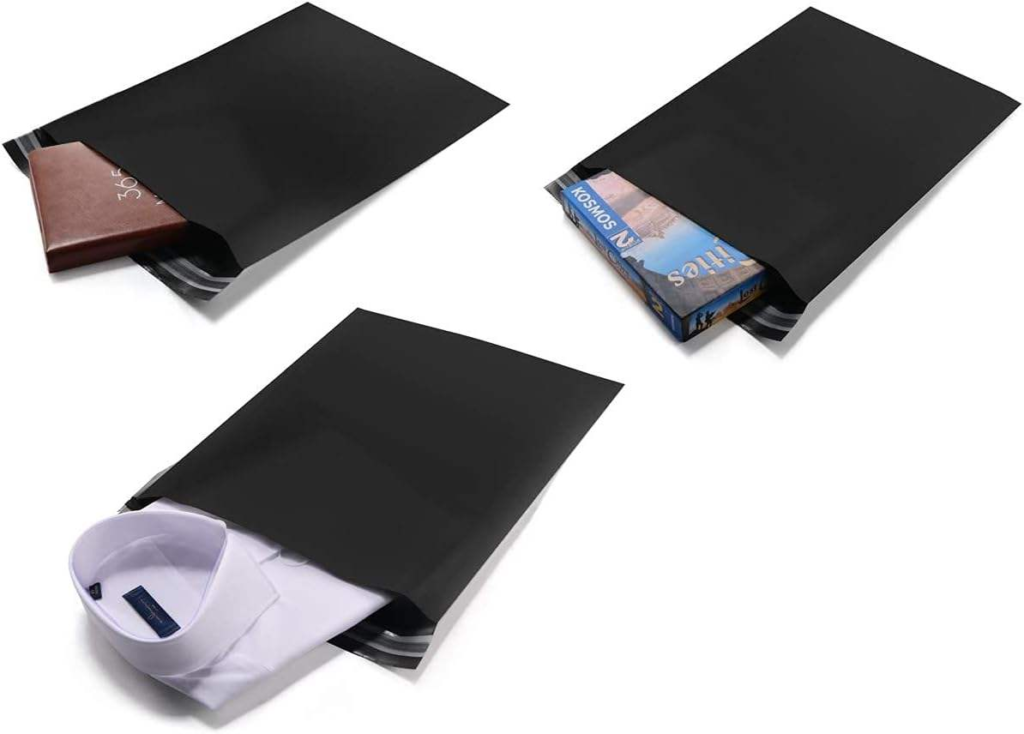
The correct packaging format depends on the product’s actual failure risks, not only its industry category.Products with sharp edges, concentrated weight, delicate surfaces, or breakable components require more caution. Increasing the film thickness may reduce some puncture risk, but it does not create the rigid protection of a correctly specified shipping box.The easiest question to ask is: What must this package prevent?
If the answer is mainly dirt, casual viewing, and keeping a soft product contained, a poly mailer may be suitable. If the answer includes impact, compression, bending, scratching, leakage, or internal movement, the packaging system may require additional components or another format.
Avoiding Specification Problems Before Production
Many packaging problems start with a specification that sounds clear but leaves too much room for interpretation.“Large white mailer,” for example, does not define the usable dimensions, material structure, thickness, opacity, surface finish, closure, printing, or tolerance. It may be enough for an initial conversation, but it is not enough for sample approval or mass production.Here are several common mismatches to check before placing an order.
The overall dimensions fit, but the usable space does not.The quoted length may include the flap, and the side seals reduce the internal packing area. Confirm the supplier’s measurement method and test the product inside a physical sample.
The bag is thicker, but the product is still damaged.
Thickness and rigid protection solve different problems. Film can help contain a product and resist punctures, but it does not prevent a crush-sensitive item from being compressed.
The color is correct, but the contents are still visible.
Film color and opacity should be specified separately. If privacy is important, evaluate the finished sample under realistic lighting conditions.
One bag size is used for too many products.
Reducing the number of sizes can simplify inventory, but a mailer that is much larger than the product may slow packing, create loose folds, and affect label placement. Test the smallest and largest products assigned to each size.
The closure does not support the return process.
A permanent adhesive strip may work well for outbound delivery but leave no convenient way to reseal a return. If returns are common, consider a second adhesive strip and a perforated opening.
Environmental wording is approved before the material documents.
Terms such as recycled, recyclable, biodegradable, and compostable should be connected to the actual material, applicable documents, target market, and intended disposal route.
Artwork is approved before the bag construction is final.
Changing the bag size, film color, surface finish, seal position, or printing method may affect the approved artwork. Finalize the physical specification before signing off on the production design.
Once the basic details are confirmed, turn them into one clear purchasing specification. A useful request should include:
- Intended product
- Product dimensions and packed thickness
- Packed weight
- Finished or usable mailer size
- Material and film structure
- Thickness or performance requirement
- Film color and surface finish
- Closure type
- Return strip, perforation, handle or gusset
- Printing colors and coverage
- Order quantity
- Delivery destination
A specification might read:
Custom poly mailer for folded apparel, finished size 35 × 50 cm plus flap, opaque co-extruded PE film, matte outer surface, permanent self-sealing closure, two-color printing on one side, 20,000 pieces, packed for export.This gives the supplier a much stronger starting point than asking for the price of a “medium custom mailer.” It also makes it easier to compare quotations because each manufacturer is responding to the same requirement.
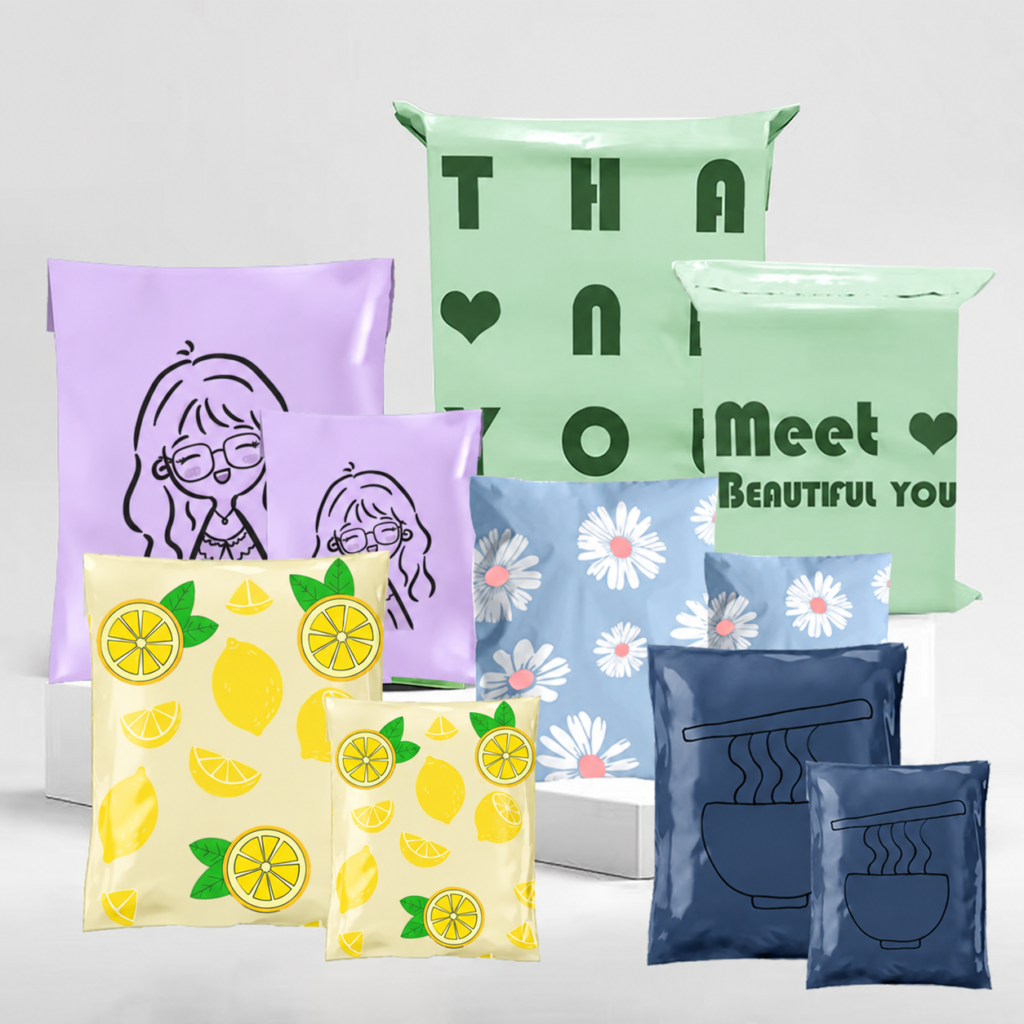
Review the bag, product fit, closure and print requirements together before approving production.
Find a Poly Mailer That Fits Your Product
A poly mailer should be selected as a complete packaging specification. The material, usable dimensions, thickness, closure, printing, and product characteristics need to work together.If you are unsure which structure to use, start with the actual product. Record its dimensions, packed thickness, weight, surface sensitivity, sharp corners, and protection requirements. These details give the supplier a practical basis for recommending a sample.Explore our poly mailer range, or contact us with your product details, preferred material, artwork, order quantity, and delivery destination for a tailored recommendation and quotation.
FAQ
What are poly mailers made of?
Most standard poly mailers are made from polyethylene film. The exact structure can vary by film type, number of layers, color, thickness, recycled content, surface finish, and production method. Ask the supplier to confirm the complete material specification.
Is a poly mailer’s listed size internal or external?
Poly mailers are commonly measured while empty and flat, but suppliers may use different measurement methods. Confirm whether the stated length includes the flap and how much usable packing space remains below the adhesive closure.
Does a thicker poly mailer always carry more weight?
No. Thickness is only one factor. Material structure, seal quality, bag dimensions, product shape, load distribution, and closure performance also affect how the finished package behaves.
Can one poly mailer size fit several products?
Yes, provided that each product can be loaded and sealed correctly without excessive empty space or film tension. Test the smallest, largest, and thickest products planned for that mailer size.
Can a poly mailer replace a shipping box?
A poly mailer may replace a box when the product is soft, durable, and able to tolerate normal compression. Fragile, heavy, sharp, liquid-filled, or crush-sensitive products normally need a more structured packaging system.