



Are you struggling to decide which courier bag size to order for your clothing products?A bag that looks suitable on a supplier’s size chart may be difficult to load once the garment is folded, placed inside an inner bag and prepared for shipping. Another bag may fit easily but leave too much unused space, making the parcel look loose and increasing packaging material consumption.This is why purchasing teams should not select a courier bag from the garment name alone. “T-shirt bag,” “hoodie bag” and “jacket bag” can be useful starting descriptions, but they are not reliable size specifications. Fabric thickness, folding method, inner packaging and the number of items in an order can all change the final packed dimensions.This courier bag size guide explains how to measure the product, allow room for loading and sealing, create a practical courier bag size chart, and test candidate sizes before placing a bulk order.

What Size Courier Bag Do You Need?
The right courier bag is usually the smallest practical size that allows the packed product to enter smoothly, accommodates its thickness and leaves the sealing area flat and unobstructed.“Smallest practical size” does not mean forcing the garment into the narrowest possible bag. If warehouse staff need to compress the product heavily, bend corners or pull the opening apart, the bag is probably too small for efficient daily packing. Excessive tension can also cause wrinkles around the package and place unnecessary stress on the side seams and closure.A bag is also not automatically better because it is larger. Too much empty space can allow the garment to move inside the parcel. The finished package may look untidy, and the extra film may make label placement and automated handling less consistent.A practical size should satisfy four conditions: the item can be inserted without force, the product sits naturally inside the bag, the adhesive strip can close on a clean and flat surface, and the finished parcel remains suitable for labelling, weighing and carrier handling.Courier bags are also commonly described as poly mailers. If you are comparing materials, colours, printing and closure options as well as size, you can review our poly mailer product options.
How to Measure Clothing and Allow Enough Packing Space
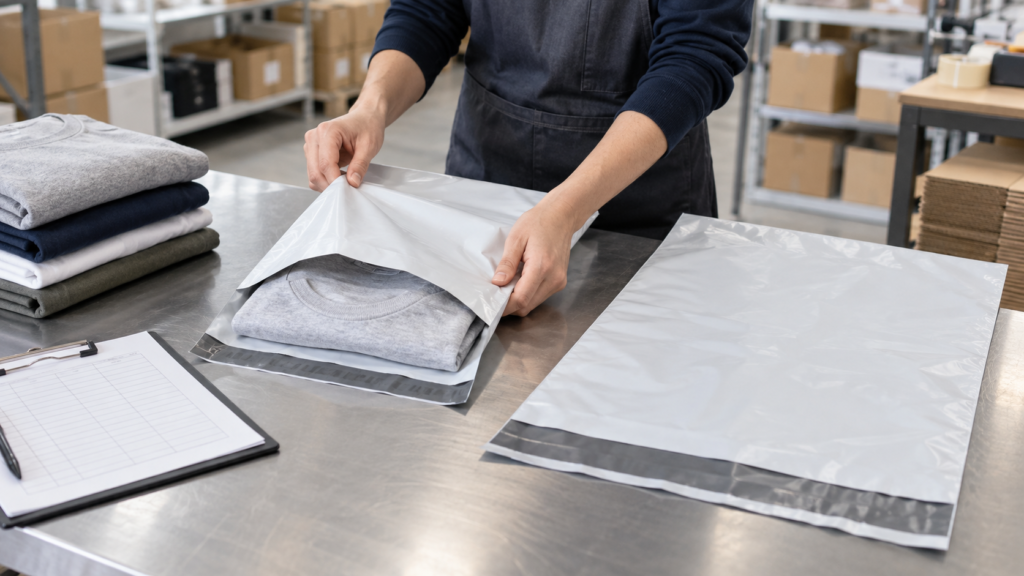
The most reliable measurement comes from the product in its final shipping configuration. Measuring an unfolded garment or copying the dimensions from a clothing specification sheet will not show how much space the parcel actually needs.Before measuring, fold the garment using the same method your fulfilment team will use. Add any tissue paper, cardboard insert, hang tag or protective inner bag that will be included in the real order. Then place the package on a flat surface without pressing it down unnaturally.
Record the Final Packed Length, Width and Thickness
Measure the longest side as the packed length, the shorter front-facing side as the packed width, and the highest point as the packed thickness. Thickness is particularly important for hoodies, sweaters, denim products, padded clothing and multi-item orders.Do not measure only one sample if the same SKU is produced in different sizes. An XL hoodie may fold to a different footprint or thickness than an S hoodie. A size recommendation based only on the smallest garment can create loading problems when larger variants reach the packing station.For a mixed-size SKU, measure at least the smallest and largest saleable variants. If the difference is substantial, you may need two courier bag specifications rather than forcing the entire range into one oversized bag.

Convert Product Dimensions Into a Candidate Bag Size
A flat courier bag must wrap around the width and thickness of the packed product. Therefore, a product measuring 30 cm across does not necessarily fit comfortably into a bag with exactly 30 cm of usable internal width.As a conservative starting point, add the packed thickness and a small handling allowance to the product width when selecting a candidate bag. Apply the same thinking to the length so the product does not extend into the sealing area. This is a starting method for sample selection rather than a universal production formula.For example, a thin T-shirt may need relatively little additional space, while a thick sweatshirt requires more room even when both items have a similar folded width. Gusseted bags, side-seal bags and bags made from films with different flexibility can also fit differently.
Keep the Sealing Zone Separate From Usable Packing Space
One of the most common purchasing mistakes is treating the entire listed bag length as usable product space. Some suppliers state the bag body size separately from the flap, while others may show the overall external length. Before comparing quotations, confirm exactly what the published dimension includes.The garment should remain below the adhesive strip and fold line. The closure needs a clean, flat film-to-film contact area. If fabric, tissue paper or an inner bag enters this area, the seal may become uneven.If your operation needs a permanent closure for outbound shipping, read more about self-sealing poly mailers and confirm whether you need a single adhesive strip or a dual-strip design for returns.
How Product Type and Order Composition Affect Bag Size
Product names can help organise testing, but actual packed dimensions should make the final decision. Two brands may both sell “basic T-shirts,” yet use different fabric weights, folding boards, retail sleeves and inserts.
Lightweight Tops and T-Shirts
Lightweight tops generally form relatively flat packages, so the main challenge is often avoiding excessive bag width. A bag that is much wider than the folded product can create loose edges, making the finished parcel look less consistent.However, do not reduce the bag size until the opening becomes difficult to use. Warehouse operators should still be able to insert the garment without catching the inner sleeve or folding the corners.
Hoodies, Sweaters and Denim
Bulky clothing uses bag capacity in three dimensions. A hoodie may have a manageable folded length and width but still require a larger bag because of the hood, cuffs or thick fleece fabric.The folding method can have as much influence as the garment size. A wide, flat fold may require a wider bag, while a narrow fold can increase thickness. Test the fold your warehouse can repeat consistently rather than choosing a fold that works only for one carefully prepared sample.For more category-specific considerations, see our guide to choosing poly mailer sizes for hoodies.
Jackets, Padded Clothing and Multi-Item Orders
Jackets and padded garments can contain trapped air after folding. Measuring immediately after heavy compression may produce a size that appears suitable during testing but becomes difficult to use when the garment naturally expands.Allow the folded garment to settle before recording its thickness. If your fulfilment process uses controlled compression or vacuum packing, test the package in that exact condition and confirm that the process is repeatable.Multi-item orders require separate attention. Two T-shirts stacked together do not always behave like one package with twice the thickness. Items may shift, inner bags may overlap, and the stack can become wider near the edges.If multi-item orders represent a meaningful share of your sales, test common combinations as separate packing groups. A slightly larger secondary size may be more practical than using the largest courier bag for every order.
How to Build a Courier Bag Size Chart for Your SKUs
A useful courier bag size chart should be based on your own products and packing process. A generic internet chart can help you identify sample sizes, but it cannot account for your fabric, folding standard, inner packaging or order combinations.Start by grouping products that produce similar packed dimensions. For example, several T-shirt SKUs may share one bag if their final packages are close in length, width and thickness. A heavyweight oversized T-shirt may belong in a different group even though it has the same product category name.
Standard Sizes or Custom Sizes?
Standard sizes are often suitable when a supplier already offers a bag that fits your key SKUs and order combinations. They can also make initial sampling and repeat purchasing more straightforward.Custom sizing becomes useful when standard bags consistently leave excessive space, interfere with the packing process or force one unsuitable size across a large order volume. It may also be appropriate when the bag dimensions need to coordinate with printed artwork, label placement, return strips or automated packing equipment.Bag size is only one pricing factor. Material structure, film thickness, printing, order quantity and closure design can also affect the quotation. Our overview of poly mailer pricing factors can help purchasing teams prepare a more complete comparison.
Test the Size Before Placing a Bulk Order
Measurements help narrow the options, but a physical packing test should make the final decision. Request two or three adjacent sample sizes rather than relying on one theoretical calculation.Use real production garments, real inner packaging and the same folding method used in the warehouse. Ask several operators to pack repeated samples. A bag that works when one person carefully inserts one garment may still be inefficient during normal order volume.During the test, observe whether the bag opening catches the garment, whether corners curl or bunch, whether air can be removed naturally, and whether the adhesive strip closes without stretching. After sealing, check that the shipping label can sit on a broad, flat area without crossing wrinkles or the opening edge.
Do Not Treat Bag Size as a Weight Rating
A size chart shows whether an item may fit inside a bag. It does not prove how much weight the bag can safely carry.Performance depends on the film material, film thickness, seam quality, closure design, product shape, temperature, handling conditions and test method. Two bags with identical external dimensions may perform differently if their materials or production specifications are different.For heavier or sharp-edged products, ask the supplier for relevant material information and test samples using your own packed goods and distribution conditions. Avoid selecting a bag from an unsupported load claim.
What Information Should You Send When Requesting a Quote?
A supplier can provide a more useful recommendation when the inquiry contains real packing information. Instead of writing only “I need bags for hoodies,” provide the final packed length, width and thickness of the smallest and largest products in the group.It also helps to explain whether orders normally contain one item or several items, whether each garment has an inner bag, which closure style you need, your estimated quantity, printing requirements and destination market.These details allow the supplier to recommend samples and prepare a quotation around the actual use case. They also reduce the risk of comparing quotations that use different size definitions or material specifications.If you would like us to review your packed product dimensions, send your measurements and order requirements through our contact page. We can use them to identify suitable sample sizes and discuss standard or custom options.
Choosing a courier bag begins with the finished package rather than the garment name. Measure the folded product, account for its thickness, protect the sealing area and confirm the final choice through repeated packing tests.A well-designed courier bag size chart can then help purchasing, operations and warehouse teams use the same packaging standard across different SKUs and order combinations.For a size recommendation or custom quotation, send us your packed product dimensions, expected order quantity, printing requirements and destination through the RHK Packaging contact page.
Should I measure the garment or the inner packaging?
Lorem ipsum dolor sit amet, consectetur adipiscing elit. Ut elit tellus, luctus nec ullamcorper mattis, pulvinar dapibus leo.
What size courier bag should I choose?
Measure the product after it has been folded and placed in its inner packaging. Choose a bag that allows easy loading while leaving enough space for a flat and secure seal.
Can I print my logo on courier bags?
Yes. Courier bags can be customized with logos, colours, instructions and other brand elements. Confirm the bag size before approving the artwork so the design remains clear after packing.
Can I request samples before ordering?
Yes. Testing samples with your actual products is the best way to check size, loading, sealing and overall appearance before bulk production.
How do I create a courier bag size chart for my business?
Group products by their final packed dimensions, record the length, width and thickness of representative SKUs, select nearby sample sizes and test them using the real warehouse process. The final chart should connect each product group or order combination with a tested bag specification.
Ready to eliminate seal failures and size mismatches from your supply chain?
Planning to purchase poly mailers in bulk? Send us your size, thickness, quantity and destination requirements.Request a formal quote with your specifications. Response within 4 business hours.
RHK Packaging — ISO 9001:2015 Certified Manufacturer Since 2010
[email protected]