


Ecommerce sellers lose an average of $1.2 per shipment when packaging lightweight items in oversized boxes. Poly mailers can cut that cost by 40% through DIM weight optimization.
This guide covers what MIL thickness actually means, how dimensional weight affects your shipping bill, and which eco-certification matters for your brand. Built from real carrier requirements and supplier conversations.
What Is a Poly Mailer?
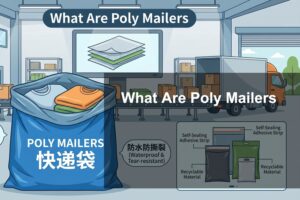
A poly mailer is a flexible plastic mailing bag built for ecommerce fulfillment. Made from polyethylene (PE) film, these bags fold flat for storage and expand to fit items during packing. They repel water, resist tearing, and seal with a self-adhesive strip—no tape required.
Standard poly mailers weigh 20 to 50 grams. Comparably sized corrugated boxes weigh 80 to 500 grams. That difference translates directly to lower freight costs.
The most common material is low-density polyethylene (LDPE). Some manufacturers use linear low-density polyethylene (LLDPE) for better stretch resistance, or polypropylene (PP) for higher temperature tolerance.
Supplier red flag: A vendor who quotes “poly mailer” without specifying the resin type may be buying whatever pricing is cheapest that quarter. That creates quality inconsistency—seams that weaken, film that varies in thickness.
When shipped flat, poly mailers occupy 95% less warehouse space than assembled boxes. A 12-by-15-inch poly mailer lays flat at roughly 0.02 cubic feet. For businesses shipping 200+ packages daily, that footprint difference can reclaim an entire shelving section.
Request a free sample pack to test fit and thickness for your product line.
Poly Mailers vs Bubble Mailers vs Boxes
The choice depends on item fragility, dimensional weight, and budget.
Bubble mailers add cushioning for items with sharp edges like hardcover books or jewelry. They cost 30-50% more—but for a cotton t-shirt with smooth surfaces, bubble cushioning adds cost without meaningful protection.
Corrugated boxes provide maximum rigidity for multi-pound items or fragile components. But they carry hidden costs: dimensional weight pricing means carriers charge based on package volume, not actual weight. A 10-by-10-by-6-inch box shipping a 1-pound pullover ships at a 4-pound rate.

| Factor | Poly Mailer | Bubble Mailer | Box |
|---|---|---|---|
| Best for | Clothing, soft goods | Books, small electronics | Heavy, fragile items |
| Cost/unit | $0.05–$0.15 | $0.15–$0.35 | $0.30–$1.50 |
| DIM impact | None (thin film) | Minimal | Significant |
| Water resistance | High | High | Low |
| Storage footprint | Very low | Low | High |
MIL Thickness Decision Tree
MIL thickness is the most misunderstood specification in poly mailer purchasing. MIL stands for thousandth of an inch. A 2-mil poly mailer is 0.002 inches thick.

Critical distinction: A vendor advertising “2mm” is describing 79 MIL—far thicker than the 2 MIL most buyers expect.
Step 1: Identify your item category
- Clothing and textiles: 2 to 2.5 MIL baseline
- Books, magazines with smooth edges: 2 MIL
- Items with corners or protruding hardware: bubble mailers or boxes
- Products over 5 pounds: 4 MIL+ or corrugated box
Step 2: Match weight to thickness
| Item Weight | Recommended MIL | Suitable For |
|---|---|---|
| Under 1 lb | 1.5–2 MIL | Scarves, lightweight tops, accessories |
| 1–3 lb | 2–2.5 MIL | T-shirts, jeans, sweaters |
| 3–5 lb | 3–4 MIL | Heavy denim, boots, coats |
| Over 5 lb | Box or 4 MIL+ | Heavy-duty rated only |
Step 3: Adjust for shipping conditions
- Local/regional: standard thickness
- National shipments: upgrade one thickness level
- International: add 0.5 MIL + water-resistant construction
For a complete MIL thickness guide with decision tree, see our detailed breakdown.
Eco-Friendly Poly Mailers Explained
Three distinct concepts—recycled content, recyclable material, and compostable certification—describe different environmental pathways with different cost premiums.
Recycled content (5-10% premium): Poly mailers made from previously used polyethylene, verified by SCS Global. Does not mean the mailer itself will be recycled—means material was diverted during manufacturing.
Recyclable (0-5% premium): APR-certified PE film processable through standard curbside recycling. Must be clean and dry. Most cost-effective environmental option.
Compostable (15-30% premium): PLA/PBAT bio-polymers requiring industrial composting conditions. BPI or TUV Austria certified. For brands with sustainability commitments verified through third-party audits.
How to Choose the Right Poly Mailer Size
Size selection failure accounts for 60-70% of poly mailer damage claims. The result: split seams or torn bottoms that expose products to loss.
Size recommendations:
- 8-by-10-inch: silk blouses, lightweight t-shirts, scarves
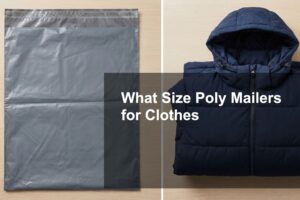
- 10-by-13-inch: folded jeans, sweaters, lightweight jackets
- 12-by-15-inch: shoes without boxes, large-size garments
- 14-by-18-inch: multiple items, bedding components
- 14-by-20-inch: coats, formal wear, large apparel bundles
All dimensions listed as width by length, measured flat. Always add 2-3 inches to both dimensions to accommodate film stretch, handling clearance, and the adhesive seal zone.
Common mistakes:
- Selecting based on retail packaging rather than shipping configuration
- Ignoring the adhesive strip zone (consumes ~1.5 inches of length)
- Skipping the sample fit test before ordering in bulk
What Can You Ship in Poly Mailers?
Poly mailers serve most ecommerce shipping categories: apparel, soft goods, bedding, books, and accessories without glass or sharp components.
Never ship in standard poly mailers: glass containers, ceramics, items containing liquids, electronics with exposed circuitry, or products with sharp edges. These require corrugated boxes with interior cushioning.

DIM Weight Explained
Dimensional weight pricing means carriers charge based on package volume rather than actual weight. The formula: (length x width x height) / 139 for UPS/FedEx domestic shipments.
Example:
Box: 12x10x8 inches → DIM weight 6.9 lb
Poly mailer: 12x10x2 inches → DIM weight 1.7 lb
Difference: 5.2 billable pounds saved per shipment
For a business shipping 300 packages monthly at $0.65/lb: $1,014 monthly savings, or $12,168 annually.
Use our free DIM weight calculator to estimate your potential savings.
Carrier Requirements: USPS, UPS, FedEx
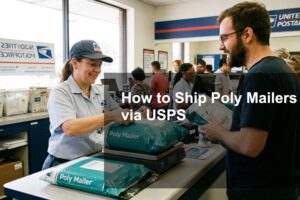
USPS: Accepts poly mailers for First Class Package Service (up to 15.999 oz), Priority Mail, Priority Mail Express. Max size 12×15 inches for First Class. Maximum uninsured value: $100.
UPS/FedEx: Accept poly mailers for all domestic services with DIM weight at the 139 divisor. No size restrictions beyond 150-pound maximum.
All carriers: Standard hot-melt adhesive loses effectiveness below 32°F. For year-round cold-region shipping, specify low-temperature adhesive formulations (rated to -20°F).
How to Source Poly Mailers
Before contacting suppliers, define your specifications: MIL thickness, dimensions, certification requirements, and custom printing needs.
Supplier evaluation checklist:
1. Request samples first
Test MIL thickness with a micrometer, inspect seam integrity, and fit test with actual products. Suppliers who decline samples should be disqualified.
2. Verify quality controls
Defect rate below 0.5% is achievable with proper manufacturing controls. Above 2% indicates systemic quality problems.
3. Assess reliability
Confirm MOQ aligns with your volume, lead time (7-21 days standard, 21-45 days custom print), and capacity to scale during peak seasons.
4. Watch pricing red flags
A price more than 30% below market rate signals potential material substitution. Verify whether quoted price includes freight, duties, and certification documentation.
Frequently Asked Questions
1.What is the difference between poly mailers and padded envelopes?
$0.05 to $0.15 per unit for standard sizes in quantities of 1,000 to 5,000 units. Recycled content adds 5-10%. Compostable materials add 15-30%. Custom printing adds 10-20%.
2.How much do poly mailers cost?
A padded envelope contains bubble cushioning for sharp or rigid items. Standard poly mailers have no cushioning. Bubble mailers cost 30-50% more and are only necessary for items like hardcover books or jewelry.
3.Are poly mailers waterproof?
Water-resistant but not waterproof. They protect against rain and humidity but not submersion or high-pressure water exposure.
4.Can you ship shoes in poly mailers?
Yes. Most single pairs fit in a 12-by-15-inch poly mailer. Use tissue paper at contact points to prevent film puncture from hard components.
5.What MlL thickness for shipping clothing?
2 to 2.5 MIL for most clothing (1-3 lb). Lightweight items under 1 lb need 1.5-2 MIL. Heavy items over 3 lb need 3-4 MIL.
6.Are poly mailers recyclable?
100% PE poly mailers without composite lamination are recyclable through standard curbside recycling if clean and dry. APR certification verifies compatibility.
7.How do I reduce shipping costs with poly mailers?
Two ways: direct material savings ($0.05-0.15 vs $0.30-1.50 per box) and DIM weight optimization by reducing package dimensions.
8.Does USPS accept poly mailers?
Yes. USPS accepts poly mailers for First Class Package Service (up to 15.999 oz), Priority Mail, and Priority Mail Express.
9.Can poly mailers be customized with my brand logo?
Yes. MOQs typically 5,000-25,000 units. Setup costs $200-500 per color. Per-unit premium adds 10-20%. Learn more about custom printing options.
10.What are the main disadvantages of poly mailers?
Four limitations: no crush protection, temperature-sensitive adhesive below 32°F, requires DIM weight discipline, and environmental perception concerns for plastic-free brands.
Ready to eliminate seal failures and size mismatches from your supply chain?
Request a formal quote with your specifications. Response within 4 business hours.
RHK Packaging — ISO 9001:2015 Certified Manufacturer Since 2010
[email protected]