

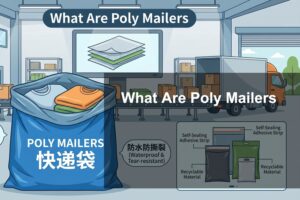



The answer depends on who you ask: USPS says yes, UPS has size restrictions, and FedEx sets different limits. Understanding these classifications directly impacts your shipping costs and which services you can use.
If you have ever wondered whether poly mailers legally count as envelopes, you are not alone. This question comes up constantly in ecommerce shipping forums, and the answer matters more than most sellers realize. The classification affects which carrier services you can use, how packages are priced, and whether you qualify for certain rate discounts.
The confusion stems from the fact that different organizations use different definitions. What counts as an envelope for USPS purposes may not meet UPS standards, and FedEx has its own separate requirements. This guide breaks down each carrier classification, explains the legal definitions, and shows you exactly why the distinction affects your bottom line.
The Short Answer: It Depends on the Definition
Poly mailers are legally considered envelopes by most carriers, but the classification comes with caveats. The determining factor is not the material, but rather the physical characteristics: flat, flexible, and within specific thickness limits.
Think about how carriers process mail. Envelopes move through sorting machines designed for thin, flexible items. Packages go through different handling streams built for rigid or bulky contents. The machine pathways, rate structures, and service options all branch based on this fundamental distinction.
For ecommerce sellers, the practical implication is significant. Shipping a 12-by-15-inch poly mailer as an envelope versus a package can mean the difference between qualifying for envelope-specific rates or paying package pricing. Since envelope shipments often carry lower handling fees, misclassification costs money.
Key insight: Poly mailers qualify as envelopes when they are flat, flexible, and within carrier thickness limits. Most standard poly mailers easily meet these criteria, making envelope classification the default for most ecommerce shipments.
Legal Definition: What Counts as an Envelope
The legal definition of an envelope varies depending on whether you are looking at postal regulations, carrier contracts, or shipping industry standards. Understanding these distinctions helps you navigate classification questions with confidence.
USPS Definition
The United States Postal Service defines envelopes as “flat, flexible” packaging containers. Their official packaging guidelines describe envelopes as any smooth or wrinkled paper container with a rectangular shape and adhesive seal. The key requirement is flexibility: the item must be capable of bending without damage.
USPS does not specify a maximum thickness for envelope classification. Instead, they focus on the flat, flexible characteristic. This means poly mailers, which are made from polyethylene film and fold flat, clearly meet the definition. However, thick bubble mailers or padded envelopes with rigid cushioning may push into package territory.
Industry Standard Definition
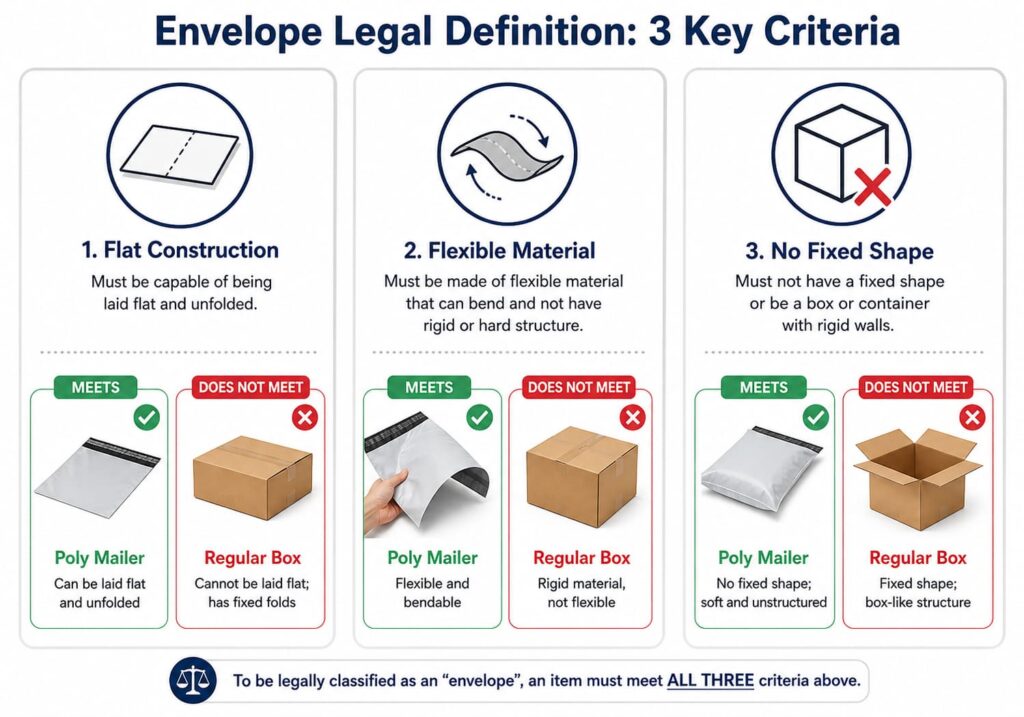
Shipping industry associations and trade groups generally define envelopes using three criteria:
- Flat construction: The item maintains a relatively flat profile when empty and when packed
- Flexible material: The packaging bends without permanent deformation or damage
- No fixed shape: Unlike boxes, envelopes conform to their contents rather than maintaining rigid walls
Poly mailers satisfy all three criteria. They ship flat, fold around contents without requiring assembly, and bend to accommodate various item sizes. This flexibility is precisely why carriers distinguish them from rigid packaging options.
Commercial Shipping Context
In commercial shipping contexts, envelope classification often determines which rate tables apply. Carriers maintain separate pricing schedules for envelope shipments versus packages, with envelopes typically carrying lower base rates and handling fees. The choice of shipping supplies directly influences which pricing structure applies to your shipment.
Note: While no federal regulation explicitly defines “envelope” for shipping purposes, carriers maintain their own standards. These carrier-specific definitions control which services and rates apply to your shipment.
Carrier Classification: How USPS, UPS, and FedEx Define Envelopes
Each major carrier maintains its own classification system for distinguishing envelopes from packages. These classifications determine handling procedures, rate structures, and available services.
USPS Envelope Classification
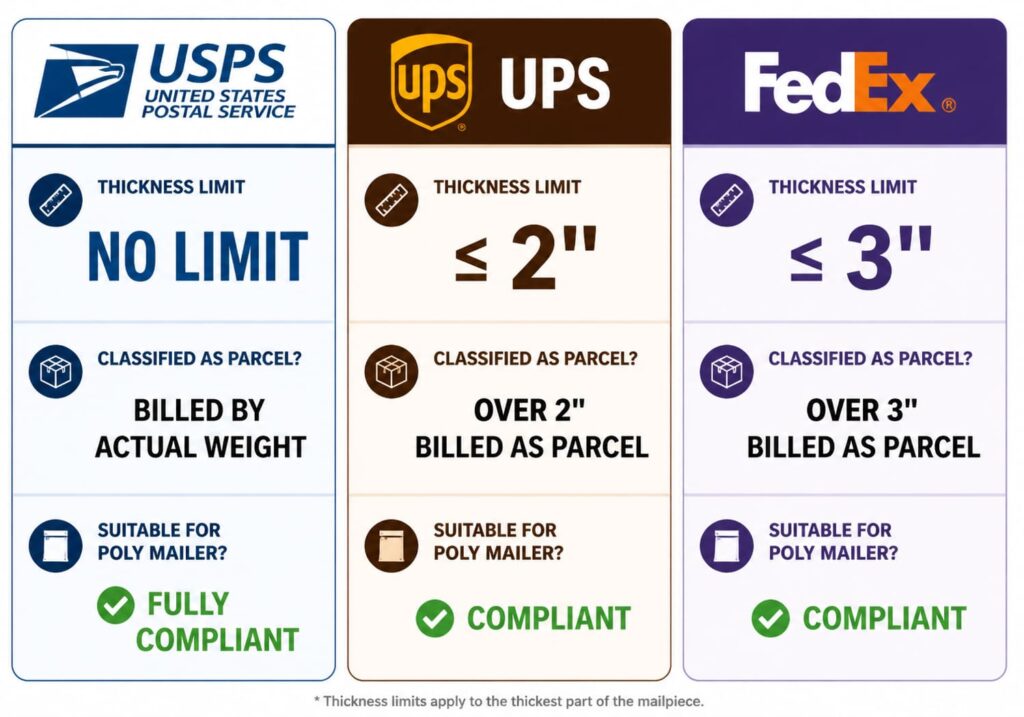
USPS treats poly mailers as envelopes under their First Class Package Service guidelines. The service accepts flat, flexible packaging up to 15.999 ounces, and poly mailers consistently qualify for this classification.
The critical size limitation for USPS First Class involves dimensions rather than thickness. Maximum dimensions for First Class Package Service are 12 inches by 15 inches. Items exceeding these dimensions must ship via Priority Mail or Priority Mail Express, which handle larger packages with different rate structures.
USPS also offers Priority Mail Flat Rate Envelopes, which provide predictable pricing regardless of weight within the size limit. Poly mailers that fit within these dimensions can qualify for flat rate envelope pricing, offering significant savings for heavier items within the size constraints.
UPS Envelope Classification
UPS defines envelopes as items under 2 inches thick. This thickness limit appears in their official packaging guidelines and determines which rate structures apply to your shipment. Items exceeding 2 inches in thickness are classified as packages, triggering different pricing.
Since standard poly mailers measure approximately 2-4 mil (0.002-0.004 inches), they fall far below the 2-inch threshold. A poly mailer containing a sweater might measure 2-3 inches thick when packed, still well within UPS envelope classification limits.
UPS offers specific envelope rate options through UPS Express Envelopes and UPS Simple Rate Envelopes. These services provide flat pricing regardless of destination within the service area, making them attractive options for lightweight shipments.
FedEx Envelope Classification
FedEx permits envelopes up to 3 inches thick under their official guidelines. This slightly more generous threshold provides additional flexibility for thicker poly mailer shipments that might approach UPS limits.
FedEx One Rate Envelopes offer flat pricing for documents and flexible items meeting their size specifications. This program works well for sellers shipping standardized poly mailer sizes, as predictable pricing simplifies cost forecasting and budgeting.
| Carrier | Max Envelope Thickness | Envelope Service Options | Poly Mailer Classification |
|---|---|---|---|
| USPS | No specific limit; flat/flexible required | First Class Package, Priority Mail Flat Rate | Qualifies as envelope for most services |
| UPS | 2 inches | Express Envelope, Simple Rate Envelope | Well under limit; always qualifies |
| FedEx | 3 inches | FedEx One Rate Envelope | Well under limit; always qualifies |
| DHL | 4 inches | Envelope options available | Comfortably within envelope limits |
The thickness limits across carriers reveal an important pattern: standard poly mailers contain enormous safety margins. Even when packed with multiple items or thicker products, poly mailers typically remain well below carrier thickness restrictions.
Poly Mailers vs Paper Envelopes: Key Differences
While both packaging types qualify as envelopes by carrier definitions, their physical properties create distinct advantages and limitations. Understanding these differences helps you select the right packaging for specific shipping scenarios.
Material Composition
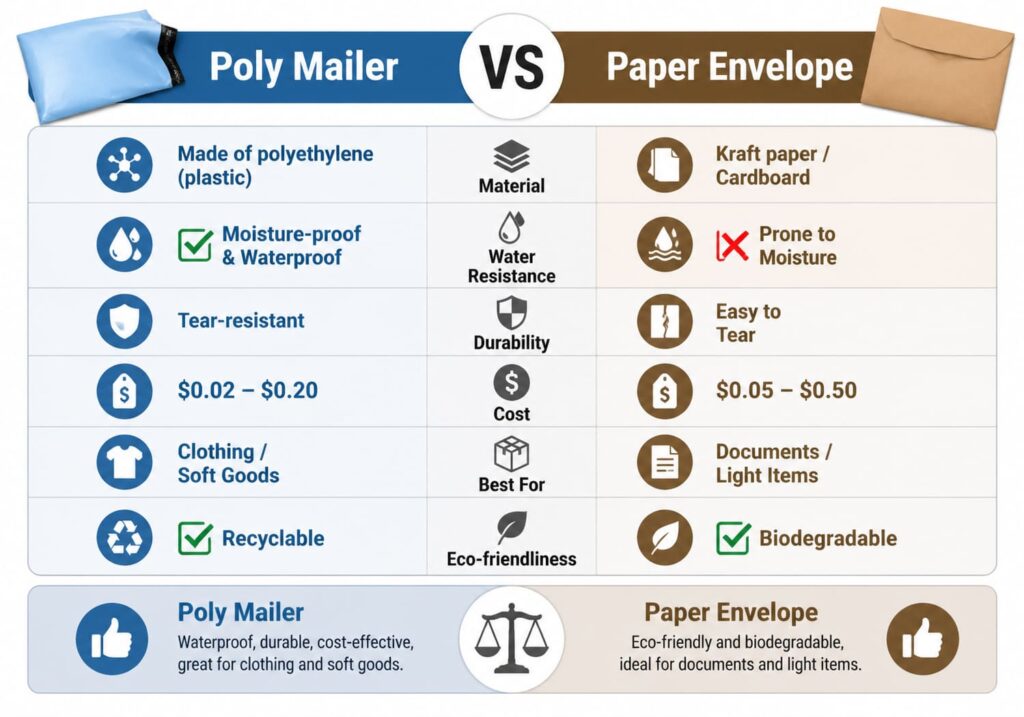
Paper envelopes use cellulose fiber sheets, typically 20-90 pound basis weight paper. The material breathes naturally, allowing air circulation that prevents moisture buildup. However, paper degrades when exposed to water, tearing or dissolving when saturated.
Poly mailers use polyethylene film, a synthetic polymer ranging from 1.5 to 4 mil thickness. This material repels water completely, protecting contents from rain, humidity, and moisture exposure during transit. The tradeoff is zero breathability, which matters for certain product categories.
Durability Comparison
Polyethylene film outperforms paper in tear resistance and puncture protection. A standard 2-mil poly mailer withstands handling and sorting equipment better than a comparably sized paper envelope. For ecommerce shipments that pass through multiple handling points, this durability translates to fewer damaged packages and lower loss rates.
Paper envelopes excel in one area: presentation. Documents shipped in paper envelopes arrive without static charge buildup. Important papers, legal documents, and items requiring professional appearance often benefit from paper envelope packaging. The visual perception of paper also matters for certain business contexts.
Cost Analysis
Poly mailers typically cost $0.05 to $0.15 per unit in standard sizes. Paper envelopes in comparable dimensions cost $0.10 to $0.30 per unit. For high-volume ecommerce operations shipping clothing and soft goods, this cost difference compounds significantly across thousands of monthly shipments.
The total cost picture includes more than unit price. Poly mailers ship flat, reducing storage requirements and freight costs. Their water resistance reduces damage claims. Paper envelopes require more protective layering for equivalent contents. When you calculate total cost including these factors, poly mailers frequently offer superior economics.
Environmental Considerations
Both materials present environmental tradeoffs. Paper envelopes biodegrade faster but require deforestation and significant processing energy. Poly mailers persist longer in landfills but are recyclable through standard curbside programs when properly manufactured from 一 PE material.
The environmental calculus depends on your brand priorities and customer expectations. Some retailers deliberately choose paper-based packaging to align with sustainability positioning, accepting higher costs as a marketing expense. Others recognize that durable poly mailers reduce shipping damage and waste from lost or destroyed merchandise.
| Factor | Paper Envelopes | Poly Mailers |
|---|---|---|
| Water resistance | None; degrades when wet | Complete protection |
| Tear resistance | Low; tears easily | High; flexible but durable |
| Cost per unit | $0.10-$0.30 | $0.05-$0.15 |
| Storage footprint | Moderate | Very low (ships flat) |
| Best use case | Documents, legal papers | Clothing, soft goods, ecommerce |
| Environmental profile | Biodegradable but energy-intensive | Recyclable, longer landfill life |
| Professional appearance | Premium, traditional | Casual, functional |
Why the Distinction Matters for Shipping
The envelope versus package classification affects your operations in ways that extend beyond simple rate differences. Understanding these implications helps you optimize your shipping strategy and avoid costly mistakes.
Rate Structure Implications
Carriers structure pricing differently for envelope versus package services. Envelope rates typically include:
- Lower base handling fees
- Predictable flat-rate options
- Simplified rate calculations
- Potential volume discounts for envelope-specific services
Package rates incorporate dimensional weight calculations more aggressively, meaning larger but lightweight shipments incur higher charges. A 12-by-15-by-1-inch poly mailer shipping at 2 pounds might cost $8.50 as an envelope shipment versus $12.75 as a package, depending on zone and service level.
Dimensional Weight Impact
Dimensional weight pricing affects how carriers calculate shipping costs for bulky items. The formula divides package volume by a dimensional factor, charging based on whichever is greater: actual weight or dimensional weight.
Envelope-classified items often receive more favorable dimensional weight treatment or may be exempt from DIM weight calculations entirely. This advantage compounds for sellers shipping lightweight items in moderately sized packaging. Choosing the right poly mailer size helps you maximize these benefits while protecting your products.
Service Availability
Some carrier services restrict shipments based on envelope versus package classification. USPS First Class Package Service, limited to 15.999 ounces, accepts envelope-classified items but applies stricter dimensional limits. Heavier poly mailer shipments might require Priority Mail, which offers different rate structures and delivery timeframes.
International shipping adds another layer of complexity. Different countries maintain varying definitions of envelope-classified items, and customs documentation requirements may differ based on how your shipment is classified. Research destination country requirements before shipping internationally.
Reclassification Risks
Miscalssifying your shipment creates financial and operational risks. If a carrier determines that your poly mailer shipment exceeds envelope limits, they may:
- Reclassify the shipment and charge the difference
- Delay processing pending reclassification verification
- Return the package to sender for proper repackaging
- Apply penalty fees for incorrect classification
These outcomes hurt your customer experience, increase costs, and create administrative burden. Understanding the limits and staying within them prevents these problems.
Practical takeaway: For most ecommerce poly mailer shipments, envelope classification saves money and qualifies you for better rate options. Ensure your packed poly mailers remain within carrier thickness limits (2 inches for UPS, 3 inches for FedEx) and dimensional requirements (15×12 inches for USPS First Class).
Frequently Asked Questions
Are poly mailers considered envelopes by USPS?
Yes, USPS classifies poly mailers as envelopes. According to USPS standards, envelopes are flat, flexible packaging, and poly mailers meet this definition. They qualify for First Class Package Service (up to 15.999 oz), Priority Mail, and Priority Mail Express.
What is the legal definition of an envelope for shipping?
The legal definition varies by context. For shipping purposes, most carriers define envelopes as flat, flexible items with no fixed shape or structure. USPS defines them as flat, flexible containers. UPS and FedEx impose dimensional limits, typically requiring envelopes to be under 2-3 inches thick. Poly mailers easily meet all these criteria.
Do UPS and FedEx consider poly mailers as envelopes?
Yes, both UPS and FedEx classify poly mailers as envelopes, but with thickness restrictions. UPS defines envelopes as items under 2 inches thick, while FedEx allows up to 3 inches. Poly mailers, even when packed with multiple items, typically remain well within these limits.
What is the maximum thickness for an envelope when shipping?
Maximum thickness varies by carrier: USPS has no specific thickness limit but requires flat, flexible packaging; UPS limits envelopes to 2 inches thick; FedEx allows up to 3 inches; DHL permits up to 4 inches. Poly mailers, typically 2-4 mil thick (0.002-0.004 inches), easily qualify as envelopes across all carriers.
Why does the envelope vs package classification matter for shipping costs?
Envelope classification affects pricing tiers, dimensional weight calculations, and service availability. Some carriers offer discounted envelope rates, while package pricing follows different weight and dimension brackets. Choosing the correct classification ensures accurate pricing and avoids reclassification fees that occur when shipments are improperly categorized.
Are paper envelopes better than poly mailers?
Neither is universally better. Paper envelopes offer biodegradability and premium presentation for documents. Poly mailers provide superior water resistance, tear strength, and cost efficiency for ecommerce. For shipping clothing or soft goods, poly mailers outperform paper envelopes in durability and protection. USPS sells poly mailers and they remain the dominant choice for ecommerce precisely because of these practical advantages.
Can poly mailers replace standard paper envelopes for shipping?
For most ecommerce shipping, yes. Poly mailers work effectively for clothing, soft goods, books, and accessories. However, paper envelopes remain preferable for important documents, items requiring breathability, or shipments where plastic perception matters. Poly mailers cannot replace paper envelopes for legal documents or items requiring specific packaging certifications.
What happens if my poly mailer exceeds carrier thickness limits?
If your packed poly mailer exceeds carrier thickness limits, the shipment gets reclassified as a package. This triggers package rate pricing (typically higher than envelope rates), potential dimensional weight charges, and possible processing delays. Staying within the 2-inch (UPS) or 3-inch (FedEx) limits ensures envelope classification and optimal pricing.
Ready to eliminate seal failures and size mismatches from your supply chain?
Request a formal quote with your specifications. Response within 4 business hours.
RHK Packaging — ISO 9001:2015 Certified Manufacturer Since 2010
[email protected]