


A custom printed poly mailer involves more than placing a logo on a standard shipping bag. The material, size, thickness, bag color, printing method, artwork coverage, adhesive closure, and order quantity can all affect its appearance, performance, price, and production requirements.For ecommerce brands, retailers, fulfillment companies, distributors, and logistics businesses, a printed mailer can protect the product while also presenting the brand when the customer receives the order. However, the project should begin with the packaging specification rather than the artwork.Before deciding where the logo should go, buyers should confirm what will be packed, the packed dimensions and weight, the required protection, and how the order will be sealed, labeled, transported, and returned.
What Can Be Customized on a Poly Mailer?
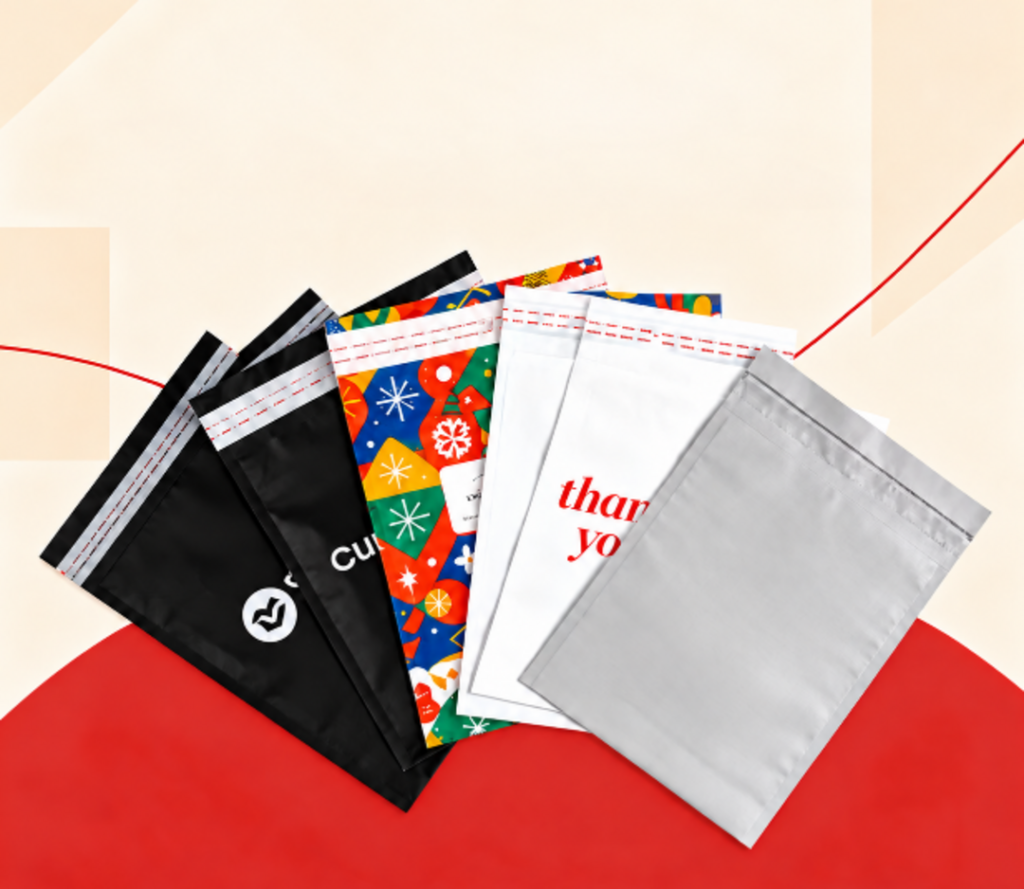
Custom printed poly mailers can be produced according to a buyer’s packaging, branding, and fulfillment requirements. Common customization options include:
| Customization Item | What Buyers Should Confirm |
|---|---|
| Material | Film composition, number of layers and applicable documentation |
| Finished size | Width, length, flap and gusset |
| Thickness | Product weight, edges, puncture risk and handling conditions |
| Film color | White, black, stock color or custom color |
| Surface finish | Matte, glossy or another available appearance |
| Logo printing Logo | Logo size, position, colors and orientation |
| Print coverage | Small logo, partial design, repeating pattern or larger coverage |
| Printing sides | Front only or front-and-back printing |
| Closure | Permanent adhesive, resealable strip or double-seal return design |
| Opening feature | Perforation or tear line |
| Additional structure | Handle, gusset, document pouch or roll-fed format |
| Packing | Bundle quantity, inner packing and export carton requirements |
Some businesses need only a small logo on a stock-colored bag. Others may need a custom film color, repeating pattern, double adhesive strip, QR code, printed instructions, or several sizes for different products.An unpadded poly mailer does not provide rigid protection or built-in cushioning. Fragile, sharp, heavy, liquid-filled, or crush-sensitive products may require a box or additional protection. For help choosing between the two formats, read our guide to poly mailers vs. boxes. Explore common bag structures on our poly mailers product page.
Material, size, thickness, color, printing, and closure should be evaluated as one complete specification.
Choosing the Material, Size, Thickness, and Color
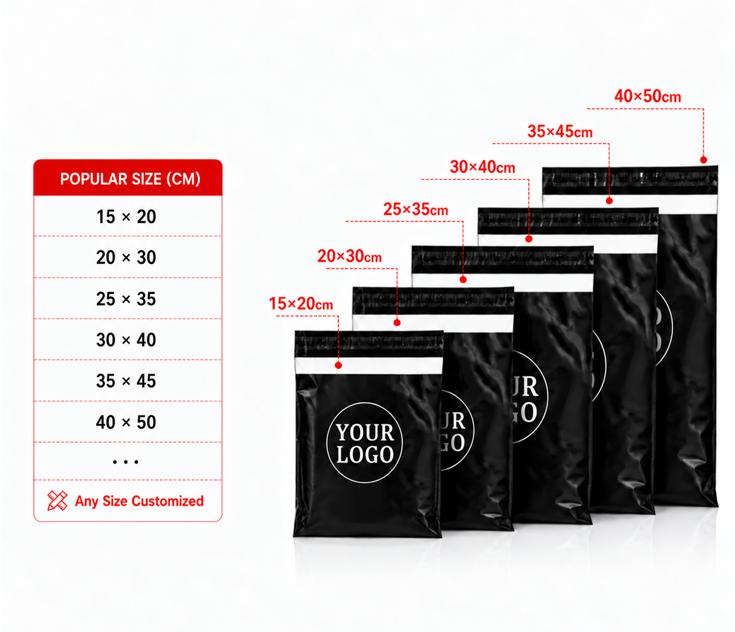
Standard polyethylene film is widely used for ecommerce and courier packaging because it is flexible, lightweight, and moisture-resistant. Film structures can differ in opacity, stiffness, stretch, puncture resistance, surface gloss, and printing performance.Buyers with sustainability requirements may also consider recycled-content, recyclable, biodegradable, or compostable structures. These terms describe different material characteristics and should not be used interchangeably. Any environmental claim printed on the bag should match the actual material and relevant supporting documents.When selecting the size, measure the product after adding any inner packaging. Product thickness uses part of the available width and length, so a bag that looks large enough while flat may become difficult to close after loading.
Provide the supplier with:
- Product length, width, and thickness
- Product length, width, and thickness
- Number of products per bag
- Existing inner packaging
- Required flap or gusse
- Preferred shipping-label position
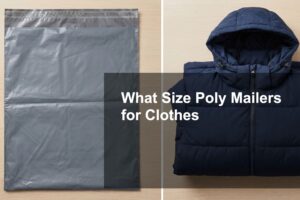
A bag that is too small can stress the side seals and adhesive closure. An oversized bag may leave loose film that folds, covers the design, or makes the shipping label difficult to apply.Film thickness should be selected according to the product weight, shape, corners, inner packaging, and handling conditions. A thicker film may improve puncture resistance, but it does not provide the rigid protection of a corrugated box.For color selection, white film often provides a neutral base for colorful artwork. Dark or colored film can create a stronger brand appearance, but it may affect ink visibility. Light-colored ink on a dark bag may require a white underbase or another production adjustment.If color consistency is important, provide a Pantone reference and agree on an acceptable tolerance. Screen colors may not exactly match colors printed on plastic film because film opacity, surface gloss, lighting, and ink coverage can change the result.Before placing a bulk order, test the real product in a representative sample. Our courier bag size guide explains how to evaluate usable dimensio
Printing Methods and Logo Placement
The appropriate printing method depends on the supplier’s equipment, film structure, number of colors, artwork complexity, print coverage, and order quantity.Flexographic printing is commonly used for logos, text, and repeating designs. Gravure printing may be considered for certain high-volume or high-coverage projects. Digital printing may be available for samples, shorter runs, or complex designs, but it is not suitable or available for every film and bag specification.There is no single printing method that is best for every custom poly mailer. Send the supplier the complete artwork and estimated order quantity so that the process can be evaluated correctly.Common logo and artwork layouts include:
- A small centered logo
- A large front-side logo
- A repeating brand pattern
- Front-and-back printing
- A larger surface design
- QR codes or website information
- Return or disposal instructions
Before positioning the logo, decide where the shipping label will be applied. Important text, logos, and codes should also remain away from side seals, adhesive areas, perforations, and parts of the bag that may fold after loading.QR codes and barcodes should be tested on the actual filled bag. Wrinkles and curved surfaces can affect scanning even when the code appears correct on a flat digital proof.
Allow space for shipping labels, seals, perforations, and normal print-position tolerances.
How to Prepare and Approve Poly Mailer Artwork
Vector artwork is normally preferred because it can be resized without losing clarity. Commonly accepted formats include AI, EPS, editable PDF, and other vector formats approved by the manufacturer.
Before submitting the artwork:
- Convert fonts to outlines
- Embed linked images
- Use sufficient image resolution
- Identify print colors clearly
- Separate front and back designs
- Confirm the logo size and position
A small JPEG copied from a website is usually unsuitable for production. Enlarging a low-resolution image can create blurred edges and unclear text.Buyers should request an artwork template based on the confirmed bag specification. Side seals, bottom seals, gussets, adhesive strips, and perforations can limit the printable area. Important content should remain inside the safe area defined by the manufacturer.RGB screen colors do not directly predict printed-film colors. Depending on the process, the supplier may require Pantone references, separated spot colors, CMYK information, or another color system.
A practical approval process normally includes:
- Confirm the product and packaging requirements
- Finalize the bag specification
- Receive the artwork template
- Submit and review the artwork
- Approve the proof or sample
- Begin mass production
A digital proof can confirm position, direction, size, and basic content, but it may not reproduce the exact color, opacity, gloss, or texture of the finished bag. When color is important, discuss a physical sample or another color-control method before production.Some degree of color variation in the finished bags is unavoidable.Check every visible element before approval, including spelling, website addresses, QR codes, contact details, return instructions, and environmental statements. Retain the approved proof or sample as a reference for mass-production inspection.
Confirm the material, dimensions, bag color, sealing structure, and printable area before approving the final artwork.
Closures and Functional Features
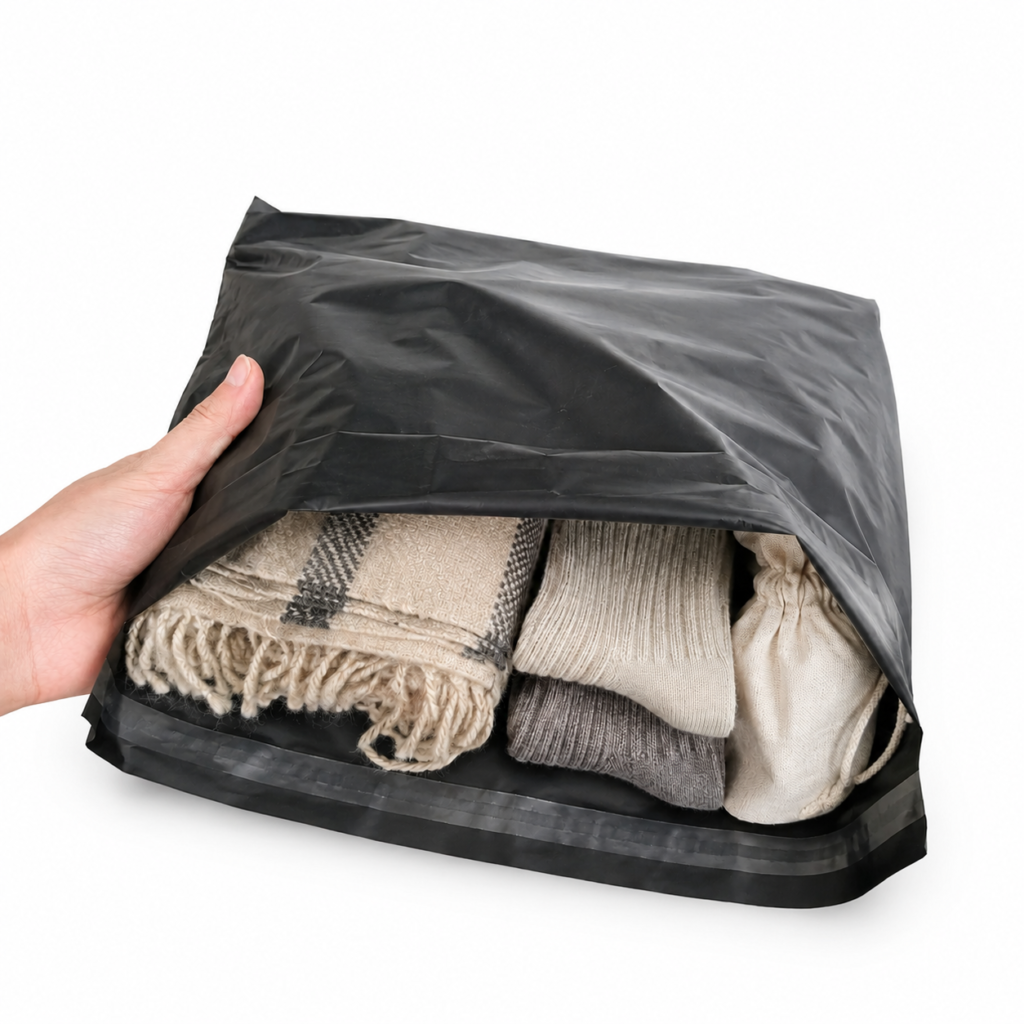
A permanent self-seal strip is suitable for many one-way ecommerce and fulfillment shipments. Packers insert the product, remove the release liner, and close the flap without using separate tape.A double-seal design adds a second adhesive strip for customer returns. A perforated opening can help recipients open the original shipment without damaging the return strip.The closure should be tested with the real packed product. An overfilled bag may place pressure on the adhesive and side seals even if the empty bag appears suitable.Additional features may include gussets for thicker products, die-cut handles, external document pouches, tear lines, roll-fed formats, and different carton-packing arrangements.You can view a common closure format on our self-sealing poly mailers page.
Pricing Factors and RFQ Information
The price of custom printed poly mailers cannot be determined from the logo alone. Two similar-looking bags may have different costs because they use different materials, thicknesses, printing coverage, closures, or packing methods.Important quotation factors include:
- Finished bag dimensions
- Material and film structure
- Film thickness and color
- Number of printing colors
- Print coverage
- Single-sided or double-sided printing
- Order quantity
- Delivery destination and Incoterm
There is no universal MOQ for every project. Stock bags, digitally printed bags, flexographically printed mailers, and gravure-printed mailers may have different setup and quantity requirements.For a more accurate quotation, provide:
- Intended product and packed dimensions
- Product weight
- Required bag size
- Material and thickness
- Bag color and finish
- Artwork and print coverage
- Number of print colors
- Order quantity
- Delivery country and postal code
- Target delivery date
A request for “10,000 mailers with our logo” does not provide enough information for an accurate comparison. Suppliers should quote the same material, size, thickness, printing, closure, packing, quantity, destination, and Incoterm.
Common Mistakes and Pre-Production Checks
A common mistake is approving the artwork before confirming the bag specification. If the size, flap, film color, or sealing structure later changes, the design may need to be repositioned.Other mistakes include:
- Using a low-resolution logo
- Placing artwork too close to seals
- Ignoring the shipping-label area
- Expecting screen colors to match printed film exactly
- Using text that is too small
- Failing to test QR codes on a filled bag
- Printing unsupported environmental claims
- Comparing suppliers only by unit price
Before mass production, check the usable dimensions, thickness, color, opacity, seals, flap, adhesive, perforation, logo position, print registration, QR-code performance, label adhesion, product fit, and carton packing.The final evaluation should use the actual product. An empty mailer may appear suitable, but its performance can change after loading, sealing, labeling, stacking, and handling.
Looking for a reliable custom poly mailer supplier? Contact us with your size, material, artwork, quantity, and delivery destination for a tailored recommendation and competitive quotation.
FAQ
Can poly mailers be printed on both sides?
Yes, depending on the material and printing process. Clearly identify the front, back, flap, opening direction, and shipping-label area.
What is the MOQ for custom printed poly mailers?
MOQ varies according to the size, material, film color, printing method, artwork, and production setup. Request the MOQ for the exact specification.
Can I approve a sample before production?
Available options may include a stock sample, custom-size unprinted sample, material sample, digital proof, or printed sample. Confirm whether the sample uses the same material and process as mass production.
Are custom printed poly mailers recyclable?
Recyclability depends on the complete material structure, ink, labels, closures, and local collection facilities. Review the relevant material information before making a recycling claim.
What artwork file is required?
AI, EPS, or editable PDF files are commonly preferred. Convert fonts to outlines, embed linked images, and clearly identify the print colors and orientation.
Ready to eliminate seal failures and size mismatches from your supply chain?
Planning to purchase poly mailers in bulk? Send us your size, thickness, quantity and destination requirements.Request a formal quote with your specifications. Response within 4 business hours.
RHK Packaging — ISO 9001:2015 Certified Manufacturer Since 2010
[email protected]