



Poly mailer durability depends on the complete film and bag construction, not on thickness alone.Two poly mailers can have the same dimensions and the same stated thickness but perform differently after a product is packed inside. One may stretch smoothly around the contents, while another develops white stress marks. One side seal may remain stable, while another begins to separate near a product corner.This happens because thickness is only one part of the specification. Polyethylene formulation, film layers, thickness consistency, side seals, adhesive closure, bag dimensions, product shape, and load distribution all influence the performance of the finished package.The word “weight” can also create confusion. It may refer to the weight of the empty mailing bag, or it may be interpreted as the amount of product the bag can carry. These are not the same measurement. A heavier bag does not automatically have a higher load capacity, and a lighter bag is not automatically less durable.This guide takes a specification-based approach. Instead of assigning a universal load rating to each film thickness, it explains how B2B buyers can compare materials, understand thickness measurements, identify likely failure points, and test representative samples with the real product.
Start With the Film Structure, Not the Marketing Label
Terms such as “strong,” “heavy-duty,” “premium,” and “extra-thick” may be useful for product presentation, but they do not provide enough information for a technical comparison. A buyer needs to know what the film is made from, how the thickness is measured, and how the finished bag is produced.Most standard polyethylene mailers are made from polyethylene film, but polyethylene is a material category rather than one fixed recipe. A manufacturer may use different polyethylene grades or blends to adjust flexibility, stiffness, stretching behavior, sealing performance, surface feel, and puncture resistance.Low-density polyethylene and linear low-density polyethylene may be used separately or as part of a blend. Knowing the resin name is useful, but it does not fully predict the performance of the finished plastic mailer. The ratio of the materials, total thickness, number of layers, production settings, and bag-making process still matter.Some plastic mailing bags use a relatively simple film structure, while others use co-extruded film with multiple layers. In a multilayer construction, the outer surface may be selected for appearance and printing, while an inner layer may support opacity, sealing, color, or another manufacturing requirement.More layers do not automatically mean better performance. A multilayer bag can still fail if its dimensions are unsuitable, the side seals are weak, or the product creates concentrated pressure against the film. Buyers should compare the complete construction rather than using the number of layers as a quality grade.Virgin and recycled-content polyethylene also require a specification-based comparison. Virgin film may provide more consistent appearance or processing in some applications. Recycled-content film may require additional checks for color, odor, surface appearance, batch consistency, and supporting documentation.The color of a bag does not prove its recycled content. A gray or black plastic shipping bag may contain recycled material, virgin material, or a mixture. If a recycled-content claim will appear on the packaging, the buyer should confirm the percentage, source, material structure, supporting documents, and markets where the claim will be used.For available material options, see our Recyclable Mailing Bags. Recycled content, recyclability, biodegradability, and compostability describe different material attributes and should not be used as interchangeable terms.For a useful comparison, ask the supplier to describe the proposed film structure, total thickness, material composition, surface finish, color, opacity, and recycled-content requirement. These details provide a more reliable starting point than a description such as “premium heavy-duty plastic mailer.”
How to Compare Film Thickness and Finished Bag Weight
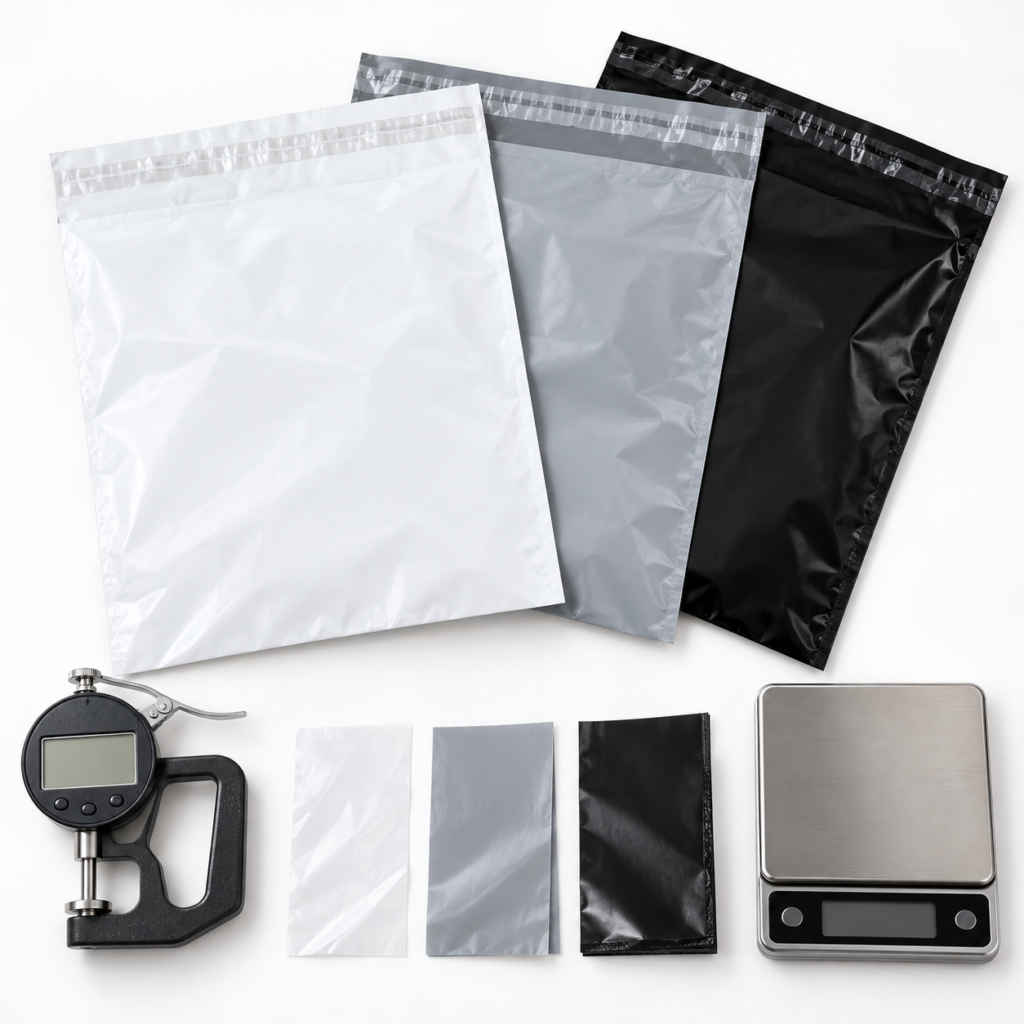
Poly mailer thickness may be stated in microns, mil, or gauge. Microns are common in metric specifications, while mil is frequently used in inch-based markets. One mil equals one-thousandth of an inch, or approximately 25.4 microns.The conversion itself is simple. The more important question is what the stated number represents.A supplier may report single-wall thickness, meaning the thickness of one film layer on one side of the bag. Another supplier may report the combined thickness of the front and back walls. A quotation may also show a nominal target rather than the measured result from an actual sample.Before comparing quotations, confirm whether the figure refers to:
- Single-wall thickness
- Combined double-wall thickness
- Nominal production target
- Average measured thickness
- Minimum accepted thickness
Film production also involves tolerances. A nominal thickness does not mean that every point across the web or finished bag is identical. The buyer and supplier should agree on the target, measurement tool, sampling locations, number of measurements, calculation method, and acceptable tolerance.This is why a simple comparison such as “2 mil versus 3 mil” can be misleading. The numbers become meaningful only when the material, bag dimensions, layer structure, measurement method, and tolerance are also comparable.A thicker film may create a firmer feel, reduce excessive stretching, improve puncture resistance, or provide better opacity in some constructions. It will also use more material and usually increase the weight of the finished bag. However, greater thickness does not repair weak side seals, improve an unsuitable adhesive, or add rigid crush protection.Finished bag weight is influenced by more than thickness. It also depends on the bag’s width, length, flap, gusset, film density, number of layers, adhesive strips, handles, labels, and other features.Two bags made from similar film can have very different weights if their dimensions or structures differ. For this reason, bag weight should be measured on a finished production-representative sample rather than estimated from a generic product category.Bag weight should not be presented as load capacity. A heavy empty bag may still perform poorly around a sharp or rigid product. A lightweight shipping bag may perform well when it contains a smooth, flexible product and is correctly sized.Avoid assigning one fixed product weight to each film thickness unless the claim is connected to a specific bag size, construction, product shape, test method, and acceptance standard. A thickness-to-weight chart without these conditions can give buyers a false sense of certainty.
Durability Is a Combination of Different Failure Modes
A mailing bag does not have one universal form of strength. It may resist stretching but perform poorly after a small cut appears. Its film may remain intact while a side seal begins to open. Its adhesive may be strong under ordinary conditions but unreliable when the closure area is dusty or under constant tension.For a useful durability assessment, examine the main ways in which the complete package could fail.
Puncture resistance
Punctures often come from concentrated pressure rather than total product weight. A zipper pull, metal buckle, rigid box corner, sharp component, or protruding product feature can press against a very small area of film.Film formulation, thickness, number of layers, fit, and internal protection all influence puncture performance. A thicker film may reduce the risk, but it cannot remove the risk created by an exposed sharp point.If the product has a sharp component, consider rotating the product, adding an inner wrap, covering the corner, or choosing a more structured shipping package.
Tear initiation and tear propagation
Stretch resistance and tear resistance are not identical. A film may stretch considerably without breaking, but once a small cut or puncture appears, the damage may continue along the bag.Inspect areas around the bag opening, side seals, perforations, corners, and points that contact hard parts of the product. These areas may behave differently from the center of an empty film sample.A hand-pull demonstration can be useful for an initial comparison, but it should not be treated as a complete or standardized durability test.
Side-seal performance
The strongest film cannot compensate for an unsuitable side seal. Seal performance depends on the film structure, heat-sealing conditions, seal width, bag dimensions, product thickness, and distribution of the packed load.A bulky textile product may not be especially heavy, but it can push continuously against both side seals. A dense compact product may create a different problem by pulling strongly on a smaller area near the bottom of the bag.The bag should therefore be tested with the actual product in its normal shipping orientation. Testing the empty bag will not reproduce these stresses.
Adhesive closure
Adhesive performance depends on the adhesive system, strip width, flap length, film surface, application pressure, storage conditions, dust, moisture, and tension from the packed product.A closure that works well on a loosely packed garment may begin to lift when used on a rigid product that continuously pushes against the flap.Buyers should specify whether the closure is permanent, resealable, or designed with a second strip for returns. These options serve different workflows and should not be evaluated as though they were the same product.
Stretching, surface wear, and appearance
A mailer can remain closed and still perform poorly from a branding perspective. Excessive stretching may reduce opacity, distort printed artwork, create white stress marks, or make the product shape clearly visible.Surface scuffing can also affect dark or heavily printed bags. If appearance matters, inspect the complete packed sample after handling rather than judging only the unused bag.Durability should therefore be defined by the buyer’s real priorities. A suitable bag should remain closed, contain the product, avoid unacceptable punctures or seal failure, maintain sufficient opacity, and arrive with an acceptable appearance.
Build a Product-Specific Sample Test
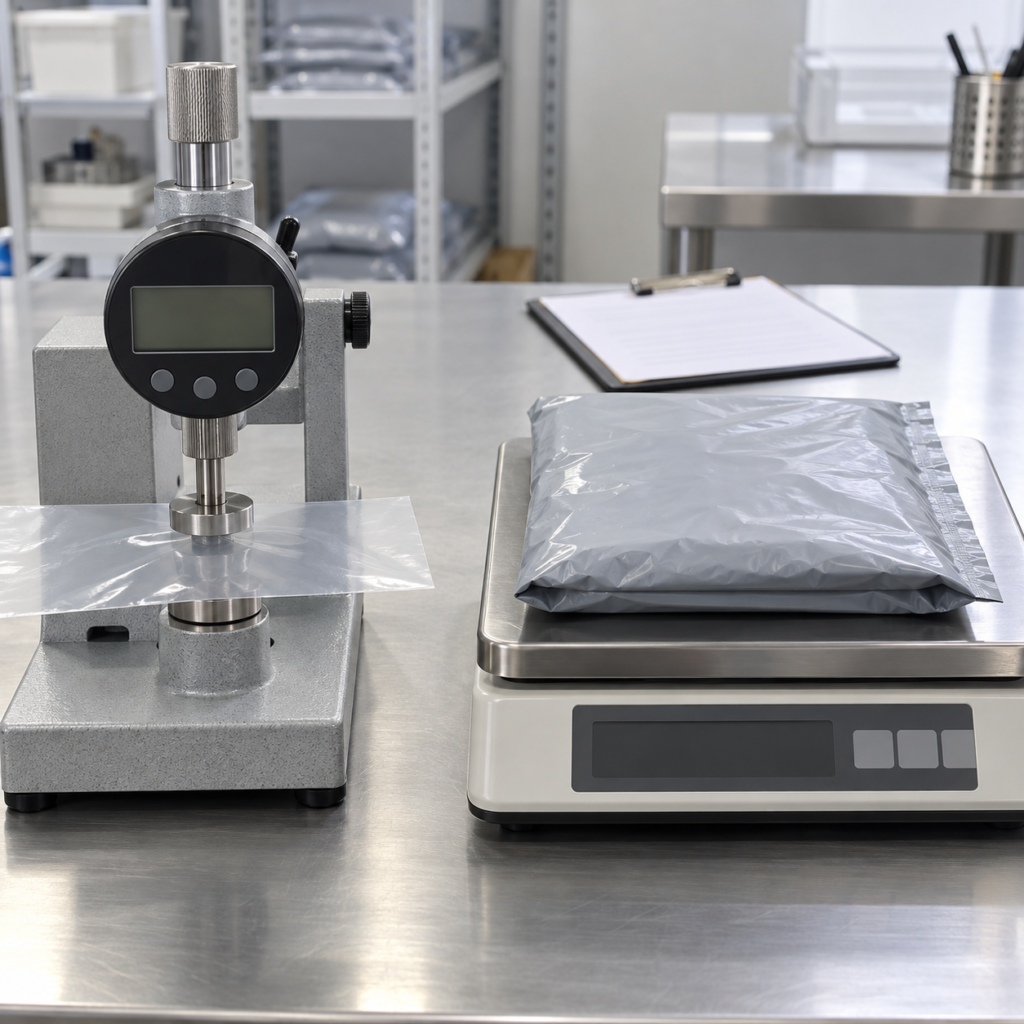
The most useful test is not a dramatic demonstration performed on an empty bag. It is a repeatable comparison using the real product, normal warehouse packing method, and representative mailing bag samples.Begin by preparing the product exactly as it will be shipped. Fold it using the warehouse’s normal method, include any tissue paper, retail box, insert, inner bag, tag, or accessory, and allow soft products to return to their normal thickness after compression.If size selection is still being finalized, use the measuring process in our Courier Bag Size Guide before comparing thicknesses. An undersized bag can create seal stress that is incorrectly blamed on the film.A practical internal comparison can include the following stages.
1. Loading and fit check
Record whether the product can be loaded without excessive force. Check the remaining closure space, film tension, side-seal pressure, label area, and final parcel shape.If one operator can pack the sample but other operators struggle, the size or packing method may not be reliable enough for production use.
2. Product-corner inspection
Identify all rigid corners, zippers, buckles, metal parts, and protrusions. Check whether they create visible stress points immediately after packing and after the sample has remained sealed for a period of time.Use the same product orientation for every sample so that the results can be compared fairly.
3. Seal and closure hold
Inspect both side seals and the bottom area while the packed bag is lifted, placed flat, and stored in its normal orientation. Check whether the adhesive edge begins to lift or whether the flap is under continuous tension.If the bag includes a return strip or perforated opening, test the outbound and return functions separately.
4. Controlled handling comparison
Move every sample through the same internal handling sequence. For example, place the packed bags in a carton, transfer them between work areas, stack them with similar parcels, and inspect them again.This does not replace a formal laboratory or carrier test, but it provides a more useful comparison than casually pulling different bags by hand.
5. Label, print, and surface inspection
Check whether the shipping label remains flat and firmly attached. Inspect printed areas for scuffing, cracking, distortion, or loss of readability.If the bag uses a matte, glossy, recycled-content, or heavily colored film, label adhesion and printing appearance should be tested on the final material rather than on a different sample film.
6. Record the result
Use written acceptance criteria. For example, the buyer may require no open side seals, no exposed product, no lifted closure, readable labels, and no puncture above an agreed size.The purpose is not to claim that the bag is indestructible. The purpose is to compare samples consistently and decide whether the construction is suitable for the intended product and process.
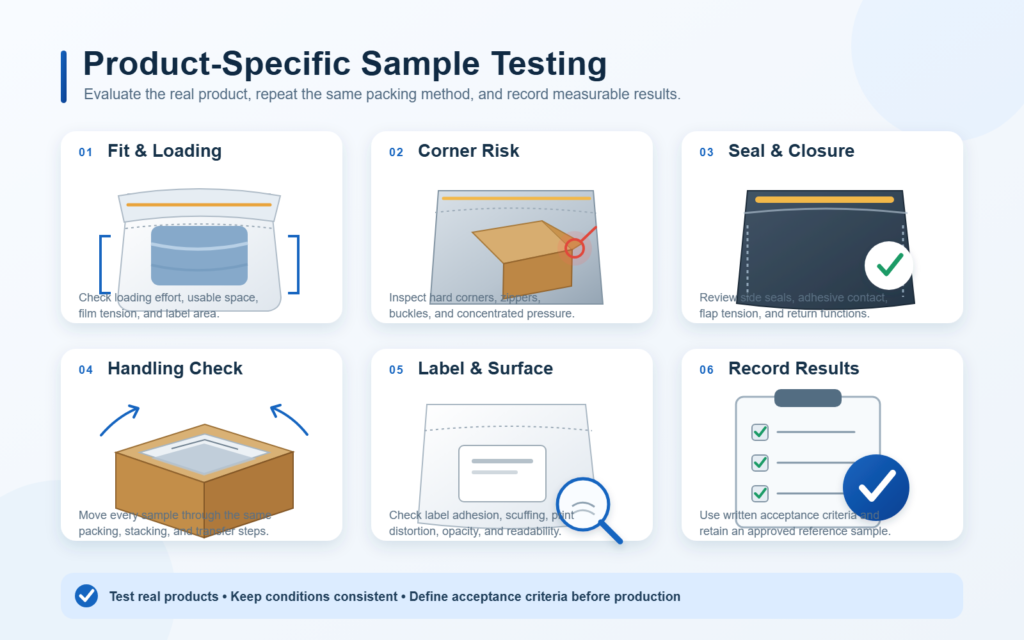
Test representative mailers with the real product, consistent packing, and written acceptance criteria.
Compare Supplier Samples Using the Same Specification
A quotation is only comparable when suppliers are pricing the same construction. If one supplier quotes a smaller bag, a different thickness measurement, wider tolerance, simpler film, or different closure, the lowest unit price may not represent the same product.Provide each shortlisted supplier with the same information:
- Intended product and shipping application
- Product dimensions and packed thickness
- Packed product weight
- Finished and usable bag dimensions
- Proposed polyethylene structure
- Required thickness and thickness unit
- Single-wall or double-wall measurement
- Color, finish, and opacity
- Printing colors and coverage
- Order quantity
- Delivery destination
Ask how the supplier measures film thickness and whether the sample represents the intended production material. A hand sample made from another film or thickness may help confirm dimensions, but it cannot confirm the final material performance.Agree on the sampling method before production. For example, specify how many bags will be inspected, where thickness will be measured, how dimensions will be recorded, and what will happen if results fall outside the agreed tolerance.The approved sample should be retained as a physical reference. Written specifications remain essential because appearance alone cannot confirm material composition, thickness, or adhesive performance.Avoid relying on unqualified terms such as “heavy-duty” or “premium grade.” Convert them into measurable requirements. Instead of asking for a heavy-duty plastic mailer, describe the film structure, thickness measurement, dimensions, seals, closure, product, and acceptance criteria.Likewise, avoid publishing a universal load claim unless it is supported by a defined construction and repeatable test. A statement such as “carries 5 kg” is incomplete without the bag dimensions, product shape, load distribution, handling method, and failure criteria.Pricing questions should be handled separately from performance evaluation. Size, thickness, material, printing, quantity, closure, packing, and delivery destination all affect the quotation. These variables are covered in more detail in our B2B Poly Mailer Pricing Guide.Buyers comparing available structures can also review our Poly Mailer range.
Request a Material and Thickness Recommendation
Selecting polyethylene mailers involves more than choosing a thickness from a product list. The material structure, dimensions, seals, adhesive closure, product shape, and packing process should be evaluated together.Send us your product dimensions, packed thickness, packed weight, preferred material, required bag size, artwork, order quantity, and delivery destination. We can help you review suitable specifications and prepare a tailored quotation.Explore our Poly Mailer range or contact us to discuss your packaging requirements.
Does a thicker plastic mailer always last longer?
Not always. Greater thickness may improve stiffness, stretching behavior, or puncture resistance, but durability also depends on the film formulation, seals, closure, bag size, product shape, and handling conditions.
Why do two mailers with the same thickness feel different?
They may use different polyethylene blends, film layers, additives, colors, surface finishes, or production settings. Stiffness and surface feel cannot be predicted from thickness alone.
Is bag weight the same as load capacity?
No. Bag weight describes the empty package. Load performance depends on the complete bag construction, dimensions, seals, closure, product shape, and distribution of weight inside the bag.
Can lightweight shipping bags be durable?
Yes. A lightweight mailer can perform well when the product is smooth, flexible, correctly sized, and suitable for flexible shipping packaging. Low packaging weight does not automatically mean low quality.
Does recycled polyethylene make a mailer weaker?
It cannot be determined from the recycled-content claim alone. Performance depends on the source and percentage of the recycled material, film formulation, layer structure, thickness, production control, and finished-bag testing.
Ready to eliminate seal failures and size mismatches from your supply chain?
Planning to purchase poly mailers in bulk? Send us your size, thickness, quantity and destination requirements.Request a formal quote with your specifications. Response within 4 business hours.
RHK Packaging — ISO 9001:2015 Certified Manufacturer Since 2010
[email protected]