


Documents, photos, books, and specialty printed items need different levels of protection during shipping.At first glance, documents, photo prints, books, and certificates may seem easy to ship. They are flat, lightweight, and often fit into a standard mailing bag. But the real challenge is not whether the item fits inside the bag. The challenge is whether it arrives in a condition that still looks professional, presentable, and ready to use.A document can arrive with a crease through the middle. A photo print can be scratched or marked by moisture. A paperback book can arrive with bent corners, while a hardcover book may suffer from pressure damage around the spine and edges. Even when the contents are technically intact, poor packaging can still make the shipment look careless.That is why document mailers should be selected as part of a complete packing method. The outer bag matters, but so do the inner sleeve, backing support, product arrangement, label area, and the way the item is handled before dispatch.
Why Flat Items Still Need a Packing Plan
Flat items are often treated as low-risk shipments because they are not liquid-filled, breakable, or mechanically complex. However, many flat items are highly sensitive to appearance. A bent certificate, a scratched photograph, or a book with visibly damaged corners can create dissatisfaction even if the product remains usable.The main risks are usually bending, moisture, compression, surface friction, corner impact, and internal movement. During fulfillment and carrier handling, a parcel may be placed under heavier items, slide across a conveyor, be exposed to humidity, or move inside a delivery vehicle. The packaging should help reduce the effect of those normal handling conditions.The best starting point is to define the condition requirement. Ask yourself whether the item must remain completely flat, whether the corners must stay sharp, whether the surface must stay clean, and whether the contents need privacy. Once those requirements are clear, it becomes much easier to choose the right packing structure.
Start With the Item, Not the Mailer
Before selecting a document mailer, look closely at the item itself. Do not choose a bag based only on width and length. The item’s thickness, rigidity, surface finish, corner shape, value, and intended use can all change the packaging requirement.For example, a stack of internal office papers may only need a clean outer mailer and basic protection from moisture. A signed agreement may need a folder or backing board to avoid creasing. A glossy photo print may need a clean protective sleeve before it enters the outer bag. A hardcover book may need additional edge protection because its corners can create pressure against flexible packaging.
| Item Type | Main Risk | Packing Priority |
|---|---|---|
| Loose documents | Folding, moisture, privacy | Flat support and secure closure |
| Signed contracts | Creasing, loss, poor presentation | Organized contents and opacity |
| Photo prints | Scratches, fingerprints, bending | Clean separation and surface protection |
| Paperback books | Corner wear, cover scuffing | Stable fit and edge protection |
| Hardcover books | Compression and puncture risk | Stronger outer protection |
| Certificates | Creasing and surface damage | Flat reinforcement |
| Catalogs and brochures | Bent corners and loose pages | Stable stacking |
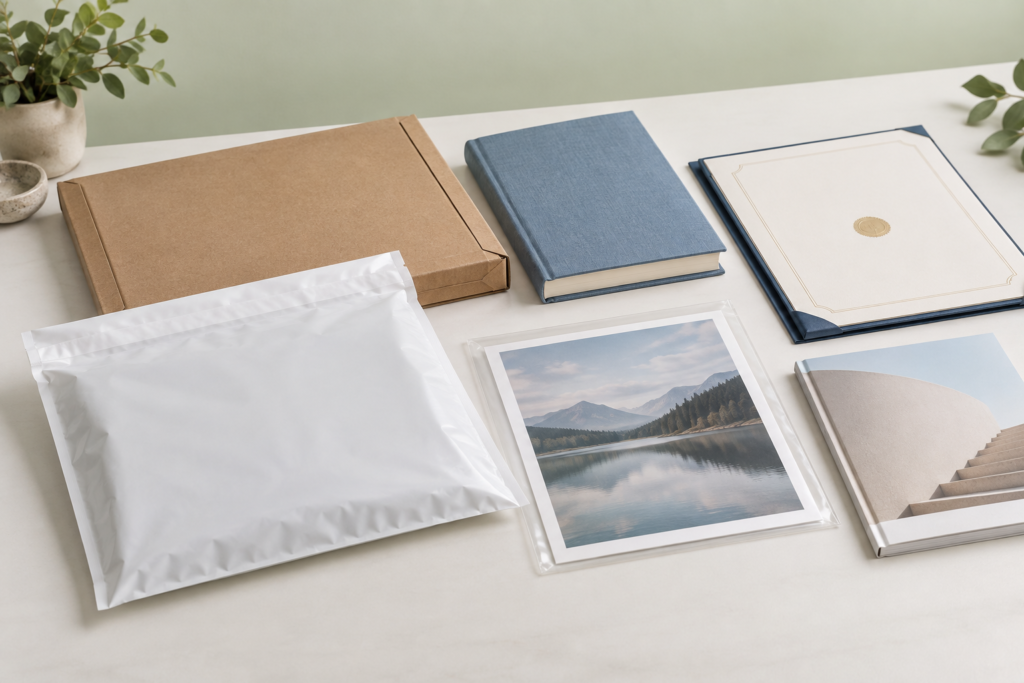
Choose packaging based on the item’s condition requirements, not only on its weight or dimensions.
Document Mailers for Business Documents and Paperwork
Business documents are often simple to pack but important to present well. Contracts, quotations, invoices, certificates, brochures, product sheets, training materials, and sample paperwork may be replaceable, but sending them in poor condition can still affect how your company is perceived.A document envelope for mailing is useful when the contents are already organized and the shipment does not need heavy impact protection. However, if the papers must arrive without folds, it is worth adding a folder, backing board, or rigid insert inside the outer mailer. The purpose is not to create unnecessary packaging layers. It is to prevent the document set from becoming loose, uneven, or bent during handling.For confidential paperwork, opacity may also matter. An opaque outer mailer helps prevent casual visibility of the contents during warehouse handling and delivery. It does not replace formal information-security procedures, but it can add a practical layer of privacy for invoices, contracts, personnel documents, and commercial files.If you have already confirmed the size of your documents and need help selecting a practical outer-bag size, see our Courier Bag Size Guide.
Photo Mailers: Protecting Prints, Photos, and Artwork
Photo prints, art prints, posters, greeting cards, and glossy marketing materials require a different way of thinking. Their main risk is often not whether they will fall out of the package. The bigger concern is whether the printed surface will still look clean and undamaged when the recipient sees it.A small scratch, a fingerprint, a moisture mark, or a pressure line may be enough to reduce the perceived quality of the item. This is especially important for photographers, artists, print shops, galleries, stationery brands, and businesses selling display-ready materials.The first step is clean handling. Before packing, make sure the printed surface is dry and free from dust, fingerprints, adhesive residue, or loose particles. Then add a clean sleeve, separating sheet, or inner protective layer to reduce direct surface contact.For prints that need to remain flat, the outer mailer should not be expected to do all the work. Add suitable flat support before placing the item into the mailer. This is particularly important for larger prints, limited-edition artwork, premium cards, and materials intended for resale or display.A photo mailer should protect more than the edges. It should help keep the printed surface clean, separated, flat, and protected from moisture during transit.For compact photo products or smaller printed items that need light cushioning, explore our Mailing Bubble Bags.
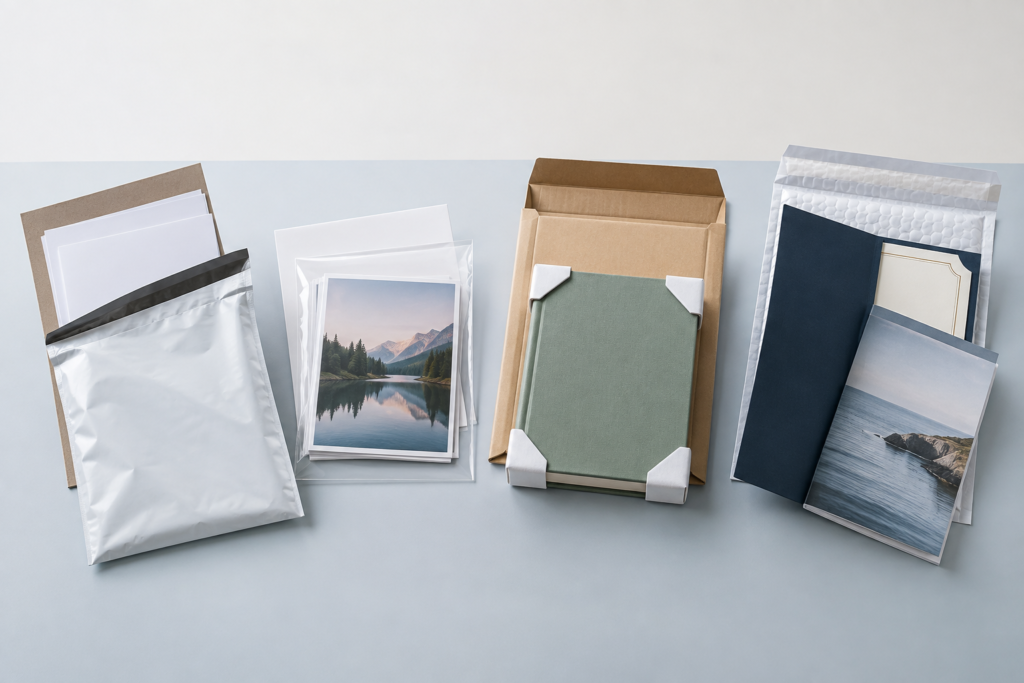
Book Mailing Bags: Paperback, Hardcover, and Multi-Book Orders
Books are often treated as durable items, but the condition of a book is part of its value. A customer may be happy with the written content, but still disappointed when a new book arrives with folded corners, a scratched cover, or a damaged spine.For paperback books, the main goal is usually to prevent shifting and corner wear. A book should sit naturally inside the package without being forced into an undersized bag. At the same time, a bag that is too large can allow the book to slide, creating friction and increasing the risk of bent edges.Hardcover books need more attention because their hard edges and corners create concentrated pressure. They can place stress on flexible packaging, and they can also be damaged if the parcel is compressed during sorting or transport. Signed books, collector editions, gift books, and premium publications should be evaluated using the complete packaging system rather than only the outer bag.Multi-book orders create another challenge. Books of different sizes can slide against each other or place heavy corners against lighter covers. Before placing them into the outer package, group the books in a stable way and test the actual order combination. A method that works for one paperback may not work for a three-book mixed order.If your shipment needs more rigid structure or stronger internal protection, read Poly Mailers vs. Boxes: When to Use Each.
Can I Mail a Book in a Brown Paper Bag?
This question comes up often because brown paper bags appear simple, low-cost, and easy to use. The answer is not simply yes or no. It depends on the book, the shipping route, the handling conditions, and the standard you expect at delivery.A brown paper bag may be suitable for a lightweight, low-value, low-risk book shipment. If the book is not highly sensitive to appearance and the route is controlled, simple paper packaging may be practical. However, paper bags can be affected by moisture, tearing, corner impact, and compression.The important question is not whether the bag can hold the book. It can. The better question is whether it can help the book arrive in the condition the recipient expects. A gift book, premium hardcover, or collectible edition often needs a stronger and more controlled protection method.A brown paper bag may work for some lightweight book shipments, but it may not provide enough protection for every book.
Mailing Bags for Certificates, Catalogs, Media, and Specialty Items
Documents, photos, and books are only part of the mailing category. Many businesses also send certificates, calendars, art cards, event packs, sample cards, media materials, product catalogs, training packs, and collector items.These products are often described as “specialty items” because their value depends on more than their weight or size. A certificate needs to arrive flat and official-looking. A catalog needs clean corners and a neat cover. A collector card may need a protected surface. An event document pack needs all components to remain organized.That is why it helps to define the recipient’s priorities before selecting packaging. Are they likely to notice flatness first? Surface condition? Privacy? Corner quality? Organization? Once you understand that, you can build the packaging around the item’s actual value.
Build a Practical Protection System
A reliable document mailing solution is rarely just one bag. It is usually a combination of several simple parts working together.
Item → Inner Protection → Flat Support → Outer Mailer → Label Area → Dispatch Check

For a simple document set, the system may only include organized papers and a secure self-sealing outer mailer. For a photo print, it may include a protective sleeve, separating paper, flat support, and an outer bag. For a book, it may involve stable placement, edge protection, and a stronger outer layer depending on the book’s condition requirement.The key is to avoid treating every item as the same. A packaging system should be simple enough for your team to use consistently, while still being appropriate for the item being shipped.For fast packing workflows, explore our Self-Sealing Poly Mailers.
Questions to Ask Before Ordering Document Mailers in Bulk
When ordering document mailers in bulk, a supplier needs more than a general request for “mailing bags.” The clearer the product and packing details are, the easier it is to recommend a suitable structure and prepare an accurate quotation.Before sending an inquiry, prepare the finished dimensions of the item, the packed thickness, the expected order quantity, and the type of protection required. If the product has sharp corners, a glossy surface, confidential information, or specific branding requirements, include those details too.You may also need to confirm whether the mailer will carry one item or multiple items, whether it needs logo printing, whether it requires a return strip, and whether your warehouse has a specific packing process.A useful RFQ can include:
- Item type
- Finished width, length, and packed thickness
- Required material and outer appearance
- Need for opacity, printing, or logo customization
- Internal protection requirements
- Order quantity and repeat-order expectation
- Delivery destination
Common Packing Mistakes for Documents, Photos, and Books
The most common mistake is assuming that a flexible mailer alone will protect every flat item. A mailer may contain the product, but it does not automatically prevent bending, scratches, or corner damage.Another mistake is using an oversized bag. Extra space may look harmless, but it allows the contents to shift during handling. A photo print may rub against the bag. A book may slide into the corner. A document stack may become uneven before it reaches the recipient.It is also common to focus only on the outer bag and ignore the internal condition of the item. A clean sleeve, backing board, separating paper, or simple folder can sometimes make a bigger difference than changing the outer mailer alone.Finally, do not skip practical testing. Pack a real product using the intended materials, check the final fit, inspect the label area, and review the item condition after representative handling. A sample test can reveal problems that are not obvious from a flat bag specification.
Need Custom Document Mailers?
If you are planning a document, photo, book, certificate, catalog, or specialty-item mailing project, share your product type, dimensions, packing requirements, artwork, order quantity, and delivery destination.Explore our custom poly mailer options to see suitable mailing bag structures for document, photo, book, and specialty-item projects.We can help you evaluate a mailing bag structure that fits your packing process and helps protect the condition your recipient expects to receive.
Frequently Asked Questions
What is the best way to prevent documents from bending during shipping?
Use a document mailer together with a suitable backing board, folder, or rigid insert when the documents must remain flat. The outer bag should be large enough for loading and sealing without forcing the papers to bend.
Can I ship paperback books in a poly mailer?
Some paperback books can be shipped in a poly mailer when the book fits securely and its corners are protected. Test the complete package with the actual book before applying the same method to bulk orders.
Can one mailer size be used for several document formats?
It may be possible when the formats have similar packed dimensions, but using one oversized bag for every item can create excess movement and an untidy presentation. Businesses with several common document formats may benefit from selecting a small group of standardized mailer sizes.
Do hardcover books need a box?
Not every hardcover book requires a box, but hard covers and sharp corners can create higher pressure during transit. Valuable, heavy, signed, collectible, or multi-book orders may need a more rigid packaging system and additional internal protection.
What should be approved before mass production?
Before mass production, confirm the finished and usable dimensions, material structure, thickness, bag color, surface finish, adhesive closure, printing position, artwork, carton packing, and agreed production tolerances. Keep an approved sample or signed artwork proof as the reference for production inspection.
Ready to eliminate seal failures and size mismatches from your supply chain?
Planning to purchase poly mailers in bulk? Send us your size, thickness, quantity and destination requirements.Request a formal quote with your specifications. Response within 4 business hours.
RHK Packaging — ISO 9001:2015 Certified Manufacturer Since 2010
[email protected]