



Can you place a product in a poly mailer, close the flap, add a label, and send it? Technically, yes. But a bag that is too large can let the contents shift, a contaminated adhesive strip can open in transit, and a label wrapped over an edge can become difficult to scan.Shipping with poly mailers works best when five things are controlled: the mailer fits the packed product, the contents remain stable, the seal is complete, the label stays flat, and the final weight and dimensions are accurate.This guide explains how to ship with poly mailer bags as a repeatable fulfillment process. It is written for ecommerce brands, packaging buyers, warehouse operators, and logistics managers who need fewer packing errors rather than another general definition of a poly mailer.
Can You Ship Products Safely in Poly Mailers?
Yes, provided the product can tolerate ordinary parcel handling and the package is prepared correctly.
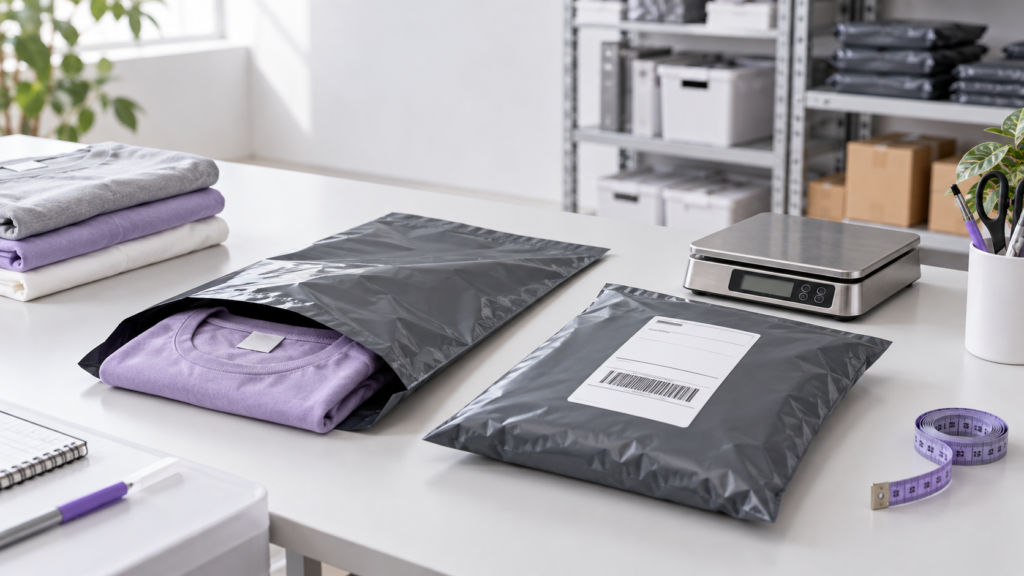
A standard poly mailer provides a lightweight outer barrier against dust, surface contact, and light moisture exposure. It does not provide the rigid support or impact protection of a corrugated box. In a successful shipment, the product supplies most of the structure while the mailer keeps it contained, covered, and labeled.A cotton T-shirt and a glass cosmetic bottle may weigh about the same, but they do not have the same packaging needs. The shirt can absorb normal compression. The bottle can crack, leak, or puncture the film.Use a standard poly mailer when the product is soft, flexible, difficult to break, and free from exposed sharp points. Use a padded option when the item needs light cushioning. Choose a box when the product requires structural support, impact protection, or internal bracing.For a more detailed packaging comparison, read Poly Mailers vs. Boxes and Poly Mailers vs. Bubble Mailers.
Which Products Should and Should Not Go in a Poly Mailer?
Products Commonly Suitable for Poly Mailers
- T-shirts, shirts, trousers, and other apparel
- Towels, linens, and soft home textiles
- Socks, scarves, hats, and fabric accessories
- Soft promotional products
- Durable goods already protected by strong retail packaging
Products That Need More Protection
- Glass, ceramics, and other breakable products
- Liquids without compliant secondary and outer packaging
- Heavy metal components or dense parts
- Items with sharp corners or exposed hardware
- Electronics without protective retail packaging
- Products that can be damaged by compression
A Quick Packaging Decision
When you are unsure, evaluate the product in its actual shipping configuration. Fold it, add any retail packaging and inserts, and ask three questions:
- Can the item tolerate compression from other parcels?
- Can any corner, zipper, fastener, or metal part puncture the film?
- Will the item remain stable when the package is lifted, turned, and moved?
If any answer raises concern, add protection or change the packaging format. RHK Packaging offers mailing bubble bags for products that need light cushioning.
How to Ship With Poly Mailer Bags: A Six-Step Packing Process
The most reliable way to pack poly mailers is to treat the work as a short operating procedure. Each step prevents a different failure later in the shipment.
Step 1 — Verify the Order
Confirm the SKU, size, color, quantity, and destination. Check that the product is clean, dry, and free from damage. Remove temporary clips or packaging parts that could puncture the bag.For multi-item orders, verify the full order before sealing. Reopening a permanent self-seal mailer usually damages the flap and increases material waste.
Step 2 — Prepare and Stabilize the Product
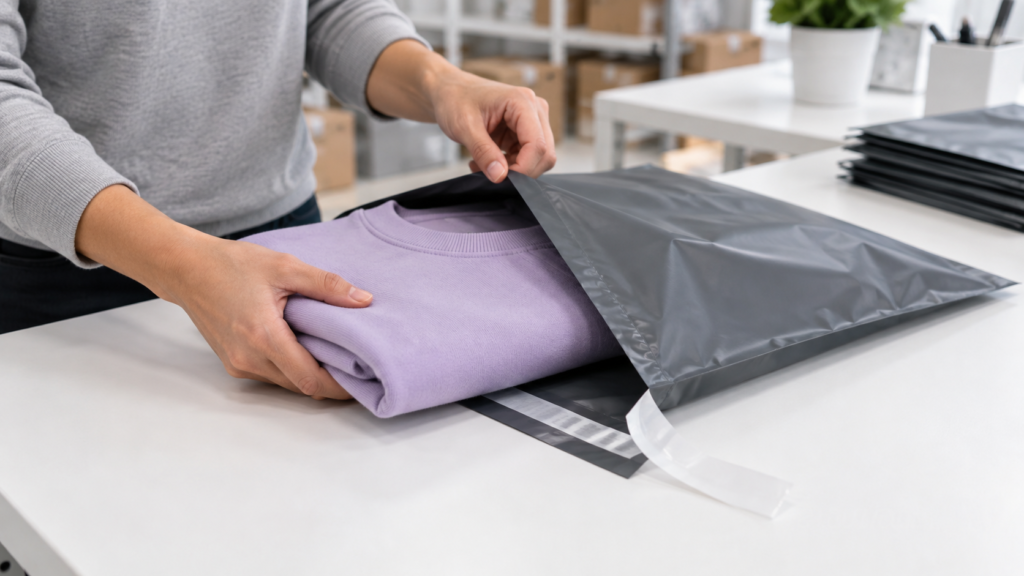
Fold soft goods into a compact rectangle with no loose sleeves, straps, or drawstrings. Secure zippers, metal aglets, buckles, and other hard components so they cannot press directly against the film.Use tissue paper, an inner bag, or a thin protective insert when the product needs better presentation, moisture separation, or protection from surface friction.
Step 3 — Load the Mailer
Slide the product into the bag without forcing it through the opening. Keep it below the adhesive flap and away from the heat-sealed side seams.A mailer that only closes under tension is too small. A mailer that lets the product slide freely from end to end is probably too large.
Step 4 — Remove Excess Air
Gently smooth the bag and release trapped air before closing it. This creates a flatter parcel and a better surface for the label.Do not compress the product so aggressively that it becomes distorted or places continuous pressure on the seams. The objective is a stable package, not the smallest possible package at any cost.
Step 5 — Seal the Bag
Make sure the adhesive area is clean and dry. Remove the release liner, fold the flap straight across the opening, and press firmly along the full width of the seal.Pay particular attention to the center and both corners. A flap can look closed while still containing small unbonded areas that catch during handling.
Step 6 — Complete the Final Pack Check
Lift and turn the parcel. The contents should not move significantly, the side seams should not stretch, and the flap should remain flat. Confirm that the largest face provides a usable label area.
How Do You Keep a Poly Mailer From Opening in Transit?
A self-sealing mailer can open when the adhesive does not make full contact with the film. Common causes include contamination, overfilling, uneven pressure, unsuitable storage conditions, and old or damaged adhesive.
Does a Poly Mailer Need Extra Tape?
A properly matched, good-quality self-sealing poly mailer normally does not need extra tape. Tape can help when the original closure is damaged or a validated packing specification calls for reinforcement. It should not cover the tracking barcode or leave loose ends.
What Should Procurement Teams Test?
- Adhesive consistency across production samples
- Bonding on the actual film surface
- Performance after warehouse storage
- Performance under expected temperature and humidity
- Side-seam strength when loaded
- Puncture resistance around corners and hardware
Testing the finished package is more useful than judging the adhesive strip by appearance alone.
Where Should You Put the Shipping Label?
Place the label on the largest, flattest face of the finished parcel. Keep it parallel to the longest side and away from seams, wrinkles, the closure flap, and curved edges.USPS advises keeping the return address, delivery address, postage, and related labels on the same side. Labels should not bend, fold over an edge, or overlap. Review the official USPS package addressing guidance for current instructions.
How to Prevent Labels From Peeling
Wipe dust from the film with a clean, dry cloth. Apply the label from one edge to the other, then press around all four sides. Keep the tracking barcode flat, visible, and free from glare-producing tape.If labels repeatedly lift, review the label adhesive as well as the bag. Label performance can vary with the adhesive, film finish, dust, temperature, and storage conditions.For detailed address layouts, read How to Address Poly Mailers.
How Should You Weigh and Measure a Packed Poly Mailer?
Always weigh the completed parcel, not the product alone. The final shipment weight includes the mailer, inner bag, tissue paper, inserts, promotional items, and protective material.Measure the package after it has been packed and sealed. Record its length, width, and maximum thickness in the form required by your shipping platform or carrier. Do not substitute the empty bag’s listed dimensions for the finished parcel dimensions.Accurate measurements help prevent postage adjustments and create better packaging data. Over time, this information can show which SKUs use oversized mailers and where a different bag size could improve packing consistency.USPS notes that package dimensions and nonstandard characteristics can affect charges. Polybags whose contents shift, cause the parcel to roll, or prevent it from maintaining its integrity may be subject to additional characteristics fees. Review the current USPS postage verification guidance.
How to Ship Poly Mailers USPS: What Must Be Checked?
If you are searching for how to ship poly mailers USPS, focus on four decisions: whether the contents are mailable, which service fits the shipment, whether the package data is accurate, and how the parcel will enter the USPS network.
Confirm That the Contents Are Mailable
Ordinary apparel and soft goods are generally straightforward. Liquids, perfume, aerosols, batteries, and other restricted products may require special packaging, markings, declarations, or ground transportation. A poly mailer does not change the restrictions that apply to the contents.
Match the Service to the Shipment
Choose the USPS service after considering destination, delivery speed, finished weight, package dimensions, insurance needs, signature requirements, and whether the contents are eligible for air transportation.For a fuller service comparison, read How to Ship Poly Mailers via USPS.
Check Package Integrity and Data
Before purchasing postage, confirm that the mailer keeps its shape, the contents do not shift excessively, and the label can remain flat. Enter the finished weight and dimensions rather than estimates based on the unpacked product.
Choose the Handoff Method
Depending on postage, package characteristics, and USPS eligibility, a parcel may be handed over at a Post Office, placed in an approved drop-off location, collected through Package Pickup, or given to the carrier during regular delivery.Keep an acceptance or pickup record when possible. The first carrier scan is useful evidence when investigating an order that shows no tracking movement.
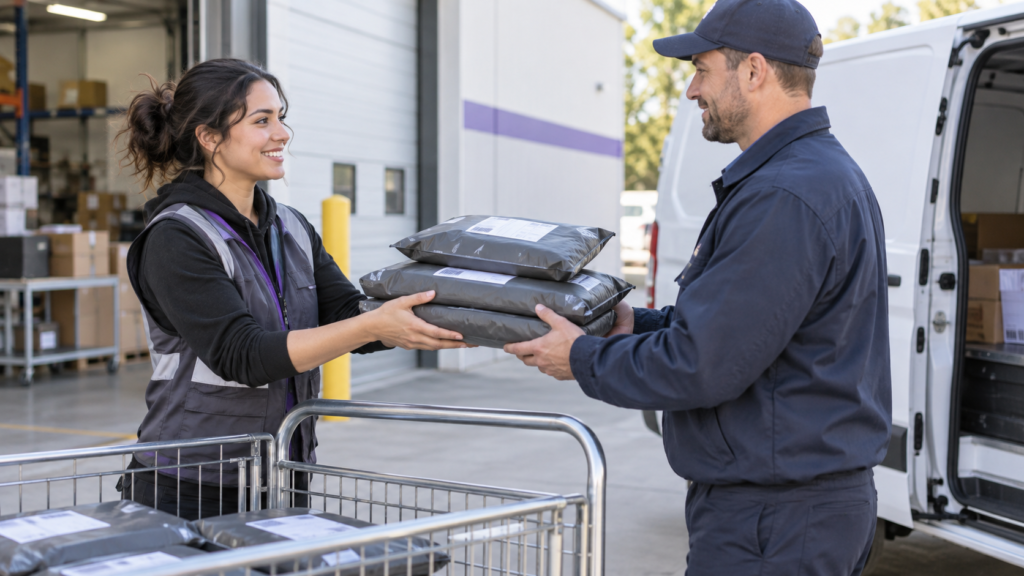
What Should Be Checked Before Carrier Handoff?
Use this checklist at the packing station or include it in your warehouse SOP.
Product
- The SKU, quantity, size, and color match the order.
- The product is clean, dry, and appropriately protected.
- Sharp components are covered or positioned away from the film.
- Loose straps, drawstrings, and hardware are secured.
Package
- The mailer fits without excessive tension or empty space.
- The contents do not shift significantly.
- The side seams are intact and not stretched.
- The adhesive flap is completely bonded.
- The parcel maintains a stable shape when turned.
Label and Postage
- The recipient and return details are correct
- The label is flat and fully attached.
- The barcode is visible and does not cross an edge.
- The finished weight and dimensions are accurate.
- The carrier service matches the parcel and contents.
Handoff Record
- The package count matches the shipment record or manifest.
- Restricted or unusual shipments are separated for review.
- The pickup, acceptance, or first-scan record is retained.
Build a Repeatable Poly Mailer Shipping Process
Shipping with poly mailers is reliable when the product, bag size, film strength, seal, label, final measurements, and carrier service work as one packaging system.For an occasional shipment, a final visual check may be enough. For a growing ecommerce operation, document the approved mailer for each SKU group, the packing method, the finished weight range, the label position, and the handoff procedure. That turns individual judgment into a process that can be trained, measured, and improved.If you are standardizing poly mailers across several products, test the folded product dimensions, packed weight, seal performance, and label adhesion before placing a bulk order. Contact RHK Packaging to discuss sizes, film thickness, closure options, printing, and production requirements.
FAQ
Can I ship a poly mailer through USPS?
Yes. The contents must be mailable, and the parcel must be properly packed, sealed, labeled, weighed, and entered under an eligible USPS service.
Do poly mailers need extra tape?
Good-quality self-sealing mailers normally do not need extra tape. Use reinforcement only when the closure is damaged or your tested packing specification requires it. Keep tape away from the barcode.
Can I put a shipping label directly on a poly mailer?
Yes. Apply it to a clean, flat area away from seams, folds, and the closure flap. Press all edges firmly.
Are poly mailers charged by weight or dimensions?
Pricing depends on the carrier service, destination, weight, dimensions, and package characteristics. Use the completed parcel’s measurements when calculating postage.
Can USPS pick up poly mailer packages?
Eligible parcels with appropriate prepaid postage may qualify for USPS Package Pickup. Availability and preparation requirements depend on the shipment and pickup address.
Ready to eliminate seal failures and size mismatches from your supply chain?
Planning to purchase poly mailers in bulk? Send us your size, thickness, quantity and destination requirements.Request a formal quote with your specifications. Response within 4 business hours.
RHK Packaging — ISO 9001:2015 Certified Manufacturer Since 2010
[email protected]