

The bottom line: Poly mailers save 15-20% on shipping costs for lightweight soft goods compared to boxes. For ecommerce businesses shipping 500 packages weekly, that difference can mean $15,000-$25,000 in annual savings.
If you are running an ecommerce business, you already know that shipping costs eat into your margins. What many sellers overlook is how much they are overpaying simply by choosing the wrong packaging. The decision between poly mailers and boxes is not just about protection. It is a direct profit margin question that most businesses have not calculated correctly.
This guide gives you the complete cost analysis you need. We break down material costs, carrier rates, DIM weight impacts, and real-world scenarios so you can make packaging decisions based on actual numbers, not guesswork.
The Short Answer: Yes, Poly Mailers Are Usually Cheaper to Ship
For lightweight items under 5 pounds, poly mailers consistently outperform boxes on total shipping cost. This is not a marginal difference. The savings come from two distinct sources: lower material costs and significantly reduced dimensional weight charges.
Material costs for poly mailers range from $0.15 to $0.25 per unit depending on size and thickness. A comparable corrugated box costs $0.45 to $3.00 per unit before you factor in tape, tissue paper, or void fill materials. For a business shipping 1,000 packages monthly, material savings alone can exceed $3,600 per year.
But the real money comes from dimensional weight pricing. Carriers charge based on the greater of actual weight or dimensional weight. A 12-by-12-by-8 inch box has a dimensional weight of roughly 4 pounds, regardless of what you actually ship inside. A poly mailer containing the same hoodie might measure 14-by-14-by-2 inches, resulting in a dimensional weight of just 1 pound. That difference directly translates to your shipping bill.
Key finding: For clothing and soft goods under 5 pounds, poly mailers deliver 15-20% total savings on shipping costs compared to boxes. The heavier or more rigid your product, the less advantage poly mailers provide.
The math is straightforward. A single hoodie shipped in a poly mailer costs approximately $4.50 via USPS Ground Advantage. The same hoodie in a shipping box costs $7.80. At 500 monthly shipments, that is $1,650 in monthly savings, or nearly $20,000 annually.
Direct Cost Comparison: Poly Mailers vs Boxes
Let us look at the complete cost picture. Material cost is only the starting point. True cost comparison requires accounting for all inputs: packaging materials, labor, storage space, and shipping charges.
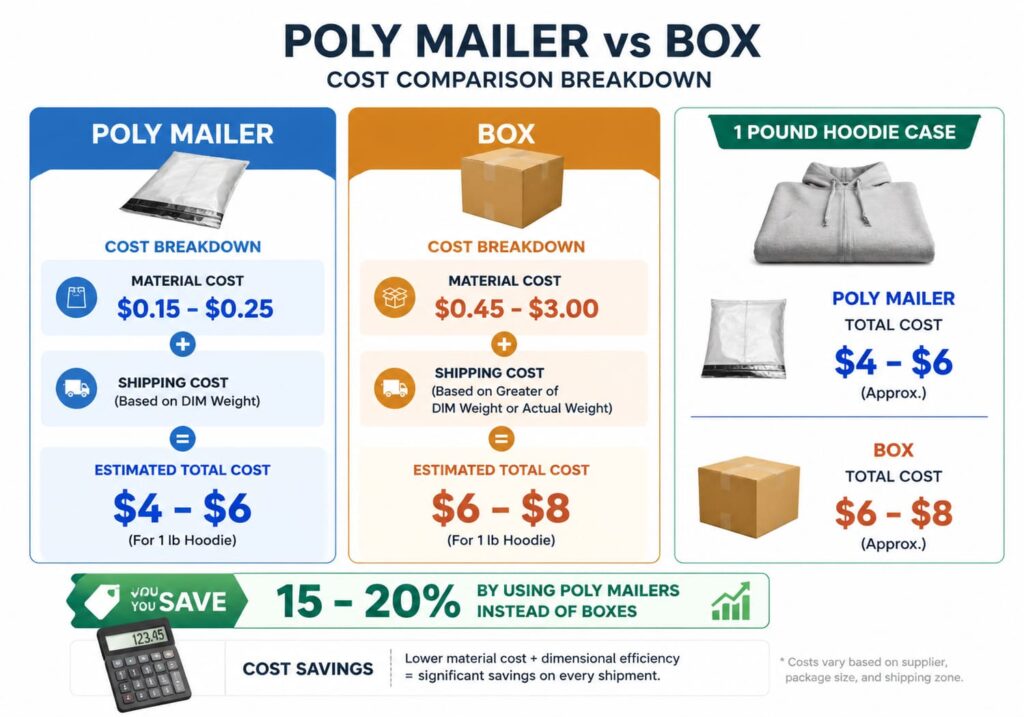
Material Cost Breakdown
| Cost Factor | Poly Mailer | Shipping Box |
|---|---|---|
| Packaging material cost | $0.15 – $0.25 | $0.45 – $3.00 |
| Tape / sealing cost | Included (self-seal) | $0.10 – $0.30 |
| Void fill / cushioning | Not needed for soft goods | $0.20 – $1.00 |
| Tissue paper / wrapping | Optional ($0.05-0.15) | Optional ($0.10-0.25) |
| Total material cost per shipment | $0.15 – $0.40 | $0.85 – $4.55 |
The self-sealing nature of poly mailers eliminates the need for packing tape entirely. This seems like a small detail until you calculate the per-shipment cost of tape rolls and the labor time spent sealing boxes.
Shipping Cost Impact: Real Scenario
Consider a realistic ecommerce scenario: shipping a 1-pound hoodie from New York to Los Angeles. This is one of the most common shipments for apparel businesses.
| Cost Element | Poly Mailer (14.5″ x 17.5″) | Shipping Box (8″ x 8″ x 6″) |
|---|---|---|
| Package dimensions | 14.5″ x 17.5″ x 2″ | 8″ x 8″ x 6″ |
| Actual weight | 1 lb | 1 lb |
| Dimensional weight | 1 lb (DIM divisor 166) | 2 lb (DIM divisor 166) |
| Billed weight | 1 lb | 2 lb |
| USPS Ground Advantage | $4.50 | $7.80 |
| UPS Ground | $9.85 | $14.25 |
| FedEx Ground | $10.20 | $14.85 |
The dimensional weight difference explains why boxes cost more even when shipping identical items. A more compact package literally costs less to move through carrier networks. That 4-inch height difference in this example results in double the dimensional weight for the box.
Cost insight: When using USPS Ground Advantage, the same 1-pound hoodie saves $3.30 per shipment in a poly mailer versus a box. For 500 monthly shipments, that is $1,650 in monthly savings. For 2,000 monthly shipments, you are looking at $6,600 monthly or nearly $80,000 annually.
Why Poly Mailers Win on DIM Weight
Dimensional weight, commonly called DIM weight, is a pricing formula carriers introduced to ensure packages are charged fairly relative to the space they occupy in trucks and planes. Understanding this concept is essential for making smart packaging decisions.
DIM Weight Formula: DIM Weight (lbs) = (Length x Width x Height) / DIM Divisor
Carriers compare actual weight against DIM weight and charge you for whichever is greater. This means a lightweight item in a large box gets charged at the box’s dimensional weight, not the item’s actual weight. For soft goods that compress easily, this pricing structure works heavily in favor of poly mailers.
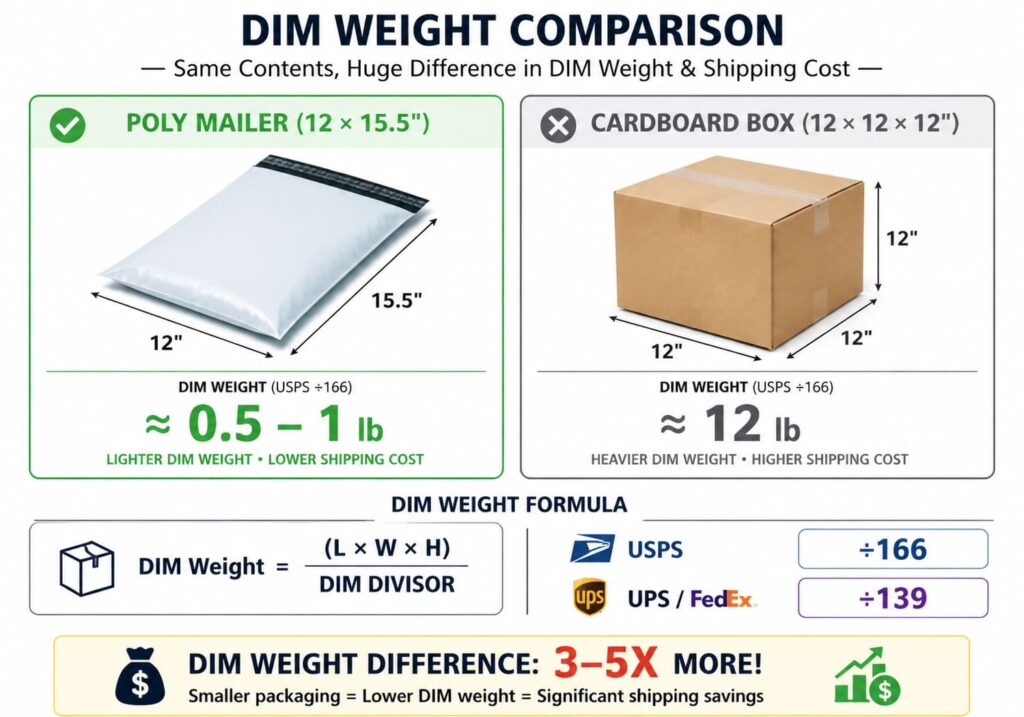
DIM Divisors by Carrier
| Carrier | DIM Divisor (Domestic) | Effect on Shipping Cost |
|---|---|---|
| USPS | 166 | Lower DIM weight, more favorable for smaller packages |
| UPS | 139 | Higher DIM weight, size matters significantly more |
| FedEx | 139 | Higher DIM weight, size matters significantly more |
Notice that UPS and FedEx use a divisor of 139, while USPS uses 166. This makes UPS and FedEx approximately 16% more sensitive to package dimensions. For those carriers, DIM weight optimization through poly mailers delivers even greater savings.
Calculating Your DIM Weight Savings
Let us walk through a practical example. Your customer orders a lightweight jacket that weighs 8 ounces (0.5 lbs) with packaging.
In a poly mailer: Package measures 14″ x 14″ x 1″ = 196 cubic inches. DIM weight = 196 / 166 = 1.18 lbs. Billed weight = 2 lbs (rounded up).
In a shipping box: Package measures 12″ x 10″ x 4″ = 480 cubic inches. DIM weight = 480 / 166 = 2.89 lbs. Billed weight = 3 lbs.
The box costs 50% more in shipping charges despite containing the exact same item. Poly mailers win on DIM weight every time for soft, compressible goods.
Important: DIM weight only applies to carrier pricing. USPS First Class Package Service (for packages under 15.999 oz) does not use DIM weight pricing. If you are shipping lightweight items under 1 pound, USPS First Class may be your most cost-effective option regardless of package size.
The key insight is that poly mailers allow soft goods to compress to their natural minimum dimensions. A hoodie folds flat. A stack of t-shirts compresses. A box, by definition, has fixed internal dimensions that create wasted space around compressible items.
Real-World Shipping Scenarios and Savings
Abstract percentages are useful, but real-world scenarios help you apply this information to your business. Here are common shipping situations and the actual savings you can expect.
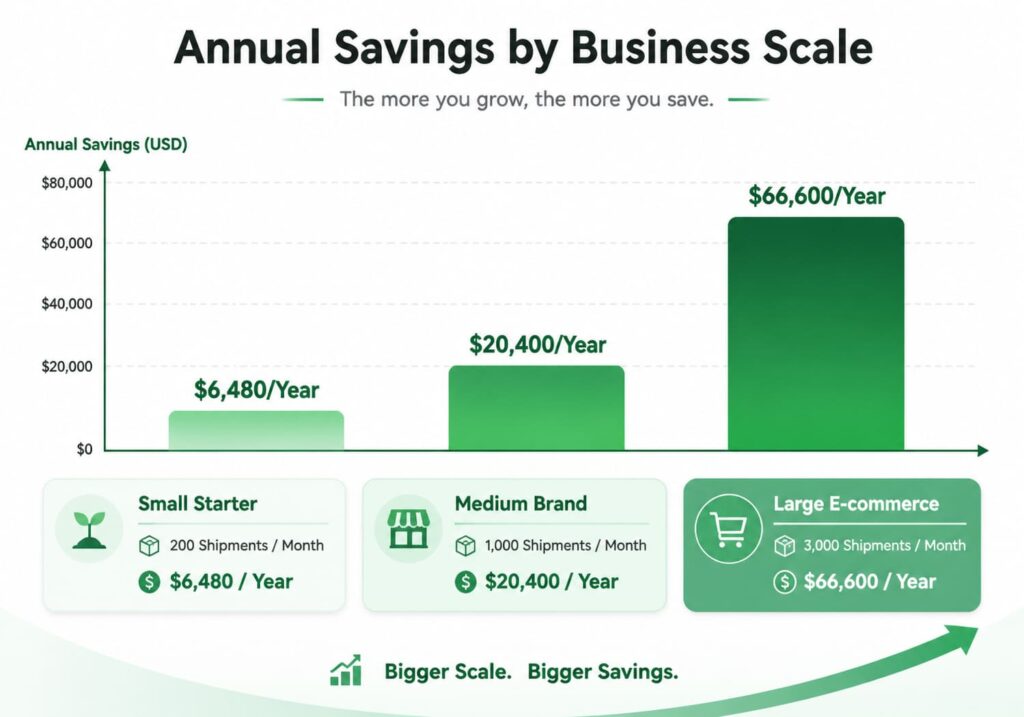
Scenario 1: Small Apparel Business (200 shipments/month)
You sell t-shirts and tank tops. Average shipment weight is 8 ounces. You ship primarily within your region (East Coast to East Coast).
Monthly Savings Calculation
Scenario 2: Medium Clothing Brand (1,000 shipments/month)
You sell a mix of shirts, hoodies, and accessories. Average shipment weight is 1.5 pounds. You ship nationally.
Monthly Savings Calculation
Scenario 3: Multi-Product Ecommerce (3,000 shipments/month)
You sell clothing, soft goods, and some accessories. Using a hybrid approach: 70% in poly mailers, 30% in boxes.
Monthly Savings Calculation
These calculations use conservative estimates. Your actual savings may be higher depending on your shipping distances, carrier negotiated rates, and product mix.
Pro tip: Use a shipping cost calculator like the one at ShippingEasy to calculate exact rates for your specific products, destinations, and carriers. Most carriers also offer rate calculators on their websites.
When Boxes Are the Better Choice
Poly mailers are not the right solution for every shipment. Understanding the specific conditions where boxes outperform poly mailers helps you make better decisions for each order and avoid costly shipping damage claims.
Items That Require Boxes
- Fragile items: Glassware, ceramics, cosmetics jars, and anything that could break under pressure. Poly mailers provide zero impact protection. External force transfers directly to contents.
- Electronics: Phones, tablets, small appliances, and electronics accessories require impact protection and often ship with manufacturer-specific packaging. Check out our guide on shipping supplies for appropriate protective options.
- Rigid or sharp items: Hard books with corners, tools, and items with edges that could puncture poly film.
- Heavy items over 5-10 pounds: Once items exceed certain weights, the dimensional weight advantage diminishes and box stacking strength becomes important for preventing damage during transit.
- Temperature-sensitive products: Poly mailers offer limited insulation compared to double-wall corrugated boxes.
- Items requiring presentation: Gift sets and premium unboxing experiences benefit from rigid boxes that enhance perceived value.
Weight Threshold Analysis
The 5-10 pound threshold is not arbitrary. Below this range, DIM weight typically determines your shipping cost, and poly mailers consistently win on compactness. Above this range, actual weight begins to dominate the cost equation, and boxes provide structural advantages that matter more.
| Item Weight | Recommended Packaging | Primary Reason |
|---|---|---|
| Under 1 lb | Poly mailer | DIM weight savings, material cost savings |
| 1-5 lbs | Poly mailer (soft goods) | DIM weight advantage, compressibility |
| 5-10 lbs | Evaluate case-by-case | DIM weight matters less, structure matters more |
| Over 10 lbs | Box | Stacking strength, weight distribution |
The Hybrid Approach
Most successful ecommerce businesses use both packaging types strategically. A hybrid approach typically saves 15-20% on the majority of shipments that qualify for poly mailers while maintaining appropriate protection for items that genuinely need boxes.
If you are currently shipping everything in boxes, audit your product catalog. For each SKU, ask:
- What is the actual weight?
- Is the item flexible or compressible?
- Does it require crush protection?
- What happens if the package is stacked under others?
Products that score well on flexibility and compressibility are your first candidates for switching to poly mailers. For guidance on selecting the right size, see our poly mailer size guide for hoodies or browse our complete poly mailer collection.
Tips for Maximizing Poly Mailer Savings
Switching to poly mailers is the first step. These optimization strategies help you extract the maximum savings from your poly mailer shipping program.
1. Right-Size Your Poly Mailers
Choosing the smallest poly mailer that fits your product accomplishes two things: it minimizes DIM weight charges and reduces material waste. A too-large poly mailer creates unnecessary volume that inflates your DIM weight calculation.
Measure your actual products in their shipping configuration. Fold items as they will ship, not as they appear on a hanger. Then add a small margin for the sealing flap. Most apparel falls into the 10″ x 13″ to 15″ x 18″ range.
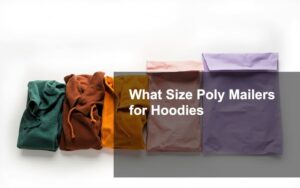
Quick reference: T-shirts and tank tops typically fit in 10″ x 13″ or 12″ x 15.5″ mailers. Hoodies and sweatshirts usually need 14.5″ x 17.5″ or 15″ x 18″ mailers. Pants and longer items may require 15″ x 18″ or larger. View our complete size guide for hoodies for detailed measurements.
2. Use USPS Ground Advantage for Lightweight Shipments
USPS Ground Advantage consistently undercuts UPS and FedEx for packages under 5 pounds. The lower DIM divisor (166 vs 139) means smaller packages are penalized less, and USPS retail rates are already competitive.
If you are using UPS or FedEx because of established accounts or negotiated rates, recalculate. Many businesses discover they can save significantly by routing lightweight packages through USPS while keeping heavier shipments on their existing carrier accounts.
3. Buy Poly Mailers in Bulk
Like most packaging materials, poly mailers offer significant volume discounts. Buying in quantities of 1,000 or more typically reduces per-unit cost by 20-40% compared to small quantities. For high-volume shippers, custom printed poly mailers become cost-effective at 5,000+ units and offer branding benefits alongside material savings.
4. Implement a Hybrid Packaging System
Develop clear criteria for when each packaging type applies. Train your fulfillment team on the decision tree so poly mailer eligibility is consistently applied across your product catalog.
A practical hybrid system might look like:
- Category A (Poly mailer eligible): T-shirts, hoodies, leggings, underwear, socks, scarves, soft toys, fabric accessories
- Category B (Box required): Electronics, fragile items, heavy items over 5 pounds, rigid items, gift sets
5. Audit High-Volume SKUs Quarterly
Your product catalog changes over time. New products enter your lineup. Existing products get redesigned or repackaged. Quarterly audits ensure your packaging choices stay optimized as your business evolves.
Focus on your top 20 SKUs by shipment volume. These represent the majority of your shipping costs. Even small optimizations on high-volume items compound into significant annual savings.
6. Consider Regional Carriers for High-Volume Lanes
Regional carriers like OnTrac, LSO, and Courier Express offer lower rates in specific geographic lanes. If you have concentrated customer bases in certain regions, regional carriers can offer 20-30% savings compared to national carriers for those shipments.
Frequently Asked Questions
Are poly mailers really cheaper to ship than boxes?
Yes, for lightweight items under 5 pounds, poly mailers save 15-20% on total shipping costs compared to boxes. This savings comes from lower material costs ($0.15-0.25 vs $0.85-4.55 per shipment) and reduced DIM weight charges from more compact package dimensions. For a typical 1-pound clothing shipment, that means saving $3.30 per package on USPS Ground Advantage alone.
How much can I save by using poly mailers instead of boxes?
For a typical 1-pound clothing shipment, poly mailers save $3.30 per shipment with USPS Ground Advantage. At 500 monthly shipments, that equals $1,650 in monthly savings or nearly $20,000 annually. Material costs alone save 60-80% compared to boxes with tape and void fill included. Larger volumes scale proportionally.
What is the DIM weight advantage of poly mailers?
Poly mailers reduce DIM weight by 20-40% compared to boxes containing the same item. A poly mailer with 14.5″ x 17.5″ x 2″ dimensions has a DIM weight of 1 pound, while an 8″ x 8″ x 6″ box containing the same item has a DIM weight of 2 pounds. Since carriers charge the greater of actual or DIM weight, this directly impacts your shipping bill. The savings are even larger with UPS and FedEx due to their stricter DIM divisor of 139.
What items should not be shipped in poly mailers?
Do not ship fragile items including glassware, ceramics, cosmetics jars, electronics, items over 5-10 pounds, rigid items with sharp edges, temperature-sensitive products, or anything requiring crush protection in poly mailers. These items need the structural integrity and cushioning that only boxes provide. Shipping fragile items in poly mailers typically results in damage claims that far exceed any shipping cost savings.
Which carrier is cheapest for poly mailer shipments?
USPS Ground Advantage offers the lowest rates for poly mailer shipments under 5 pounds, typically around $4.50 for a 1-pound cross-country shipment. UPS Ground and FedEx Ground cost approximately 2x more for equivalent lightweight shipments but use a stricter DIM weight divisor (139 vs 166), making size optimization even more valuable with those carriers. For high-volume shippers, negotiating rates with USPS can unlock additional savings.
How do I maximize savings with poly mailers?
Maximize poly mailer savings by: 1) choosing the smallest size that fits your product to minimize DIM weight, 2) using USPS Ground Advantage for shipments under 5 pounds, 3) adopting a hybrid strategy using poly mailers for soft goods and boxes for fragile or heavy items, 4) buying poly mailers in bulk for lower per-unit costs, and 5) regularly auditing high-volume SKUs to identify new poly mailer candidates. Our detailed comparison guide covers additional optimization strategies.
Are poly mailers suitable for shipping hoodies and sweatshirts?
Yes, hoodies and sweatshirts are ideal for poly mailer shipping. They are lightweight (typically 0.5-2 pounds), flexible, compress easily, and do not require crush protection. A 14.5″ x 17.5″ or 15″ x 18″ poly mailer accommodates most adult hoodie sizes. This is one of the most common and cost-effective uses for poly mailers in ecommerce. See our size guide for shipping hoodies for specific recommendations.
What is the weight limit for poly mailer shipping?
Poly mailers work best for items under 5 pounds. Above 5-10 pounds, the DIM weight advantage diminishes and box stacking strength becomes more important for preventing damage during transit. Most carriers limit poly mailers to 70 pounds maximum, but practical shipping economics make boxes the better choice for heavy or dense items regardless of actual weight. If you need to ship heavy items, browse our shipping supplies for appropriate box options.
Ready to eliminate seal failures and size mismatches from your supply chain?
Request a formal quote with your specifications. Response within 4 business hours.
RHK Packaging — ISO 9001:2015 Certified Manufacturer Since 2010
[email protected]