


When buyers ask us whether poly mailers are waterproof, they are usually not asking about the film alone. What they really want to know is whether the products inside will stay dry when the package encounters rain, wet loading areas or rough transportation.
That is a very reasonable question. A poly mailer may look simple, but its actual moisture protection depends on several parts working together. The film needs to remain intact, the seams need to be properly sealed, and the adhesive flap needs to close evenly. The bag also needs to be the right size for the product inside.
The short answer is that most PE poly mailers are water-resistant, but they should not automatically be described as completely waterproof.
An intact poly mailer can normally handle light rain, splashes and brief contact with a damp surface. However, if the bag is punctured, the adhesive area is not fully closed or a seam is damaged, water may still reach the product.
That does not make poly mailers unsuitable for shipping. It simply means we need to describe their protection accurately. For clothing and many other soft products, a well-made and correctly packed poly mailer provides the level of moisture protection needed for ordinary ecommerce transportation.
Are Poly Mailers Waterproof or Water-Resistant?
“Waterproof” and “water-resistant” are often used as if they mean the same thing. From a buyer’s point of view, however, they can create very different expectations.
A water-resistant mailer is designed to resist ordinary exposure to moisture. For example, a courier may carry the parcel through light rain, the package may sit briefly on a damp loading platform, or water may splash onto it while goods are being transferred between vehicles.
If the bag remains intact and properly sealed, this type of exposure should not normally allow water to pass directly through the PE film.
“Waterproof” suggests a much stronger level of protection. A buyer may understand it to mean that the package can remain in heavy rain for a long time, sit in standing water or even be submerged without allowing any water inside.
That level of performance cannot be assumed simply because the bag is made from polyethylene.
The film may resist liquid water, but the finished package still has an opening, seams and a closure. Water may also travel through a small gap created by a wrinkle or a piece of fabric caught in the adhesive area. If the bag is damaged during transit, the original properties of the film cannot protect the punctured area.
There is also a difference between liquid water and humidity. A poly mailer can protect a garment from rain without functioning as controlled moisture-barrier packaging for long-term storage. Products with strict humidity requirements may need a specialised inner barrier, desiccant or a different packaging system.
This is why we normally use “water-resistant” when discussing standard poly mailers. It is not weaker marketing language. It is a more accurate description of how the package performs in normal shipping conditions.
Why Can PE Film Resist Water?
Most conventional poly mailers are made from polyethylene film. Unlike ordinary paper, polyethylene does not readily absorb liquid water. When rain lands on an intact PE surface, it normally stays on the outside, forms droplets or runs off the bag.
Paper packaging behaves differently. Once an uncoated paper surface absorbs water, it can soften, lose strength or transfer moisture toward the contents. PE film provides a useful external barrier because the material itself does not respond to water in the same way.
This is one reason poly mailers are widely used for clothing, textiles, accessories and other non-fragile products. The film is lightweight and flexible, and it can wrap closely around soft goods without adding the weight and storage volume of a box.
However, buyers should not judge the entire package from the film alone.
A completed poly mailer includes the main bag body, heat-sealed edges, an adhesive strip and a closing flap. Depending on the design, it may also include a second adhesive strip, a perforated opening or a gusset.
All these parts need to work together. A good film with a poorly closed flap will not provide reliable protection. In the same way, a strong adhesive cannot compensate for a hole created by a sharp product corner.
The actual shipping environment also matters. A mailer that performs well during normal parcel delivery may not be suitable for outdoor storage, open-truck transportation or repeated exposure to heavy rain. The buyer and manufacturer should discuss the expected conditions instead of relying only on the word “waterproof.”
Where Can Water Enter a Poly Mailer?
When a product arrives wet, people sometimes assume that water passed through the plastic. In practice, the entry point is often the closure, a seam or an area damaged during transportation.
The adhesive closure is the first place to inspect. The adhesive strip needs clean and even contact across the entire opening. Dust, fabric fibres, release-liner fragments and deep wrinkles can prevent part of the adhesive from touching the opposite surface.
Overfilling is another common problem. A buyer may choose a smaller bag to reduce material use or shipping volume, but the packed product can place continuous pressure on the flap. Even if the bag can technically be closed, the adhesive area may be pulled at an angle.
This is especially common with thick hoodies, jackets, multiple garments and products packed with tissue paper or cards. The items may fit inside the bag, but there may not be enough remaining space to form a relaxed, flat closure.
Water can also enter through damaged seams. The seams may be placed under additional stress when the bag is too small, when the contents are heavy or when the product has a rigid shape. A seam that appears normal on an empty sample may behave differently after the bag has been filled.
Punctures are another major risk. Metal zippers, buttons, buckles, sharp corners and rigid retail boxes can press against the film from inside. On the outside, the parcel may rub against conveyors, cages, pallets and other packages.
A small puncture may not cause the product to fall out, so it can easily go unnoticed. However, that small opening may still allow water or dirt to enter.
The final risk is the way the parcel is opened and inspected. If the outside of a wet package is not wiped before opening, water may drip from the flap into the bag. This can make it look as though the mailer leaked when the water actually entered during inspection.

Does Thickness Make a Poly Mailer More Waterproof?
Thickness can influence the durability of a poly mailer, but it should not be treated as the only measure of water protection.
A thicker or more suitable film may be less likely to tear or puncture during normal handling. This can indirectly improve moisture protection because an undamaged bag has fewer places for water to enter.
However, thickness does not repair a poor closure. If the flap is wrinkled or the adhesive area is contaminated, water may enter no matter how thick the main film is.
Thickness also cannot correct the wrong bag size. A thick mailer that is stretched tightly around a bulky product may place more stress on its seams and closure than a correctly sized bag made with a suitable film.
There is another practical point: the thickest available film is not automatically the best purchasing choice. A heavier film may increase material use and unit cost without solving the actual packaging problem.
If the product is a soft T-shirt with no sharp parts, the main requirement may be a properly sized bag with a reliable closure. If the product contains zippers, metal accessories or rigid corners, puncture resistance may deserve more attention.
The right decision comes from matching the bag to the product. Instead of asking only, “How thick is the bag?” it is more useful to ask:
- What is going inside?
- How heavy is the packed product?
- Does it have sharp or rigid parts?
- How tightly will it fill the bag?
- What transportation conditions will it experience?
This gives the manufacturer enough information to recommend a practical structure instead of simply offering the thickest option.
How Size and Packing Affect Water Protection
Size is sometimes treated as a separate purchasing question, but it directly affects the way a mailer performs.
If the bag is too small, the product may stretch the film and pull against the seams. The flap may reach the adhesive area only when the buyer pushes down firmly on the contents. Once the pressure is released, the product may push back against the closure.
If the bag is much too large, the opening may form deep folds. The warehouse team may fold excess material over itself, creating uneven layers around the adhesive strip. These folds can leave small channels where water can travel.
The correct size is not based only on the product’s flat length and width. Thickness takes up usable space in a flat mailer. A folded hoodie, for example, may have a modest width and length but still require a larger bag because of its depth.
Additional packaging also changes the fit. Tissue paper, product bags, instruction cards, return documents and promotional inserts may look thin individually, but together they can make the final package noticeably fuller.
For this reason, buyers should measure the product in its actual shipping configuration. Fold it as the fulfilment team will fold it. Add the normal inner packaging and inserts. Then place it inside a sample mailer and check whether the flap closes without pulling.
A package that closes comfortably and lies relatively flat is easier to seal consistently. That consistency is more useful than choosing a size based only on a generic chart.
Does Custom Printing Affect Water Resistance?
Custom printing and water resistance are related, but not in the way buyers sometimes expect.
Printing a logo on the outside of a poly mailer does not normally create openings in the film. The bag can still resist ordinary rain and splashes when the film, seams and closure remain intact.
However, the appearance of the printed area is a separate issue. Moisture, friction and handling may affect how the print looks, especially when the package rubs against equipment or other parcels.
This is why a buyer should not check only whether the inside remains dry. The printed surface should also be inspected after the sample has been handled and exposed to moisture.
Pay attention to areas with large blocks of colour, fine text or important brand details. If colour accuracy and logo appearance matter, review the actual printed sample rather than judging from a digital artwork file.
The printing method, number of colours, printed area and logo requirements also affect the quotation. A simple one-colour logo and a design covering most of the bag are not the same production job.
The best approach is to send the artwork together with the product and packaging requirements. That allows the factory to consider printing, bag size and final use as one complete project.
Which Products Can Be Shipped in a Poly Mailer?
Poly mailers are best suited to products that are soft, lightweight, non-fragile and not easily damaged by compression.
Clothing is the most common example. T-shirts, trousers, dresses, lightweight sweaters and other folded garments can often be shipped efficiently in a correctly sized poly mailer.
Textiles and soft accessories may also be suitable. However, the buyer still needs to check for hard buckles, metal decorations, sharp zippers or other components that could damage the film.
A product can fit inside the bag and still be unsuitable for it. Fit only tells us that there is enough space. It does not tell us whether the mailer provides the cushioning, stiffness or impact protection the product needs.
Fragile items, sharp products and goods that must not bend usually need another packaging structure. A poly mailer is a flexible outer package, so it follows the shape of the contents rather than protecting them with rigid walls.
Documents, books and photographs require individual consideration. The mailer can help protect them from rain, but it may not prevent bending. A rigid insert, internal sleeve or stronger outer package may be needed.
Products with strict moisture requirements may also need an inner barrier. If a small amount of water, humidity or condensation could cause serious damage, a standard outer mailer should not be the only protective layer.
When deciding, ask two separate questions:
- Can the product physically fit in the mailer?
- Does the mailer protect the product against its most likely risks?
Both answers need to be yes.
When Should You Add an Inner Bag?
An inner bag is not required for every shipment, but it can provide another layer of protection when the product is sensitive or valuable.
Premium garments are one example. Even if the outer mailer becomes dirty or slightly damaged, the inner bag can help keep the product clean and separated from the external packaging.
White and light-coloured fabrics may also benefit from inner protection. These products make small marks, moisture stains and dirt easier to notice.
For documents, printed materials and photographs, an inner sleeve can reduce the risk of direct moisture contact. If bending is also a concern, the sleeve may need to be combined with a rigid insert.
An inner bag can also be useful when several items are shipped together. Separating them helps prevent metal parts, zippers or accessories from rubbing directly against another product or the outer mailer.
However, more packaging is not automatically better. Each extra layer adds material, cost and packing time. The choice should come from the product risk, not simply from habit.
If the product is low-risk and the outer mailer is correctly sized and tested, an additional plastic layer may not be necessary. If the product is expensive, moisture-sensitive or expected to travel through difficult conditions, the extra protection may be justified.
How to Test a Poly Mailer Sample
A useful test should reproduce the way the mailer will actually be used. Testing an empty bag tells you very little about how it will perform after packing.
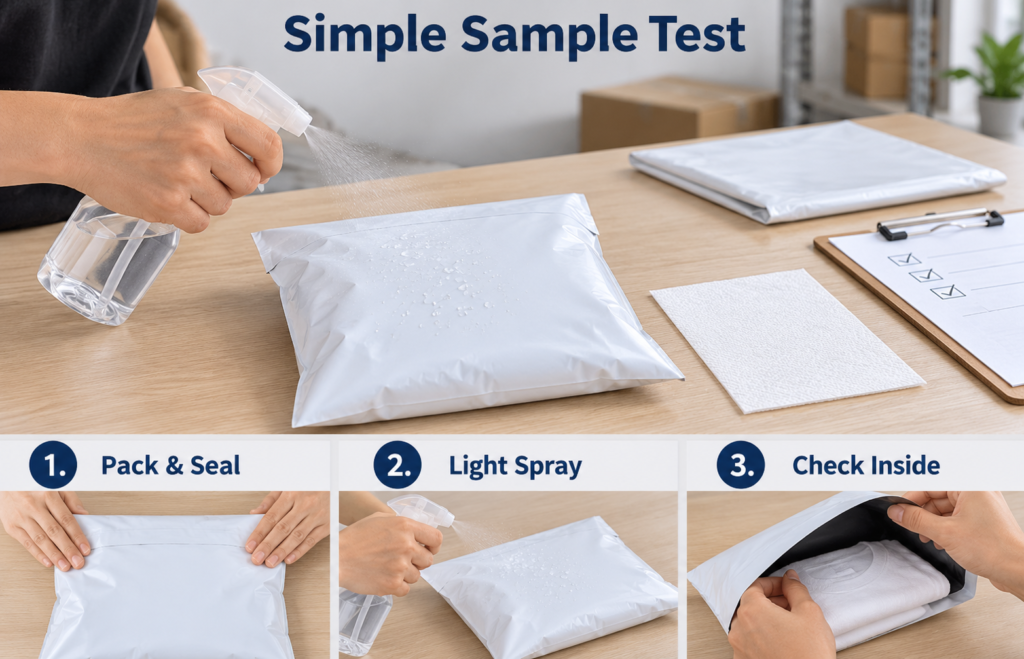
Start with the real product. Fold or arrange it exactly as the warehouse team will. Include the normal inner bag, tissue paper, cards, labels and other inserts.
Place the packed product into the sample mailer and observe how easily it fits. You should not need to force the product through the opening or pull the flap aggressively.
Before sealing, inspect the adhesive area. Make sure it is clean and free from fibres or dust. Remove the release liner and press the flap down evenly across the full width.
Now look at the completed package. Is the closure flat? Are the seams being pulled? Is a zipper, buckle or corner pressing hard against one small area of film?
For a simple moisture check, place dry absorbent paper inside the package. Apply a light spray from several directions to simulate short exposure to rain or splashing.
Do not open the bag immediately while the outside is still wet. Wipe the exterior first, especially around the flap. Otherwise, water may drip inside during opening and create a false failure.
Check the absorbent paper, internal seams and area behind the closure. Record where any moisture appears instead of simply marking the whole bag as “passed” or “failed.”
The next step is to repeat the test after handling. Move, compress and lightly rub the packed sample to represent ordinary warehouse and transportation activity. Then perform the moisture check again.
Use several samples. Testing only one bag may miss inconsistent seams, adhesive application or occasional defects.
Common Misunderstandings About Waterproof Poly Mailers
One common misunderstanding is that a plastic-looking material must be completely waterproof. The material may resist water, but the completed package can still have vulnerable areas.
Another misunderstanding is that a thicker bag is always better. Thickness can improve durability, but the correct size, closure and product compatibility may have a greater effect on actual performance.
Some buyers also assume that adding tape around the outside will solve every sealing problem. Tape may provide additional security in certain situations, but it should not be used to hide an unsuitable bag size or an unreliable original closure.
There is also a belief that passing one spray test proves the whole production batch is waterproof. A single sample shows only how that particular bag performed under that particular test.
Finally, water resistance should not be confused with product protection in general. A bag can keep out rain and still provide no meaningful protection against crushing, bending or impact.
The most reliable packaging decision considers moisture, punctures, compression, handling and presentation together.
What Information Should You Send to the Manufacturer?
“Please quote a waterproof poly mailer” is not enough information for an accurate recommendation or quotation.
Start with the product. Tell the manufacturer what will be packed, whether it is soft or rigid, and whether it includes sharp corners, zippers or metal parts.
Provide the dimensions after packing, not only the retail product dimensions. If you plan to use tissue paper, an inner bag or promotional inserts, include them when measuring.
Explain the expected shipping environment. Protection from brief rain during normal delivery is different from outdoor storage or repeated exposure to wet conditions.
You should also provide the required quantity, printing method, number of print colours and custom logo requirements. These elements all affect the quotation.
At RHK, the MOQ for custom poly mailers starts from 100 pieces. Ordering a larger quantity generally results in a lower unit price because the setup and production costs are divided across more bags.
After the order is confirmed, a sample can be arranged for checking. The normal production time is approximately 7–10 days, excluding transportation time.
A useful inquiry can include:
- Product type
- Packed dimensions
- Approximate packed weight
- Required bag size
- Order quantity
- Printing requirements
- Number of print colours
- Logo or artwork file
- Expected shipping conditions
- Required moisture protection
- Whether an inner bag will be used
The more clearly you describe the real application, the easier it is for the factory to recommend an appropriate bag.
Final Answer
Poly mailers are generally water-resistant rather than completely waterproof.
The PE film can provide useful protection against light rain, splashes and short contact with damp surfaces. However, the finished package also depends on the seams, adhesive closure, bag size and condition of the film.
A well-made bag can still fail if it is too small, overfilled, poorly sealed or punctured by the product inside. A thicker bag may improve durability, but it cannot solve every packaging problem.
For clothing and other soft, non-fragile products, a correctly selected poly mailer can provide practical everyday moisture protection. Products that are fragile, sharp, valuable or highly sensitive to moisture may need an inner bag, protective insert or different outer packaging.
The best approach is to test the actual packed product instead of relying on a general claim. Use the real product, normal inserts and several samples. Check the closure, seams, fit, printed surface and internal condition after handling and light moisture exposure.
If you are unsure which structure is suitable, send us the packed product dimensions, quantity and printing requirements. We can discuss the options with you before production and help you choose a bag that fits the real shipping situation.
Frequently Asked Questions
Are poly mailers completely waterproof?
Most standard poly mailers should be described as water-resistant. They can resist ordinary rain and splashes, but the entire package is not automatically suitable for prolonged water exposure or submersion.
Can rain get inside a poly mailer?
Yes. Water may enter if the closure is incomplete, the seams are damaged or the film has been punctured. A correctly sized and properly sealed bag provides better protection.
Does a thicker poly mailer provide better water protection?
A thicker film may reduce the risk of tears and punctures, but it does not correct a poor seal, incorrect size or damaged seam.
Do clothes need an inner bag?
Not all garments require one. An inner bag may be useful for premium clothing, light-coloured fabrics, long-distance shipping or products that must remain particularly clean and dry.
Can custom printed poly mailers resist rain?
Pack the actual product, seal the bag normally and place dry absorbent paper inside. Perform a light spray test, wipe the exterior before opening and inspect the closure, seams and internal paper. Repeat the test with several samples.
Ready to eliminate seal failures and size mismatches from your supply chain?
Planning to purchase poly mailers in bulk? Send us your size, thickness, quantity and destination requirements.Request a formal quote with your specifications. Response within 4 business hours.
RHK Packaging — ISO 9001:2015 Certified Manufacturer Since 2010
[email protected]