


If your store sells twelve products, do you need twelve different poly mailer sizes? Usually, no. Products with similar packed dimensions can often share the same mailer, so the number of bag sizes you need is normally much smaller than the number of SKUs you sell. However, putting every product into one large bag is not a perfect solution either. A phone case and a winter hoodie may both fit inside the same oversized mailer, but that does not mean the finished parcels will look good, seal easily or move through the packing station in the same way.
The practical answer sits somewhere in the middle. Start with each product after it has been fully prepared for shipping, group together items with similar packed dimensions, and choose one tested mailer size for each meaningful group. The aim is not to create a perfect individual bag for every SKU. It is to build a small size system that purchasing can manage, warehouse employees can understand and products can use comfortably.
There is no universal answer such as “every ecommerce business needs exactly three sizes.” A small apparel brand may work well with one or two core options, while a store selling accessories, boxed products, lightweight clothing and bulky garments may need more. In this guide, we will look at how to find the right number for your own catalog instead of starting with an arbitrary number.
Why One Size—and Too Many Sizes—Can Both Create Problems
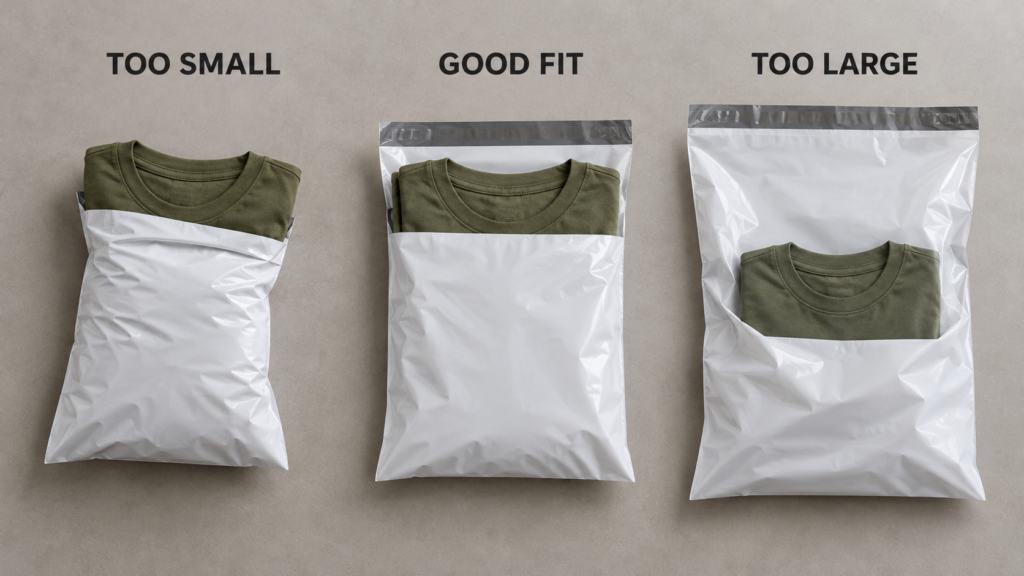
Using one mailer for everything sounds wonderfully simple at first. The purchasing team orders one specification, the warehouse stores one item and every employee reaches for the same bag. The problem normally appears after the product goes inside. A small product placed in an oversized mailer can move around, gather the film into loose folds and leave the shipping label sitting on an uneven surface. A carefully positioned logo may also appear off-center after the film folds around the product. The business may also be using more packaging material than the order actually needs. A T-shirt does not need to travel inside a mailer large enough for a winter coat simply because both products technically fit.
An undersized mailer creates the opposite problem. The operator may need to force the product through the opening, firm corners can pull tightly against the film, and side seals may carry unnecessary tension. There may also be too little material above the product to close the flap comfortably. These issues become more noticeable when the same packing action is repeated throughout the day. If every order feels like a small wrestling match between the employee, the product and the bag, the size needs another look.
One size can also make packing inconsistent. A flexible garment may be folded differently each time to make it fit, while small products may be placed at different positions inside the same large bag. Different employees start developing their own methods, so two customers ordering the same item may receive parcels that look noticeably different. What appeared to be a simple one-size system has actually moved the complexity from purchasing into the warehouse.
The opposite extreme—keeping too many sizes—creates another type of work. Every additional size becomes another stock item to count, reorder and store. Purchasing quantities are divided across several specifications, low-volume sizes may remain on the shelf for a long time, and warehouse employees must choose between bags that sometimes differ by only a small amount. Custom printed mailers can add another layer because each size may require a corresponding artwork version, print-position review and quantity decision.
This is why the goal is not “use as few sizes as possible” or “give every product its own perfect bag.” The goal is to keep only the sizes that solve a repeated, meaningful packing need. A useful size should cover a real group of products, be used often enough to justify its inventory and noticeably improve the packing result. If it cannot meet those conditions, the business may be managing an extra specification without receiving much value from it.
Measure the Final Parcel and Build Practical Product Groups
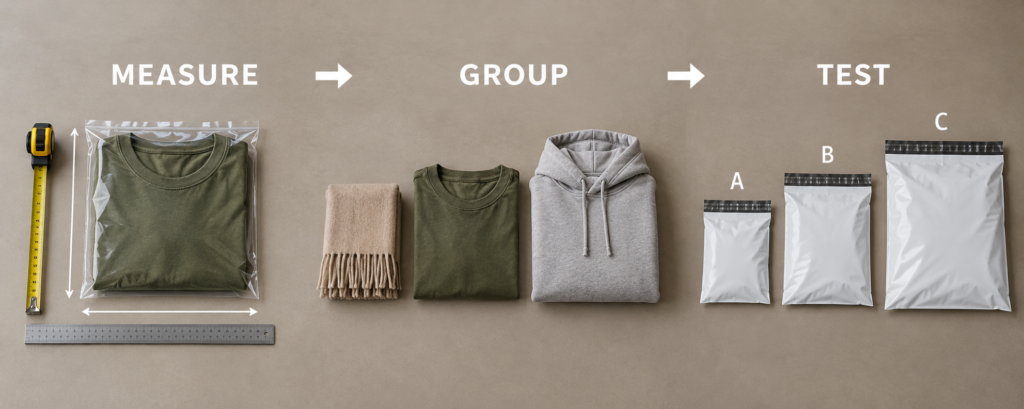
Many incorrect size decisions begin with the right measurement taken at the wrong stage. A buyer provides the dimensions of the product itself, while the warehouse actually ships something larger. A folded shirt may also include an inner bag, hangtag, tissue paper and instruction card. A small accessory may be placed inside a retail box before it enters the mailer. All of those items count because they occupy space inside the final parcel. The useful measurement is therefore not the product listing size; it is the size after the product has been prepared exactly as it will leave the warehouse.
For each SKU, record the packed width, packed length and packed thickness. Also note firm corners, protruding parts and anything else that may press against the film. Keep the packing method consistent while measuring. If one employee folds a garment into a narrow rectangle and another folds it into a wide square, the same SKU can appear to require two different mailer sizes even though the real problem is the folding method. Standardizing the internal packing step makes the size data much more reliable.
Thickness deserves particular attention because a poly mailer is measured flat, while the product inside it is three-dimensional. As the film wraps around a thick product, part of the listed width and length is used to cover the product’s depth. That is why a mailer can appear suitable on a flat size chart and still feel tight in real use. Hard corners and retail boxes also behave differently from soft garments, even when their flat width and length look similar.
Once the measurements are ready, place them into a simple spreadsheet with the SKU, product name, packed width, packed length, packed thickness and common order type. Natural groups often become visible when all the products appear in one place. Several lightweight items may finish at similar dimensions, standard garments may form another group, and bulky products or common multi-item orders may form a third. Product names matter less than the final packed shape.
The boundaries between groups do not need to be mathematically perfect. The aim is to identify products that can use the same mailer without creating obvious empty space or making the bag difficult to close. If two products differ slightly but both pack comfortably in one tested mailer, they can probably stay together. If one item consistently stretches the bag while the others fit comfortably, it may belong in the next group. Grouping should simplify the system without hiding a genuine fit problem.
Avoid creating a new custom size for every small difference. A separate size may make one low-volume product look slightly neater, but it also creates another inventory item and may split the order quantity across more specifications. Before adding it, ask whether the improvement will be seen regularly in real orders or only occasionally in a product photograph. A practical size system is built around repeated warehouse needs, not tiny differences that exist only on a spreadsheet.
Decide the Number of Core Sizes from Real Order Patterns
After the product groups are visible, you can begin deciding how many core mailer sizes are practical. A business selling only a few soft products with similar packed dimensions may work well with one core size. Two or three sizes may be more useful when the catalog clearly separates into small, regular and bulky products, or when orders often include both single items and common two-item combinations. More sizes may be justified when the catalog covers a wide range of dimensions, the product shapes differ significantly, or some items use retail boxes while others are folded and flexible.
Do not begin with a target number. Instead, test whether each proposed size solves a repeated need. Ask how many common products it covers, how frequently it will be used, whether warehouse employees can identify it quickly and whether the stock will move often enough to justify keeping it. Also ask whether it improves packing enough to deserve a separate specification. If a new size is used only for one slow-moving SKU and produces very little operational improvement, the extra inventory may not be worthwhile.
Multi-item orders must be included in this decision. A system designed only around single-item orders may fail as soon as a customer buys two products. Review the order history to identify the percentage of single-item orders, common pairs, regular bundles and unusually large orders. You may discover that the largest existing core mailer already handles the most frequent two-item combinations, which removes the need for a dedicated bundle size.
For combinations that appear only a few times per year, storing a large quantity of dedicated custom mailers may not make sense. Depending on the product and protection requirements, an existing larger mailer or a box may be more practical. The inventory plan should support orders that regularly reach the warehouse, not every combination that could theoretically occur. Otherwise, the company can end up holding packaging for situations that almost never happen.
The final choice is a balance between product fit and inventory simplicity. Too few sizes push the difficulty into daily packing; too many sizes push the difficulty into purchasing, storage and stock control. The right set is usually the smallest one that handles normal orders without forcing employees to improvise. That set may change as the catalog grows, sales patterns shift or a previously small product category becomes more important.
This is why a size system should be reviewed rather than treated as permanent. A mailer that was useful during a launch may become unnecessary after the product line changes, while a growing group of SKUs may eventually justify a separate size. Use actual consumption, packing feedback and remaining inventory to make that decision. The goal is not to keep the original plan forever; it is to keep the plan useful.
Test Each Size and Turn It into a Warehouse System
A size should not be approved from a spreadsheet alone. Test it with the actual products assigned to the group. Prepare each product using the normal folding method and internal packaging, insert it into the candidate mailer, close the flap and apply the shipping label. Check how easily the product enters, how much space remains, whether firm corners pull against the film, whether the flap closes comfortably and whether the finished parcel gives the label a reasonably flat surface.
Do not test only the largest product in the group. A bag may fit the largest item well but look unnecessarily loose around the smallest one. Test both ends of the group and at least one typical product in the middle. If the size is also intended for common two-item orders, test those exact combinations rather than assuming that two products will fit because one fits easily.
The warehouse team should take part in the test. A buyer may look at a packed sample and decide that it appears acceptable, while the person responsible for packing 200 orders notices that the opening is awkward, the product catches on the edge or the flap leaves very little working space. These are not minor details when the process is repeated throughout the day. An empty mailer tells you its flat dimensions; a packed mailer and a real operator tell you whether it works.
For custom printed mailers, look at the design after the product has been inserted. A logo that appears centered on a flat bag may shift when the film wraps around a thick item. Check where the shipping label will be applied and make sure it does not cover important artwork or sit across heavy folds. The size decision and the artwork decision should support each other because the finished parcel is what the customer will actually see.
Once the sizes are approved, create a simple SKU-to-mailer map showing the product group, approved mailer, packing method and common order type. This document helps train new employees, keeps packaging consistent and makes inventory planning easier. When a new SKU is introduced, the team can test whether it belongs to an existing group before creating another custom specification. The system should live in a shared document, not only in one experienced employee’s memory.
Review the map when products, internal packaging or order patterns change. If employees repeatedly ignore the documented size and choose another bag, find out why. The map may be outdated, or the original test may not have reflected the real workflow. A useful packaging standard should guide daily work, but it should also be updated when the evidence from daily work shows that something has changed.
Plan the Custom Order with Complete Project Information
Once the product groups and candidate sizes are clear, the quotation process becomes much easier. If you already have a size plan, provide the width, length, flap and expected quantity for each mailer. If the sizes are not final, begin with the product type, packed width, packed length, packed thickness, common single-item and multi-item orders, estimated quantity and several clear photos. This gives the factory something more useful than a message saying, “We need bags for clothing.”
For a custom printed project, also provide the number of print colors, logo or current artwork, preferred logo position and any elements that must not be changed. Include the delivery country, postal code and required arrival date. Bag size, quantity, printing and destination all influence the project discussion, so sending them together reduces the number of messages needed to understand the request.
RHK’s minimum order quantity for custom poly mailers is 100 pieces. Quantity is one of the factors that affects the quotation, and larger quantities generally result in a lower unit price. If you are comparing two possible quantities, you can ask for both options instead of guessing which one offers a better balance between unit cost and inventory. The right choice should still reflect how quickly each size will actually be used.
Normal production takes 7–10 days after the order is confirmed, while shipping time is calculated separately. If the packaging is needed for a product launch or seasonal campaign, provide the required arrival date rather than only the date you hope production will finish. A size plan is not truly practical if the correct bags arrive after the products are supposed to ship.
RHK can arrange a sample after the order is confirmed, with the exact sample form discussed for the individual project. Use the sample with the real packed products and warehouse process before approving the specification. If one size is intended to cover several SKUs, include representatives from that entire group in the review. It is better to spend a little time confirming the size now than to discover after delivery that every order requires the team to improvise.
The final goal is not to collect as many mailer sizes as possible. It is to create a manageable packaging system that still makes sense on a busy day in the warehouse. Send RHK your packed-product dimensions, proposed product groups, estimated quantities, artwork and delivery destination, and we can review the project details and discuss suitable custom poly mailer sizes for the order.
Frequently Asked Questions
Do I need a different poly mailer size for every SKU?
Usually not. Products with similar packed dimensions can often share one tested mailer. Measure them after the normal folding method, inner packaging and inserts have been included.
Can I use one large mailer for every product?
It may be possible, but it is not always practical. Small products may move inside an oversized bag, while loose folds can affect the parcel’s appearance, logo position and shipping-label surface.
Should I choose the smallest mailer that fits?
Not automatically. The product needs enough room for its thickness, internal packaging and comfortable closure. If the operator has to force it inside, the bag is too tight for a repeatable packing process.
How should I plan for multi-item orders?
Review real order history and test the combinations that occur frequently. A larger core size may already handle common two-item orders, while rare large orders may be better suited to another available mailer or a box.
Can RHK help if the final size has not been selected?
You can provide the packed-product dimensions, photos, quantities and packing requirements as a starting point. The candidate size should then be checked with the real packed product before approval.