

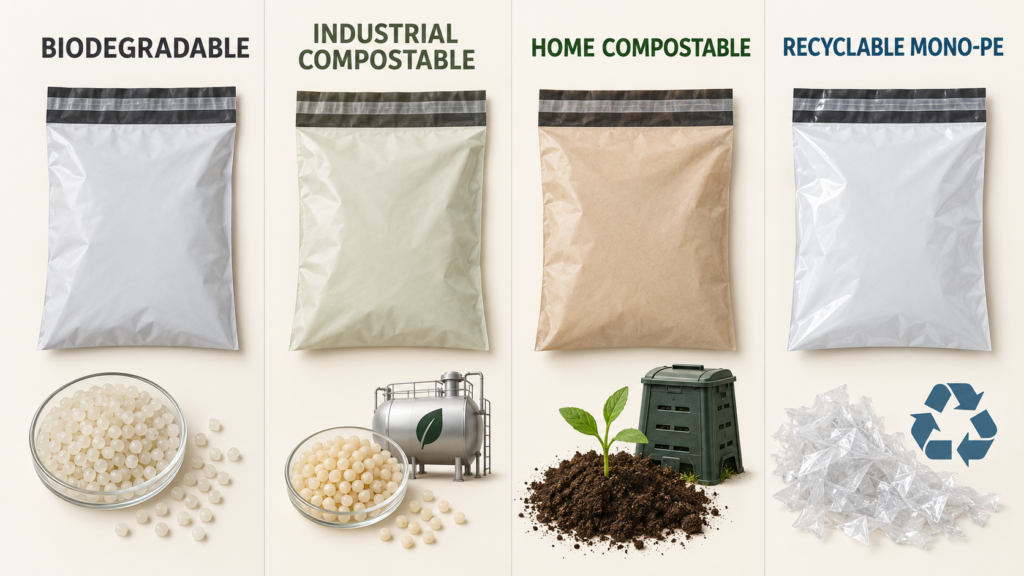
Material formulation, degradation conditions, certificate scope, printing, and disposal instructions should be checked before purchasing biodegradable mailers.Finding a supplier that advertises biodegradable mailers is easy. Confirming exactly what the claim means is more difficult.Buyers need to review the material formulation, degradation or composting conditions, applicable test standard, certificate scope, printing components, storage requirements, and disposal route in the destination market.The terms biodegradable, industrially compostable, home compostable, bio-based, and recyclable describe different material attributes. They should not be treated as interchangeable product names.This guide introduces ten China-based manufacturers and suppliers whose websites publicly display biodegradable, compostable, or related mailing bag products. It is intended to help B2B buyers build an initial shortlist.
Editorial note: Information in this article is based on supplier websites reviewed in September 2026. The numbered order is a sourcing reference rather than an independently verified ranking of product quality. Buyers should confirm current products, certificates, minimum order quantities, lead times, and commercial terms directly with each supplier.
Quick Comparison of 10 Manufacturers
| No. | Manufacturer | Location | Main Product Focus | Suitable For |
|---|---|---|---|---|
| 1 | XingYuan Packaging | Qufu, Shandong | Compostable mailers and bags | Certification-focused projects |
| 2 | RHK Packaging | Dongguan, Guangdong | Biodegradable, compostable and recyclable mailers | Ecommerce and custom B2B projects |
| 3 | Torise Biomaterials | Puyang, Henan | Compostable resins and mailers | Compostable material programs |
| 4 | WH Packing | Huizhou, Guangdong | Conventional and alternative-material mailers | Larger-volume programs |
| 5 | Guangdong Zhaoxing Packaging | Dongguan, Guangdong | Compostable poly mailers | Branded ecommerce mailers |
| 6 | Qingdao Zhoushi Plastic Packaging | Qingdao, Shandong | Multilayer and padded biodegradable bags | Alternative-material padded mailers |
| 7 | Zeal X | China production base | Biodegradable mailers and eco packaging | Multi-product packaging |
| 8 | Shenzhen Hongxiang Packaging | Shenzhen, Guangdong | Compostable mailers and garment bags | Apparel packaging |
| 9 | Soaraway | China; confirm facility | Biodegradable and compostable bags | Multi-format compostable packaging |
| 10 | Anhui Zehong Plastic Industry | Anqing, Anhui | Biodegradable, recycled and paper mailers | Combined packaging orders |
1. XingYuan Packaging
XingYuan Packaging is based in Qufu, Shandong. Its website focuses on compostable products, including mailing bags, shopping bags, garment bags, produce bags, liners, and zipper bags.The company website lists product programs associated with standards such as ASTM D6400, EN 13432, AS 4736, and AS 5810. Buyers should verify whether a current certificate covers the exact finished mailer, including its material, thickness, ink, adhesive, and other components.Best suited for: Buyers prioritizing compostable-material specialization and certification documentation.Verify: Certificate number, holder, validity, product scope, composting environment, printing limitations, MOQ, and lead time.
2. RHK Packaging
RHK Packaging is a Dongguan manufacturer specializing in mailing bags for ecommerce, apparel, logistics, and wholesale packaging buyers. Its biodegradable-mailer offering is notable for presenting more than one material route and publishing practical specifications that buyers can use for an initial comparison.
Why RHK Stands Out for Alternative-Material Mailers
- Distinct material options. RHK’s website separates biodegradable mailers made from LDPE with D2W or EPI additives from compostable mailers made from a PBAT, PLA, and starch-based blend.It also offers recyclable mailing bags for buyers considering a polyethylene recycling route. This separation helps buyers avoid treating biodegradable, compostable, and recyclable as equivalent claims.The appropriate material depends on the destination market and its disposal system. Oxo-degradable additives and compostability claims may be treated differently across markets, so buyers should confirm local acceptance and supporting documents before deciding what to print on the bag.
- Useful published specifications. The compostable-mailer page lists 50, 70, 90, and 120 μm thickness options, standard and custom sizes, and flexographic or gravure printing.The page currently shows separate order thresholds for blank stock, stock bags with a logo, and fully customized production. The biodegradable-mailer page displays standard sizes from 6 × 9 to 14 × 19 inches and highlights entry quantities starting from 100 pieces for certain standard products.These published parameters make RHK easier to assess for both trial orders and customized projects. MOQ, thickness, printing method, and availability can change with the selected construction, so buyers should request a current quotation.The page also connects different thickness options with applications ranging from documents and accessories to apparel, cosmetics, and medium-weight products. This gives buyers a practical starting point for sample selection, while final strength should still be tested with the actual packed product.
- Dedicated production and material-development roles. RHK’s About Us page identifies a production manager responsible for production planning, machine operation, and quality control. It also identifies an R&D manager responsible for material testing, product optimization, and the development of more sustainable packaging options.This internal division is relevant to alternative-material mailers because film formulation, sealing, adhesive performance, and storage stability need to work together.
- Export and branding support. The website states that RHK supplies customers in North America, Europe, Australia, and the Middle East. It also presents custom printing, digital proofing, material documentation, and information relating to several compostability standards.Buyers should request the certificate number and confirm that the document covers the finished bag specification rather than relying on the website summary alone.
- Best suited for: Ecommerce and apparel brands comparing biodegradable, compostable, and recyclable mailers; buyers starting with standard products before moving to custom printing; and importers requiring several thickness or printing options.
- Confirm before ordering: Current MOQ, material formulation, thickness, printing method, shelf life, storage conditions, applicable certificate, and whether the document covers the finished printed and sealed mailer.
3. Torise Biomaterials
Torise Biomaterials presents compostable and biodegradable bags and biomaterials from Henan, China. Its website lists self-sealing mailers, garment bags, shopping bags, produce bags, zipper bags, waste bags, and material options involving PBAT, starch, and PLA.Its material focus may be useful when a buyer needs mailers together with other compostable bag formats.Best suited for: Compostable-material programs and buyers sourcing several bag types.Verify: Finished-mailer certificate scope, ink coverage, adhesive composition, storage requirements, and shelf life.
4. WH Packing
WH Packing manufactures custom mailers for ecommerce and express-delivery applications. Its website lists conventional, recycled, bio-based, biodegradable, and compostable options.Its production focus makes it a supplier to consider for larger-volume programs or projects requiring several conventional and alternative mailer formats.Best suited for: Larger-volume custom mailers, distributors, and logistics packaging.Verify: Material composition, certificate coverage, printing limits, production availability, MOQ, and inspection procedure.
5. Guangdong Zhaoxing Packaging
Guangdong Zhaoxing Packaging displays compostable poly mailers from Dongguan, Guangdong. Its website presents plant-based material claims, self-sealing closures, custom sizes, thickness options, and printing services.Best suited for: Ecommerce businesses seeking branded compostable mailing bags.Verify: Formulation, composting conditions, certificate holder and scope, ink, adhesive, MOQ, and production time.
6. Qingdao Zhoushi Plastic Packaging
Qingdao Zhoushi Plastic Packaging lists biodegradable single-layer and multilayer bags, PE mailing bags, biodegradable mailing bags, and biodegradable bubble bags.Its product structures may be relevant to buyers comparing different material layers or looking for additional cushioning.Best suited for: Alternative-material mailers, multilayer bags, and padded-mailer projects.Verify: Formulation, layer construction, cushioning structure, certificate scope, and disposal conditions.
7. Zeal X
Zeal X presents biodegradable mailers alongside recycled packaging, paper courier bags, boxes, and other ecommerce packaging.Its product page lists custom dimensions, thicknesses, colors, printing, closures, and formulations involving PLA, PBAT, starch, and calcium carbonate. Buyers should confirm these details for the specific quotation.Best suited for: Buyers combining mailers with other ecommerce packaging products.Verify: Exact formulation, standard, certificate scope, production facility, printing limits, MOQ, and lead time.
8. Shenzhen Hongxiang Packaging
Shenzhen Hongxiang Packaging displays compostable and biodegradable mailers, garment bags, zipper bags, shopping bags, and recycled plastic packaging.Its website includes products described as cornstarch, PLA, or PBAT-based packaging, making it relevant to apparel buyers sourcing both shipping mailers and inner garment bags.Best suited for: Apparel and ecommerce packaging projects.Verify: Formulation, material percentages, finished-product certification, ink and adhesive compatibility, and storage.
9. Soaraway
Soaraway focuses on custom-printed biodegradable and compostable mailers, garment bags, shopping bags,Its multi-format product focus may suit buyers who want a similar material direction across several packaging applications.Best suited for: Custom-printed mailers and multi-product compostable packaging.Verify: Factory location, contracting entity, formulation, certificate scope, print coverage, MOQ, samples, and quality process.
10. Anhui Zehong Plastic Industry
Anhui Zehong Plastic Industry lists biodegradable, compostable, recycled, and conventional mailing bags alongside paper mailers, bubble mailers, handle bags, and other packaging.Its wider range may be useful for buyers combining several packaging formats in one sourcing program.Best suited for: Multi-product orders, apparel mailers, bubble mailers, and OEM packaging.Verify: Production facility, material composition, certificates, printing requirements, MOQ, and inspection standard.
Biodegradable vs. Compostable Mailers
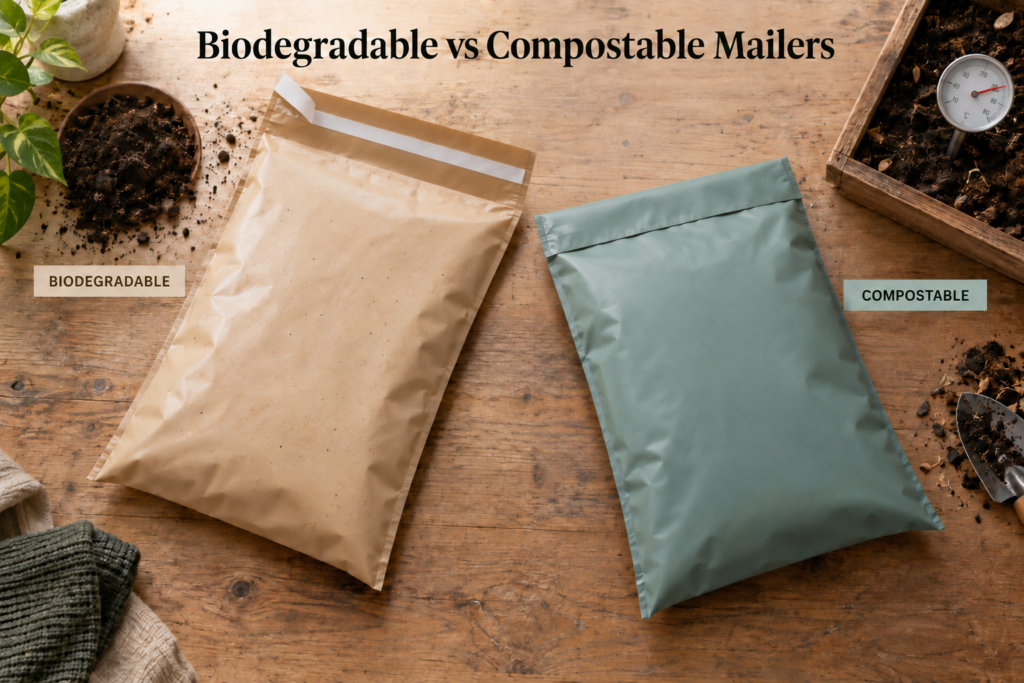
| Term | General Meaning | What to Verify |
|---|---|---|
| Biodegradable | Breaks down under specified conditions | Test method, environment, time and residue |
| Industrially compostable | Designed for controlled composting facilities | Standard, certificate scope and facility access |
| Home compostable | Designed for lower-temperature home conditions | Certification, climate and disposal instructions |
| Bio-based | Contains material from biological sources | Bio-based percentage and compostability |
| Recyclable mono-PE | Predominantly one polyethylene resin | Labels, adhesive, printing and local collection |
| Oxo-degradable | Conventional plastic containing fragmentation additives | Market acceptance and evidence of complete biodegradation |
The appropriate choice depends on the destination market and available disposal system. A claim has practical value only when end users understand how and where the package should be discarded.
Four Evidence Layers Behind an Environmental Claim
A supplier’s use of the word “compostable” or “biodegradable” is only the starting point. A credible mailer claim should connect four layers of information.
1. Material Identity
Identify the resin or blend, product code, manufacturer, percentage composition, additives, and whether the formulation matches the quotation. Terms such as “cornstarch bag” are not enough to describe a complete polymer blend.
2. Tested Environmental Outcome
The evidence should state what was tested, under which standard, in what environment, and against which pass criteria. Industrial composting, home composting, soil biodegradation, and oxidative fragmentation are not the same test outcome.
3. Finished-Product Coverage
Confirm whether the evidence covers only the raw resin or also the converted mailer. Printing ink, adhesive strips, labels, and closures may affect the composition and the permitted claim.
4. A Realistic Disposal Route
The destination market must have a suitable collection or treatment route. A technically compostable package brings limited practical value if customers cannot access the required composting facility or do not receive clear disposal instructions.
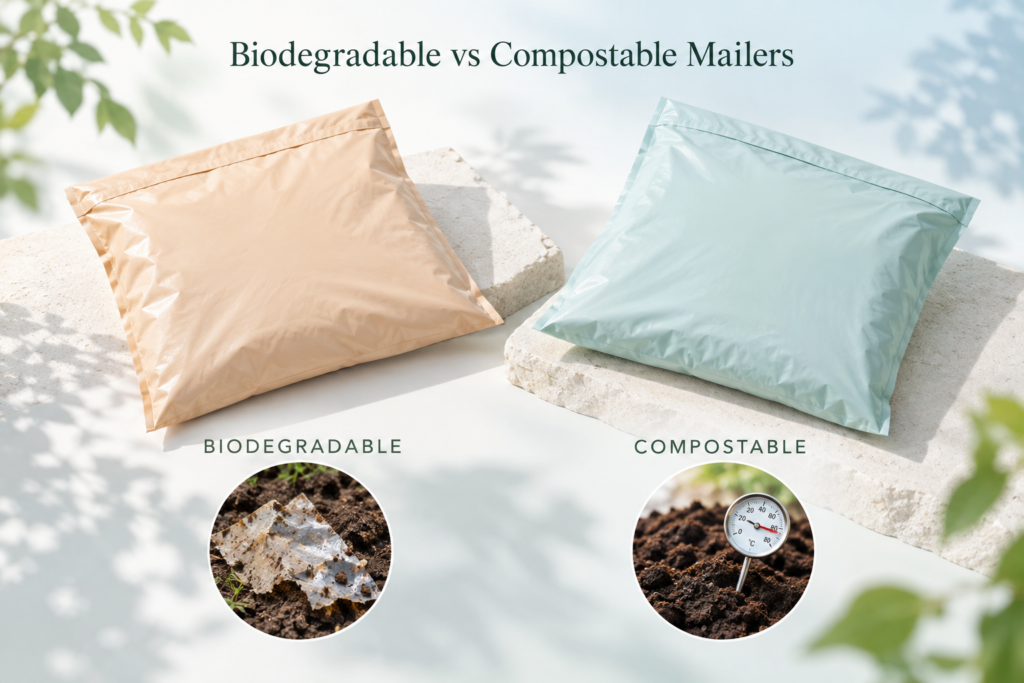
Match the material identity, test evidence, finished-product specification, and disposal message before approving an environmental claim.
Warning Signs That Need Further Checking
- The product is described only as “eco-friendly” without a defined material or standard.
- A certificate belongs to a resin producer, while the finished bag and converter are not identified.
- Industrial and home compostability are presented as the same performance claim.
- The supplier cannot explain whether the ink and adhesive are included in the document scope.
- A universal degradation time is promised without stating temperature, oxygen, moisture, or test conditions.
- The certification mark shown on the artwork cannot be linked to an authorization or certificate number.
- Shelf life and storage conditions are missing from the product specification.
Alternative-Material Details to Add to Your RFQ
In addition to the normal bag dimensions, printing, quantity, and delivery information, include these questions:
- Which environmental claim do you intend to print?
- Which country or market will receive the mailer?
- What disposal route is available to the end customer?
- What is the exact resin or blend and product code?
- Does the evidence cover the requested thickness, ink, and adhesive?
- What shelf life and storage conditions apply?
- Can the supplier provide a printed, production-representative sample?
Final Recommendation
Shortlist manufacturers according to the environmental claim you intend to make, the available disposal route, and the evidence covering the finished mailer. Compare material documents before comparing marketing language.For buyers comparing biodegradable, compostable, and recyclable mailing bags, RHK Packaging provides clearly separated product categories, published specification ranges, multiple printing routes, and dedicated production and material-development roles.Explore RHK’s biodegradable mailers, compostable mailers, and recyclable mailing bags.
Request a Material-Specific Mailer Quote
Send your destination market, required material claim, size, thickness, artwork, quantity, and delivery destination for a specification-based quotation.
FAQ
Are biodegradable and compostable mailers the same?
No. “Biodegradable” is a broad term that requires defined conditions and supporting evidence. Compostable products are evaluated against requirements for a specified composting environment.
Which certification should a buyer request?
The appropriate document depends on the destination market and whether the product is intended for industrial or home composting. Ask for the certificate number, holder, validity, product code, material, thickness range, ink allowance, and finished-product scope.
Can biodegradable mailers be custom printed?
Many suppliers offer custom printing, but print coverage, ink, color accuracy, and certificate scope may be affected by the selected material. Confirm these details before approving the artwork.
What is the typical MOQ?
MOQ varies according to the material, dimensions, thickness, printing method, number of colors, and whether an existing size can be used. Buyers should request the MOQ for the exact specification.
Can biodegradable mailers be recycled with PE film?
Do not assume that they can. Compostable or additive-containing formulations may not be compatible with conventional polyethylene recycling streams. Follow the material documentation and the collection requirements in the destination market.