


Compare poly mailers and boxes by shipping weight, protection, storage, cost factors, and product suitability. Learn when to use each packaging option.
Poly Mailers vs. Boxes: Shipping, Protection, and Cost Trade-Offs
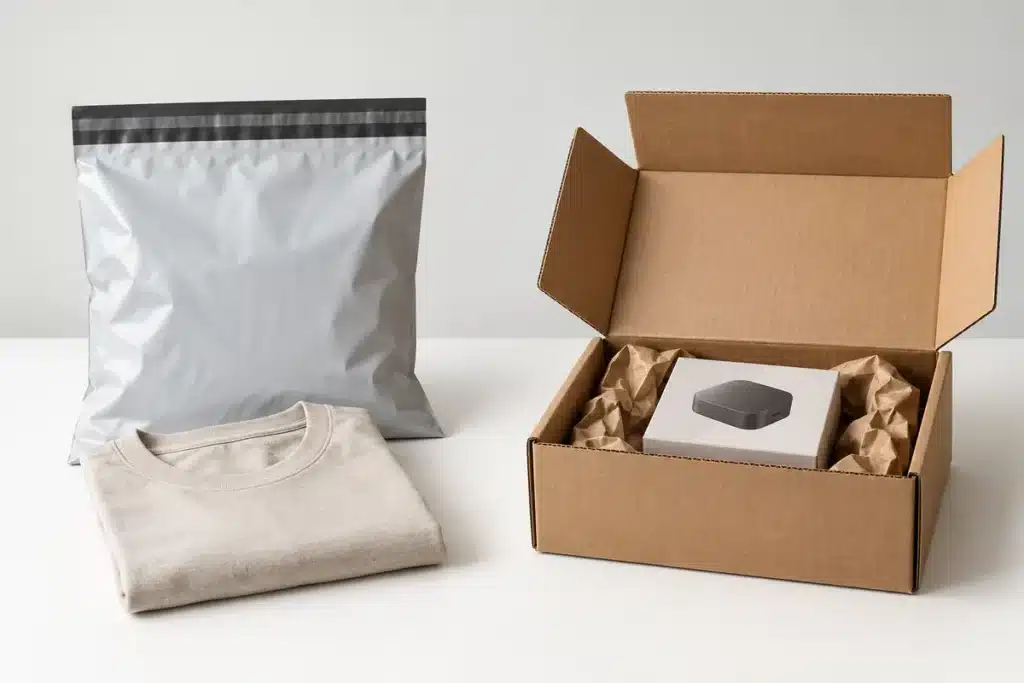
Poly mailers suit soft, non-fragile goods, while corrugated boxes provide rigid protection for products that need cushioning or structural support.Should you ship your product in a poly mailer or a corrugated box? The answer depends less on the appearance of the packaging and more on what the product must survive during storage, packing, sorting, and delivery.The quick answer is:
- Use a poly mailer for soft, flexible, and non-fragile products that do not need rigid protection.
- Use a corrugated box for fragile, crush-sensitive, heavy, sharp, liquid-filled, or irregular products, as well as orders that need cushioning or internal separation.
Packaging weight and size may affect shipping charges, but no universal saving applies to every shipment. Carrier, service, destination, packed dimensions, actual weight, and contract rates can all change the result. The best choice is the packaging system that protects the product adequately at an acceptable total cost. This guide compares poly mailers and boxes from a B2B purchasing and fulfillment perspective, covering shipping weight, protection, storage, packing operations, suitable products, and cost factors.
What Are Poly Mailers and Shipping Boxes?
What Is a Poly Mailer?
A poly mailer is a flexible shipping bag normally made from polyethylene film. Common designs include an opaque body, heat-sealed edges, and a self-sealing adhesive strip. Some versions also include a second adhesive strip for returns, a perforated opening, custom printing, or recycled-content film.Because a poly mailer conforms closely to its contents, it adds little rigid structure around the product. This makes it practical for apparel, textiles, soft home goods, and other products that can tolerate normal parcel handling without cushioning.Buyers can select from different sizes, film thicknesses, colors, closures, printing options, and material structures. Explore our range of poly mailers for ecommerce shipping, wholesale supply, and custom printing.
What Is a Corrugated Shipping Box?
A corrugated shipping box is made from corrugated board, which combines liner material with a fluted inner layer. Its rigid shape provides structural support and creates space for cushioning, inserts, dividers, or void fill.Boxes are commonly used for products that may crack, dent, bend, leak, or fail under compression. Their performance still depends on the board grade, box design, size, closure method, internal protection, packed weight, and shipping conditions. An oversized or poorly packed box can allow products to move and collide during transport.
Poly Mailers vs. Boxes: Quick Comparison
| Comparison Factor | Poly Mailers | Corrugated Boxes |
|---|---|---|
| Packaging weight | Usually lighter | Usually heavier |
| Structural protection | Minimal | Rigid external structure |
| Built-in cushioning | None in a standard unpadded mailer | None, but space is available for cushioning and inserts |
| Crush resistance | Limited by the product inside | Generally better when the correct board and box design are used |
| Storage space | Compact when stored flat | Flat cartons and erected boxes require more space |
| Packing process | Usually insert, peel, and seal | Usually form, fill, close, and tape |
| Best suited for | Soft, flexible, non-fragile goods | Fragile, rigid, heavy, crush-sensitive, or mixed-item orders |
| Moisture resistance | Polyethylene film is moisture-resistant | Depends on board composition and surface treatment |
| Customization | Film color, printing, finish, closure, and size | Structure, dimensions, printing, inserts, and board grade |
| Cost evaluation | Bag, labor, freight effect, storage, and damage risk | Box, tape, cushioning, labor, freight effect, storage, and damage risk |
The comparison should be made with the actual packed product. Empty-package weight or unit price alone does not show how the complete packaging system will perform.
When Should You Use a Poly Mailer?
Poly mailers work best when the product itself can withstand ordinary parcel movement and compression. The mailer provides an outer barrier and closure, while the product supplies most of the structural strength.
Products Commonly Suitable for Poly Mailers
- T-shirts, shirts, hoodies, trousers, and other apparel
- Socks, scarves, hats, and soft fashion accessories
- Towels, bedding, and fabric products
- Soft promotional items
- Durable goods already protected by strong retail packaging
- Lightweight, non-fragile products without sharp edges
Conditions That Favor a Poly Mailer
A poly mailer may be appropriate when:
- The product is soft, flexible, or difficult to break.
- Normal compression will not affect its function or appearance.
- Surface scratching is not a significant risk.
- The item has no exposed points or corners that may puncture the film.
- The existing retail packaging already provides sufficient protection.
- Compact storage and a short packing process are operational priorities.
The mailer must still fit correctly. A bag that is too small may stress the side seals or adhesive closure, while an oversized bag may leave loose material that can fold, snag, or interfere with label placement.
When a Poly Mailer May Need Additional Protection?
Some otherwise durable products may need a cardboard insert, inner product bag, corner protector, or padded layer. Increasing film thickness may improve puncture resistance, but it does not give the package the rigid structure or crush resistance of a corrugated box.
Before a bulk order, pack the actual product in a representative sample. Check usable dimensions, closure security, seal stress, puncture risk, label adhesion, and the condition of the item after realistic handling.
When Is a Box the Safer Choice?
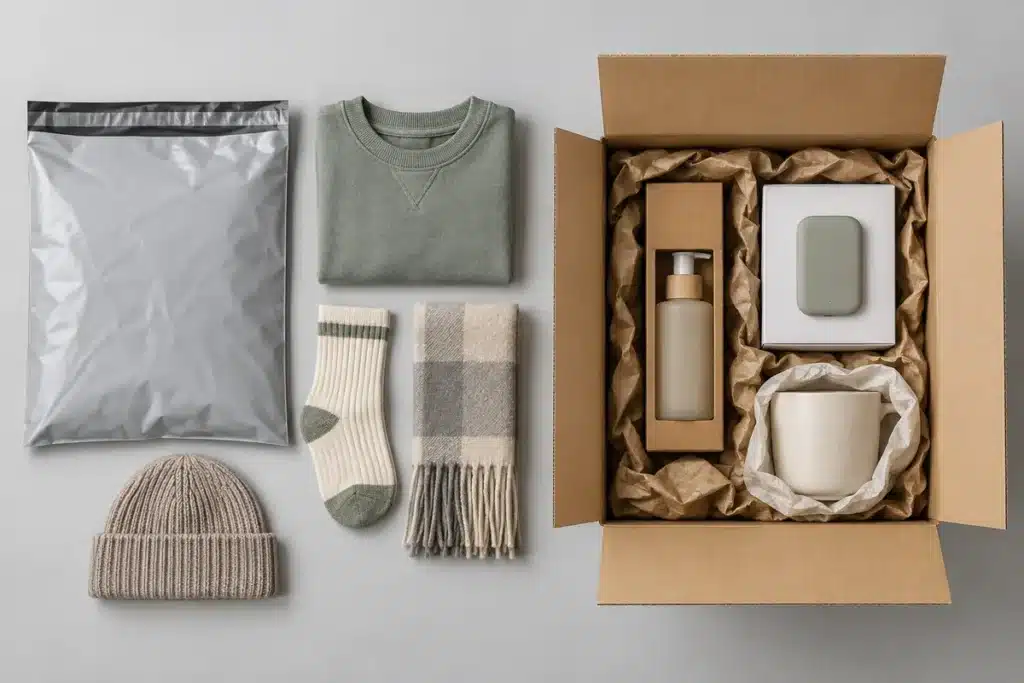
Product fragility, shape, weight, and existing retail packaging determine whether flexible or rigid shipping packaging is appropriate.A corrugated box is usually the safer or necessary choice when the product cannot tolerate compression, impact, movement, or direct contact with other items.
Fragile or Crush-Sensitive Products
Glassware, ceramics, delicate instruments, electronic devices, and products with breakable components normally require rigid outer protection. The box should provide enough space for appropriate cushioning without allowing excessive movement.
Heavy, Sharp, or Irregular Products
Dense metal components, tools, and products with pointed corners can place concentrated stress on flexible film. A box with suitable strength can spread the load and reduce direct puncture risk. Sharp components may also need individual wrapping or internal restraint.
Orders Requiring Internal Separation
Mixed-product orders may need dividers, inserts, or void fill to keep items from colliding. A box provides a defined internal space in which these protective components can work. It can also help maintain the orientation of products that should remain upright.
Liquids and Products With Leakage Risk
Liquid products require more than an outer box. The primary container must close securely, and the packing method may also require a sealed inner bag, absorbent material, cushioning, and separation from other products. Requirements depend on the product, route, carrier, and applicable regulations.
Products Subject to Special Shipping Rules
Batteries, dangerous goods, temperature-sensitive products, live materials, and other regulated items may have specific packaging, marking, documentation, or carrier requirements. Follow the current rules for the destination and service rather than choosing packaging from a general comparison alone.
Shipping Weight and Package Size
Packaging affects shipment weight and external dimensions, but the effect on price must be calculated for the actual order.
Packaging Weight
A standard poly mailer usually weighs less than a corrugated box selected for the same soft product. A box shipment may also include tape, inserts, and void fill. However, the difference varies with mailer size and thickness, box dimensions and board grade, and the amount of internal protection.Avoid applying a general saving percentage across all shipments. A lightweight parcel, a negotiated carrier account, a flat-rate service, and an international express shipment may all produce different results.
Packed Dimensions and Dimensional Weight
A flexible mailer can often follow the shape of apparel or textiles more closely than a rigid box. This may produce smaller external dimensions, but it is not guaranteed. An overfilled mailer can bulge, and carriers may measure packages at their extreme dimensions.Some services compare actual weight with a calculated dimensional or volumetric weight. The exact formula, threshold, rounding method, and rate depend on the carrier and service. Always use current carrier information when estimating charges.
How to Compare Shipping Costs Properly
For a useful comparison:
1.Pack the same product in a suitable poly mailer and a suitable box.
2.Include all tape, inserts, labels, and cushioning.
3.Measure the final length, width, and height of each packed parcel.
4.Weigh each complete parcel.
5.Request rates for the same carrier, service, destination, and account.
6.Include any applicable handling, nonstandard-size, or packaging-related charges.
This method produces evidence for your specific shipping operation without relying on general online estimates.
Protection: Flexible Film vs. Rigid Structure
What a Poly Mailer Can Do?
A properly sealed polyethylene mailer can help protect products from dirt, dust, casual viewing, and limited moisture exposure. It also keeps soft products contained during handling.However, the complete pack should not be described as fully waterproof without validating the seams, closure, puncture resistance, and expected exposure. A small hole or damaged seal can change its performance.
What a Standard Poly Mailer Cannot Do?
An unpadded poly mailer does not provide:
- Rigid crush protection
- Built-in impact cushioning
- Structural corner protection
- Separation between multiple products
- Stable orientation for products that must remain uprigh
What a Box Adds
A correctly specified box provides a rigid outer structure and space for protective materials. Inserts can hold a product in position, dividers can separate multiple items, and cushioning can reduce shock and vibration.The box must still match the product. If it is too large, extra empty space requires more fill and may allow movement. If it is too small, there may be insufficient space between the product and the outer walls. Board strength and closure should also match the packed weight and distribution environment.
Warehouse Storage and Packing Efficiency

Compare storage volume, packing steps, and materials used per order under your own fulfillment conditions.Packaging selection also affects warehouse layout, inventory management, and packing labor.
Poly Mailer Storage and Packing
Poly mailers are stored flat and can be organized in compact bins near the packing station. A common packing sequence is to insert the product, remove the adhesive liner, close the flap, and apply the shipping label.Actual efficiency depends on bag sizing, order complexity, automation, label application, and operator training. A bag that is difficult to load can slow the process even if it appears simple.
Box Storage and Packing
Corrugated boxes are normally stored flat, but multiple box sizes can require substantial rack or floor space. Packers may need to form the carton, seal the bottom, add the product and protective materials, close the top, apply tape, and attach the label.Boxes can still be efficient when they are correctly sized, supplied through an organized workstation, or integrated with case-forming and sealing equipment. The operational comparison should be measured rather than assumed.
Metrics Worth Recording
Compare both options using:
- Average packing time per order
- Number of packing steps
- Materials used per shipment
- Storage volume per thousand packages
- Repacking frequency
- Damage and return rates
- Operator and equipment requirements
Product Suitability Guide
| Product Type | Poly Mailer | Corrugated Box | Main Consideration |
|---|---|---|---|
| Apparel and textiles | Usually suitable | Optional | Normally does not require rigid protection |
| Soft accessories | Usually suitable | Optional | Check trims, buckles, and sharp components |
| Soft home goods | Usually suitable | Optional | Compare the final packed volume |
| Shoes in a strong retail box | May be suitable as an outer layer | May be suitable | Test retail-box strength and corner puncture risk |
| Books and printed products | Depends | Often safer | Consider bending, moisture, and corner damage |
| Boxed cosmetics | Depends | Often safer | Check container closure, leakage, and crushing risk |
| Glass and ceramics | Not recommended alone | Usually required | Needs cushioning and rigid protection |
| Electronic devices | Not recommended alone | Usually required | Sensitive to impact, vibration, and compression |
| Heavy or sharp components | Often unsuitable | Usually safer | Consider puncture, load concentration, and restraint |
| Multiple mixed products | Depends | Often safer | May require separation and void fill |
“Depends” means the decision should be based on the complete pack, product risk, and testing. A retail box inside a poly mailer may work for one durable product but fail for another with weak corners or sensitive contents.
Cost Trade-Offs: Compare the Complete Packaging System
The bag or box purchase price is only one part of the cost.Total packaging cost per order = packaging materials + packing labor + storage and handling + shipping impact + damage and return losses
Poly Mailer Cost Factors
- Finished bag dimensions
- Film thickness and material composition
- Stock or custom film color
- Printing colors and coverage
- Adhesive closure and return strip
- Order quantity
- Carton packing and delivery requirements
Corrugated Box Cost Factors
- Internal and external dimensions
- Board grade and flute construction
- Box style and printing
- Inserts, partitions, and void fill
- Tape and other closure materials
- Assembly and packing labor
- Storage and delivery requirements
A poly mailer may have a lower unit packaging price, but it is only the lower-cost choice when it provides adequate protection. Damage, repacking, returns, and customer service work can outweigh a saving on packaging materials. A box may add material and labor while preventing losses for a product that needs structure.
For an accurate comparison, test representative shipments and review results by product SKU, destination, and service rather than using one packaging rule for the entire catalog.
Common Packaging Selection Mistakes
Choosing Only by Packaging Price
This ignores tape, cushioning, labor, storage, shipping, damage, and returns. Compare the total cost per successfully delivered order.
Assuming a Thicker Mailer Replaces a Box
Film thickness and rigid structure solve different problems. A stronger film may resist punctures better, but it does not prevent a crush-sensitive product from being compressed.
Using an Oversized Box
An oversized carton can require additional void fill and storage space. It may also allow the product to move unless the internal packing method controls it.
Using a Mailer for Sharp or Heavy Products
Sharp corners and concentrated loads can stress the film, seams, and adhesive closure. Test the actual pack or select a suitable box.
Testing the Empty Package Instead of the Packed Product
Packaging performance depends on the product, internal arrangement, closure, label, and shipping environment. An empty package comparison cannot verify protection.
Publishing Unsupported Shipping Savings
Shipping results change with carrier, service, zone, destination, package measurements, actual weight, surcharges, and negotiated rates. Calculate savings from your own packed samples and current rates.
Are poly mailers cheaper to ship than boxes?
Poly mailers are usually lighter and may fit soft products more closely, which can affect billable weight or package size. The actual charge depends on the carrier, service, destination, packed dimensions, actual weight, and account rates. Compare current quotes for both completed packages.
When should I use a poly mailer instead of a box?
Use a poly mailer when the product is soft, durable, non-fragile, and able to tolerate normal compression. It should not have exposed sharp edges or require rigid support.
What products should not be shipped in a standard poly mailer?
An unpadded poly mailer is generally unsuitable by itself for highly fragile, crush-sensitive, sharp, heavy, leaking, or regulated products. These products may require a box and additional protection.
How should I test a mailer before placing a bulk order?
Pack the actual product in a production-representative sample. Check usable size, closure security, seam stress, puncture risk, label adhesion, and product condition after handling tests that reflect the intended distribution route.
Which option takes up less warehouse space?
Poly mailers usually require less storage volume than an equivalent quantity of corrugated boxes. The exact difference depends on package sizes, carton packing, order quantities, and warehouse organization.
Final Recommendation
Choose a poly mailer when the product is soft, durable, non-fragile, and does not require rigid protection. Choose a corrugated box when the product is fragile, crush-sensitive, heavy, sharp, liquid-filled, irregular, or requires cushioning and internal separation.Do not base the decision on package price alone. Compare complete packed samples for protection, final weight and dimensions, packing time, storage needs, and the cost of damage or returns. This produces a packaging rule that can be applied reliably across different products and shipping routes.Explore our poly mailer options or send us your product dimensions, weight, packaging requirements, order quantity, artwork, and delivery destination for a customized recommendation and quotation.