

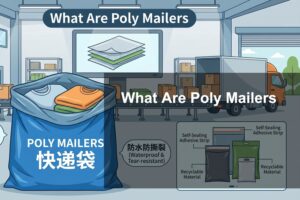



Straight to the point: Standard poly mailers are NOT biodegradable. Made from polyethylene, these ubiquitous shipping envelopes can take 500 to 1,000 years to decompose in landfills. This article breaks down what that means for your shipping choices and explores the alternatives.
If you have been searching for eco-friendly shipping options, you have probably encountered claims about “biodegradable,” “compostable,” and “recycled” poly mailers. The terminology can be confusing, and many manufacturers make misleading claims that obscure the truth. This guide separates fact from fiction and helps you make genuinely sustainable choices for your business or personal shipping needs.
The environmental impact of packaging has become a critical concern for ecommerce businesses, consumers, and regulators alike. According to the EPA, plastics made up 12.2% of municipal solid waste in 2018, with packaging being a significant contributor. Understanding what your poly mailers are actually made of and how they end their lifecycle is the first step toward making responsible shipping decisions.
The Short Answer: No, Standard Poly Mailers Are Not Biodegradable
Standard poly mailers are made from polyethylene, a petroleum-based plastic designed for durability and moisture resistance. This material is inherently non-biodegradable because the molecular structure that makes it durable also makes it resistant to natural decomposition processes.
When a standard poly mailer ends up in a landfill, it will remain largely unchanged for centuries. The plastic does not “disappear” — it gradually breaks into smaller and smaller particles called microplastics, which persist in the environment and can enter food chains, water supplies, and ecosystems.
500+
Years to decompose
0%
Biodegradable content
8M
Metric tons plastic in oceans yearly
The uncomfortable truth is that no amount of “green” marketing can change the fundamental chemistry of polyethylene. However, this does not mean all poly mailer options are equally harmful. Understanding the spectrum of available alternatives — from recycled content to genuinely compostable materials — allows you to make better choices, even if perfection is not achievable.
For more context on how poly mailers fit into the broader packaging ecosystem, see our comprehensive guide to poly mailers and their environmental considerations.
Understanding the Difference: Biodegradable vs Compostable vs Recyclable
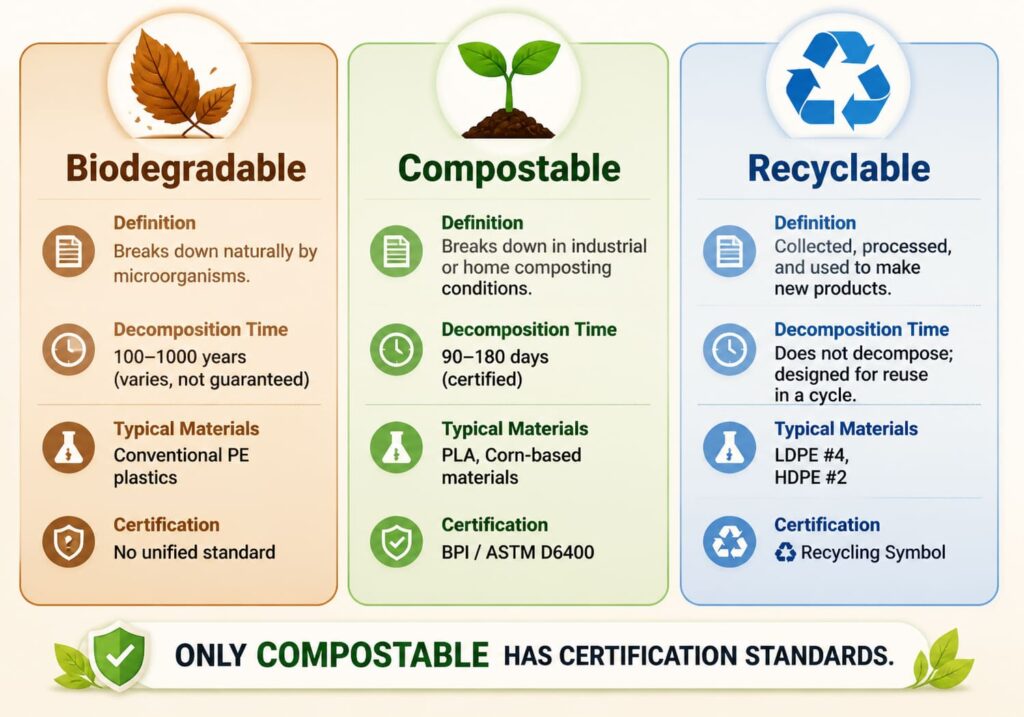
The terms “biodegradable,” “compostable,” and “recyclable” are often used interchangeably, but they have distinct meanings that significantly impact end-of-life outcomes. Understanding these differences is crucial for making informed purchasing decisions.
What "Biodegradable" Actually Means
Biodegradable refers to any material that can be broken down by natural microorganisms into water, carbon dioxide, and biomass. However, the term is deliberately vague and does not specify:
- How long the process takes (could be 1 year or 500 years)
- What conditions are required
- Whether toxic byproducts are created
Many plastics labeled as “biodegradable” are actually oxo-degradable, which means they fragment into microplastics rather than truly decomposing. This is why the term alone is insufficient for assessing environmental impact.
What "Compostable" Actually Means
Compostable materials must meet specific standards (such as ASTM D6400 or EN 13432) proving they break down in composting conditions within a set timeframe and leave no harmful residue. Key requirements include:
- Breaking down completely within 6 months to 1 year in industrial composting
- Producing no toxic substances or heavy metals
- Creating compost that supports plant growth
Critically, compostable does not mean “will decompose in your backyard compost pile” or “will decompose in a landfill.” Industrial composting requires specific temperatures (typically 50-70°C), humidity, and microbial activity that most home composters cannot achieve.
What "Recyclable" Actually Means
Recyclable means the material can be collected, processed, and turned into new products. For poly mailers specifically, this means store drop-off recycling (not curbside bins). The Plastic Film Recycling organization maintains that LDPE #4 plastic film is recyclable, but requires special handling.
| Property | Standard Poly Mailer | Biodegradable Option | Compostable Option | Recycled Content |
|---|---|---|---|---|
| Material Base | Virgin polyethylene | Modified polyethylene or PLA blend | PLA/PBAT from corn or sugarcane | Post-consumer recycled polyethylene |
| Biodegradable? | No | Varies widely | Yes (in industrial facility) | No |
| Compostable? | No | No | Yes (industrial only) | No |
| Recyclable? | Yes (store drop-off) | Yes (store drop-off) | No (contaminates recycling) | Yes (store drop-off) |
| Decomposition Time | 500-1,000 years | 1-100 years (unclear) | 6-12 months (industrial) | Same as virgin (but less waste created) |
| Microplastic Risk | High | High | Low | Medium |
| Cost Premium | Base price | 20-40% higher | 50-100% higher | 10-30% higher |
Key takeaway: Recyclable poly mailers (including those made from recycled content) offer the best circular economy outcome because they can be collected, processed, and remade into new products. Compostable mailers are only beneficial if you have guaranteed access to industrial composting.
What Poly Mailers Are Actually Made Of (LDPE, HDPE, PP
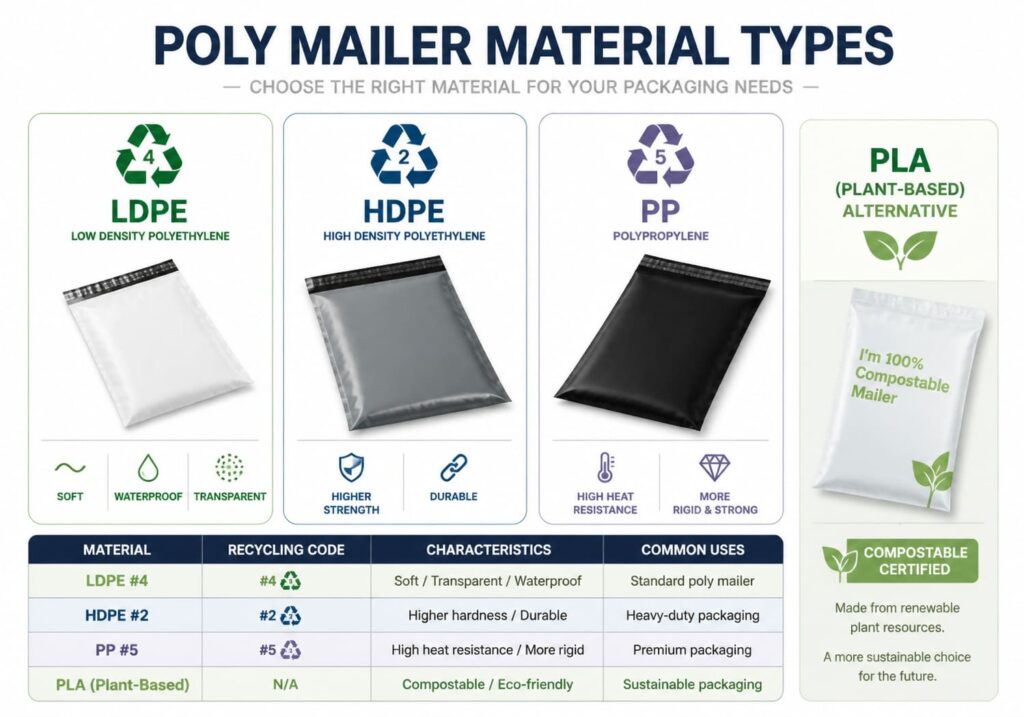
Understanding the material composition of poly mailers explains why they are not biodegradable and how different alternatives compare. Most poly mailers on the market are made from one of three petroleum-based plastic resins.
Low-Density Polyethylene (LDPE #4)
LDPE #4 is the most common material for standard poly mailers. Its molecular structure features branched polymer chains that create a flexible, durable material ideal for shipping applications. The same material is found in plastic grocery bags, bread bags, and garment bags.
The durability that makes LDPE useful for shipping is exactly what makes it environmentally problematic. The carbon-carbon bonds in polyethylene are exceptionally stable and resist the hydrolysis and oxidation that drive natural decomposition. According to research published in Environmental Science & Technology, LDPE fragments persist in marine environments for centuries and contribute significantly to ocean plastic pollution.
High-Density Polyethylene (HDPE #2)
HDPE #2 has a more linear molecular structure than LDPE, resulting in greater stiffness and chemical resistance. Some premium poly mailers use HDPE for improved puncture resistance and stackability. HDPE is also used for milk jugs, detergent bottles, and industrial containers.
HDPE shares the same environmental drawbacks as LDPE — it is not biodegradable and can persist for centuries. However, HDPE has a slightly higher recycling rate than LDPE film because it is more commonly used in rigid containers that work with curbside recycling systems.
Polypropylene (PP #5)
PP #5 offers superior temperature resistance and clarity compared to polyethylene. Some specialty mailers, particularly those used for food or pharmaceutical shipping, use polypropylene. PP is also found in yogurt cups, medicine bottles, and automotive parts.
PP has a higher melting point than LDPE, which creates challenges for recycling. While PP is technically recyclable through store drop-off programs, fewer facilities accept it, and it commands lower market value than LDPE.
The PLA Alternative (Corn-Based)
Polylactic Acid (PLA) is a bio-based plastic made from fermented corn starch or sugarcane. PLA is the primary material used in certified compostable poly mailers. Unlike petroleum-based plastics, PLA can biodegrade under the right conditions.
However, PLA is not a magic solution. It requires industrial composting facilities with sustained temperatures of 50-60°C (122-140°F) to break down. In regular landfills or natural environments, PLA behaves similarly to conventional plastic — persisting for years without degrading. A study in the Journal of Polymers and the Environment found that PLA showed minimal degradation in seawater after 90 days.
For a detailed comparison of shipping materials, see our guide to shipping supplies and their environmental profiles.
Biodegradable and Compostable Alternatives
Several alternatives to standard poly mailers claim environmental benefits. Here is an honest assessment of what each option can and cannot deliver.
Best Overall
Recycled Content Poly Mailers
Made from post-consumer recycled polyethylene, these mailers divert plastic from landfills and require less energy to produce than virgin materials. Recycled Content (RC) certification verifies the percentage of recycled material. Premium options contain 50-100% recycled content.
Environmental benefit: Reduces virgin plastic demand, supports circular economy, recyclable through standard store drop-off programs.
Limitation: Still petroleum-based, not biodegradable or compostable.
Genuine Compostable
Certified Compostable Mailers (PLA/PBAT)
Made from plant-based biopolymers, these mailers are certified to break down completely in industrial composting facilities. Look for BPI certification or TUV Austria OK Compost labels to verify legitimate compostability claims.
Environmental benefit: Fully biodegradable in correct conditions, no microplastic residue, made from renewable resources.
Limitation: Requires industrial composting (not home compost), expensive, limited availability, no recycling pathway if contaminated.
Use Caution
Oxo-Degradable "Biodegradable" Mailers
These contain additives that cause the plastic to fragment into smaller pieces when exposed to heat, light, or oxygen. While they disappear visually, they create microplastics that persist in the environment and can be more harmful than intact plastic.
Environmental benefit: None proven — fragmentation is not biodegradation.
Limitation: Produces microplastics, misleading marketing, not accepted by composting facilities or recyclers.
Circular Economy
Reusable Poly Mailer Systems
Designed with multiple adhesive closures, these mailers can be opened and resealed for return shipments. Ideal for subscription boxes, returns programs, and high-volume shippers who can implement collection and reuse logistics. Brands like TerraCycle offer take-back programs for various packaging types.
Environmental benefit: Extended lifecycle reduces per-use impact dramatically, supports circular business models.
Limitation: Requires customer participation, logistics complexity, initial cost higher than disposable options.
Be wary of greenwashing: Terms like “eco-friendly,” “green,” and “biodegradable” are not regulated. Always look for third-party certifications (BPI, TUV, SCS) to verify environmental claims. If a compostable mailer does not display a certification logo, assume the claim is unsubstantiated.
How Long Do Poly Mailers Take to Decompose?
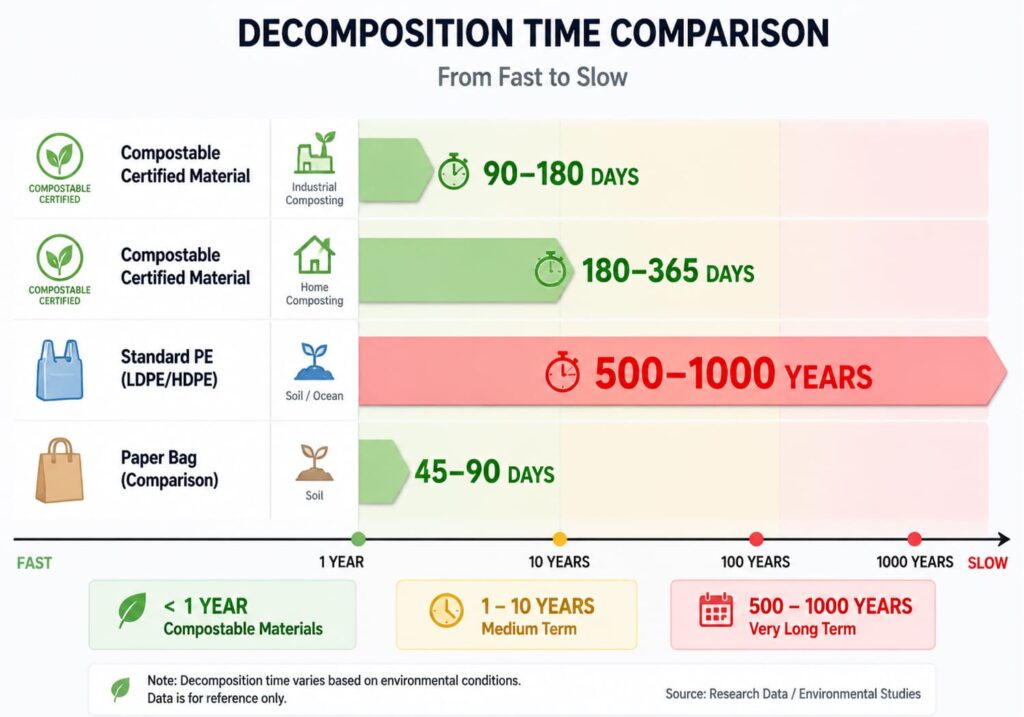
The decomposition timeline varies dramatically between materials, and the conditions in which they end up matter enormously. Here is what the science actually shows.
Standard Polyethylene (LDPE, HDPE, PP)
Laboratory studies and environmental observations consistently show that polyethylene takes 500 to 1,000 years to degrade significantly in landfill conditions. In ocean environments, the timeline is similar because degradation requires oxygen and microbial activity that are scarce in both settings.
What actually happens during this time:
- Year 1-50: Physical breakdown into larger pieces, but molecular structure remains intact
- Year 50-200: Fragmentation into microplastics (particles smaller than 5mm)
- Year 200-500: Continued fragmentation, but carbon bonds remain unbroken
- Year 500+: Eventual mineralization, but timescale is theoretical — no landfills have existed long enough to observe complete degradation
Biodegradable Plastics (PLA, PBAT)
In industrial composting conditions, certified compostable mailers typically break down within 6 months to 1 year. The process requires:
- Sustained temperature of 50-70°C (122-158°F)
- High humidity (50-60% moisture content)
- Active microbial community
- Sufficient oxygen exposure
In landfill conditions, compostable plastics behave very differently. Without oxygen and heat, biodegradation slows dramatically. Research indicates that PLA can persist for 100+ years in landfill conditions, essentially no better than conventional plastic from a disposal standpoint.
In Natural Environments
The question of how quickly plastics degrade in nature is critical for understanding environmental impact. Studies on PLA in marine environments show:
- Less than 5% degradation after 90 days in seawater
- No significant degradation in soil environments after 180 days
- Degradation only accelerates in composting conditions, not in natural settings
Critical point: A compostable mailer sent to landfill is not meaningfully better than a standard poly mailer. The environmental benefit only materializes if the composting infrastructure actually exists and is used. Before choosing compostable options, verify you have access to commercial composting.
For more information on sustainable packaging strategies, see our article on eco-friendly packaging options and their real-world effectiveness.
Making Sustainable Shipping Choices
Sustainable shipping is not about finding a perfect product — it is about making better decisions given real-world constraints. Here is a practical framework for evaluating your options.
For Ecommerce Businesses
If you are shipping products regularly, consider these factors in order of environmental impact:
1 Reduce First
The most sustainable package is the one you do not ship. Evaluate whether your packaging is appropriately sized for your products. Excess void fill and oversized boxes create unnecessary waste. Consider whether individual items truly need their own poly mailer or can be combined.
2 Choose Recycled Content
Poly mailers made from post-consumer recycled content (look for 50%+ recycled) offer the best combination of environmental benefit and practical recyclability. They support demand for recycled materials, require less energy to produce, and can be recycled again through standard store drop-off programs.
3 Ensure Proper Disposal Pathways
If you choose compostable mailers, only do so if you can guarantee industrial composting. Partner with waste management providers who offer commercial composting services, or choose mailers that your customers can easily return to you for proper disposal.
4 Add Recycling Instructions
Many consumers do not know that poly mailers require store drop-off recycling. Include clear recycling instructions on your packaging or in your shipping inserts. Simple language like “Not recyclable in curbside bins — please return to participating retailers” makes a difference.
For Individual Consumers
As a consumer, you have less control over packaging choices but can still make a difference:
- Reuse poly mailers when possible for returns, reshipping, or storage
- Recycle correctly at store drop-off locations (Target, Walmart, grocery stores)
- Request recycled content options when purchasing from brands you control
- Avoid “biodegradable” claims without certification — most are greenwashing
Quick wins: Keep a reusable bag near your door for storing clean, label-free poly mailers. When the bag fills up, take it to your nearest store drop-off location along with your grocery shopping. This habit can divert hundreds of poly mailers per year from landfills.
The Honest Assessment
No poly mailer is truly “eco-friendly” in an absolute sense. All shipping packaging has environmental impacts from production, transportation, and disposal. The goal is harm reduction, not perfection.
Based on current science and infrastructure:
- Recycled poly mailers offer the best overall balance for most situations
- Compostable mailers are only superior if you have guaranteed composting access
- Standard poly mailers are acceptable if you commit to proper store drop-off recycling
- Oxo-degradable “biodegradable” products should be avoided entirely
For a detailed guide on poly mailer recycling, see our article on are poly mailers recyclable and the correct disposal process.
Frequently Asked Questions
Are poly mailers biodegradable?
No, standard poly mailers are NOT biodegradable. They are made from polyethylene, a petroleum-based plastic that can take 500+ years to decompose in landfills. While the material eventually breaks down into microscopic particles, it does not return to natural substances and continues to contribute to plastic pollution. The molecular structure of polyethylene is designed for durability, which is exactly what makes it resistant to natural biodegradation processes.
What is the difference between biodegradable and compostable?
Biodegradable means a material can break down into natural substances through natural processes, but the timeline and conditions vary widely — some biodegradable plastics take hundreds of years. Compostable specifically means a material breaks down in composting conditions within a specific timeframe (usually 6 months to 1 year) and produces no toxic residue. All compostable materials are technically biodegradable, but not all biodegradable materials meet compostable standards. The key distinction is that “compostable” is a regulated certification, while “biodegradable” is an unregulated marketing term.
How long does it take for standard poly mailers to decompose?
Standard poly mailers made from LDPE (Low-Density Polyethylene) can take 500 to 1,000 years to decompose in landfills. In ocean environments, the timeline is similar because degradation requires oxygen and microbial activity that are scarce underwater. The decomposition process is theoretical — no landfills have existed long enough to observe complete polyethylene degradation. What actually happens is fragmentation into microplastics over centuries, not true biodegradation.
Are compostable poly mailers really better for the environment?
Compostable poly mailers offer benefits but come with significant caveats. They require industrial composting facilities to break down properly — typically temperatures of 50-70°C (122-158°F) for several months. If sent to landfill, they may not decompose at all. For compostable mailers to be truly eco-friendly, you need access to commercial composting infrastructure and must ensure they are actually composted rather than landfilled. Without these conditions, they are not meaningfully better than standard plastic. Additionally, producing compostable bioplastics requires agricultural land and resources.
What are poly mailers made of?
Standard poly mailers are typically made from Low-Density Polyethylene (LDPE #4), the most common material for flexible shipping envelopes. Some premium mailers use High-Density Polyethylene (HDPE #2) for better puncture resistance, or Polypropylene (PP #5) for higher temperature stability. All these materials are petroleum-based plastics that are not biodegradable. Biodegradable alternatives are made from plant-based materials like PLA (polylactic acid from corn starch) or PBAT (polybutyrate adipate terephthalate), but these still require industrial composting to degrade properly.
What is the most sustainable option for shipping?
The most sustainable shipping option depends on your circumstances, but recycled poly mailers offer the best balance for most situations. They use existing plastic that would otherwise go to landfill or incineration, support circular economy by creating demand for recycled materials, require less energy to produce than virgin plastic, and can be recycled again through standard store drop-off programs. Reusable mailer systems are ideal for high-volume shippers with return program logistics. For detailed guidance on making sustainable choices, see our comprehensive guide to eco-friendly packaging.
Can I recycle poly mailers instead of throwing them away?
Yes, poly mailers are recyclable but NOT in your curbside recycling bin. They require store drop-off at participating retailers. Remove paper labels, ensure they are clean and dry, and take them to plastic film recycling bins typically found at Target, Walmart, Kroger, Safeway, and Whole Foods locations. Curbside recycling facilities cannot process thin plastic film — it tangles in sorting machinery and contaminates other recyclables. For a detailed guide on the correct recycling process, see our article on poly mailer recycling.
Do biodegradable poly mailers actually exist?
True biodegradable poly mailers that break down naturally in any environment are rare and most claims are misleading. The term “biodegradable” is not regulated, so manufacturers can use it freely. Most “biodegradable” poly mailers are actually oxo-degradable, meaning they fragment into microplastics rather than truly biodegrading. Genuine alternatives include compostable mailers made from PLA/PBAT that are certified to ASTM D6400 or EN 13432 standards — but these only biodegrade in industrial composting facilities, not in nature or landfills. The safest approach is to look for specific certifications (BPI, TUV Austria) rather than marketing claims.
What happens to PLA compostable mailers in landfill?
PLA compostable mailers behave similarly to standard plastic in landfill conditions. Without oxygen, high heat, and active microbes, biodegradation slows dramatically. Research shows PLA can persist for 100+ years in landfill environments. The landfill conditions that make composting work — sustained temperatures of 50-70°C, moisture, oxygen, and microbial activity — simply do not exist in standard landfills. This means choosing compostable mailers without composting access provides essentially no environmental benefit over conventional plastic.
Are recycled poly mailers as durable as virgin plastic?
Modern recycled poly mailers made from post-consumer recycled polyethylene (PCR) are comparable in durability and performance to virgin plastic mailers. The recycling process does not significantly degrade the polyethylene’s molecular properties when properly processed. Premium recycled mailers with 50-100% recycled content meet the same shipping protection standards as virgin materials. The main differences are slight color variations (recycled mailers may appear slightly off-white rather than pure white) and potentially higher initial cost, though this is offset by the environmental benefits and growing demand for recycled content.
Ready to eliminate seal failures and size mismatches from your supply chain?
Request a formal quote with your specifications. Response within 4 business hours.
RHK Packaging — ISO 9001:2015 Certified Manufacturer Since 2010
[email protected]